1.3137: To act as key support for GBP/USD with UK CPI data on the horizon
- The British Pound finds cushion near 1.3169 against the US Dollar as the Greenback’s rally hits a pause.
- ING warns further AI trade unwinding could weigh on the US Dollar.
- Investors keenly await Wednesday's UK CPI data for October.


The British Pound (GBP) strives to snap a five-day losing streak against the US Dollar (USD) on Tuesday. The GBP/USD pair finds temporary support near 1.3169 as the rally in the US Dollar Index (DXY) hits a pause after hitting a fresh 19-month high near 103.70.
Market experts have tied the US Dollar’s rally to the outlook of Artificial Intelligence (AI) trade unwinding, citing that further sell-off in global tech stocks could lead to a correction in the currency of the United States (US).
Analysts at ING highlight that the recent “drop in US tech stocks has done little to dent the Dollar’s strong momentum.” They argue this is largely because “the sell-off has spilled over sufficiently into broader US and global equities for the Dollar to benefit from its safe-haven role."
Looking ahead, ING cautions that “we still think further weakness in tech/AI stocks should make additional greenback appreciation less sustainable as it drives more dovish Federal Reserve (Fed) repricing,” suggesting the US Dollar’s current strength may be harder to extend if the AI complex comes under renewed pressure.
Currently, financial markets expect back-to-back interest rate hikes by the Fed due to upside inflation risks. Analysts at MUFG/BTMU highlight that the sharp hawkish repricing of Fed policy has filtered directly into the US rates market, which is now "assigning a higher probability to three consecutive hikes in December, January and March, which would lift the effective Fed funds rate towards 4.6%."
On the British Pound front, investors await the United Kingdom (UK) Consumer Price Index (CPI) data for October, which will be released on Wednesday. The headline CPI is expected to arrive at 3.7% Year-on-Year (YoY), up from 3.5% in September. In the same period, the core CPI – which excludes volatile food and energy items – is seen to remain steady at 2.8%.
The inflation data is expected to have a significant impact on the Bank of England’s (BoE) interest rate expectations.
GBP/USD Technical Analysis
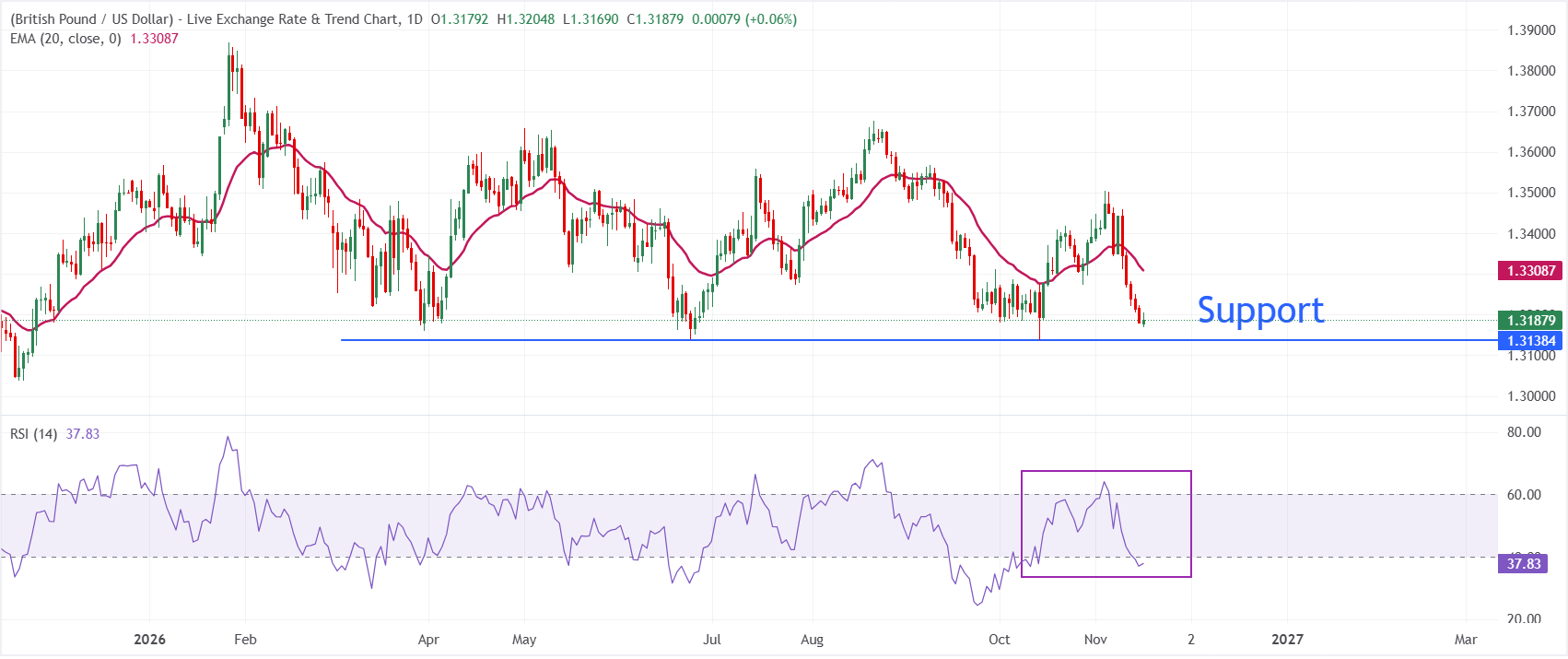
On the daily chart, GBP/USD trades at 1.3187, holding a bearish near-term bias as spot remains below the 20-day Exponential Moving Average (EMA) at 1.3309. The positioning under this key dynamic barrier suggests the latest pullback is still in play, while the Relative Strength Index (RSI) at 37.83 stays below the neutral 50 line, hinting that downside pressure persists rather than signaling an imminent bullish reversal.
On the topside, initial resistance is defined by the 20-day EMA at 1.3309, which caps recovery attempts and would need to be reclaimed to ease the current bearish tone. Looking down, the October 14 low at 1.3137 is the key support level; a break below the same would expose the pair to 1.3100, followed by 1.3000.
(The technical analysis of this story was written with the help of an AI tool. Know more.)
Economic Indicator
Consumer Price Index (YoY)
The United Kingdom (UK) Consumer Price Index (CPI), released by the Office for National Statistics on a monthly basis, is a measure of consumer price inflation – the rate at which the prices of goods and services bought by households rise or fall – produced to international standards. It is the inflation measure used in the government’s target. The YoY reading compares prices in the reference month to a year earlier. Generally, a high reading is seen as bullish for the Pound Sterling (GBP), while a low reading is seen as bearish.
Read more.Next release: Wed Nov 18, 2026 07:00
Frequency: Monthly
Consensus: 3.7%
Previous: 3.5%
Source: Office for National Statistics
The Bank of England is tasked with keeping inflation, as measured by the headline Consumer Price Index (CPI) at around 2%, giving the monthly release its importance. An increase in inflation implies a quicker and sooner increase of interest rates or the reduction of bond-buying by the BOE, which means squeezing the supply of pounds. Conversely, a drop in the pace of price rises indicates looser monetary policy. A higher-than-expected result tends to be GBP bullish.
Author
Sagar Dua
FXStreet
Sagar Dua is associated with the financial markets from his college days. Along with pursuing post-graduation in Commerce in 2014, he started his markets training with chart analysis.

















