The Yen round-trips after Japanese pay beats its forecast
- USD/JPY round-trips from just above 158.50, its highest since September 25, on Japan's pay data.
- Japanese real wages rose 1.5% YoY in August, an eighth straight gain.
- Futures give an October BoJ hike about 17% and a December move about 71%.
Japanese pay grew faster than forecast in August and the Yen weakened anyway. USD/JPY trades near 158.00, back where it was before the release took it to its highest since September 25.
Nominal pay rose 3.8% YoY against a 3.7% forecast, but that was down from July, and real wage growth slowed for a second month to 1.5%. The same release revised July down to 4.3% from 4.7%, a cut four times the size of the beat.
Pay running ahead of prices is the case the Bank of Japan (BoJ) makes for further hikes, and a slowing trend did nothing to bring the next one forward. That leaves USD/JPY following the Dollar side of the pair for most of October.
Tokyo calls the Yen undervalued and promises a tax cut
Prime Minister Takaichi told parliament on Tuesday she will cut the consumption tax on food without issuing new bonds. The 10-year Japanese government bond yield held near 3.11% on Wednesday, close to its highest in three decades. Yields that rise on budget worries rather than rate expectations can weaken a currency instead of lifting it.
Finance Minister Katayama and US Treasury Secretary Bessent called the Yen's undervaluation a concern in late September. Wednesday's Federal Open Market Committee (FOMC) minutes recorded the New York Fed's currency intervention for the Treasury, the yen purchase made alongside Japan on July 31 with USD/JPY just under 164.00. Undervalued is the word two finance ministries use for a currency they have already spent money on once.
A BoJ quarter-point is a tenth of the gap it would narrow
The BoJ's rate is 1.25% after the September 18 hike, against the Fed's 3.75%-4.00%, and futures give the BoJ about 71% odds of another move by December. The Fed on October 28 and the BoJ on October 30 carry the same odds of a hike, near 17%.
Friday's University of Michigan (UoM) survey at 14:00 GMT includes US households' one-year inflation expectations, 4.6% last month. A higher reading would add to Fed hike bets and lift USD/JPY with them.
Yen levels around the moving averages
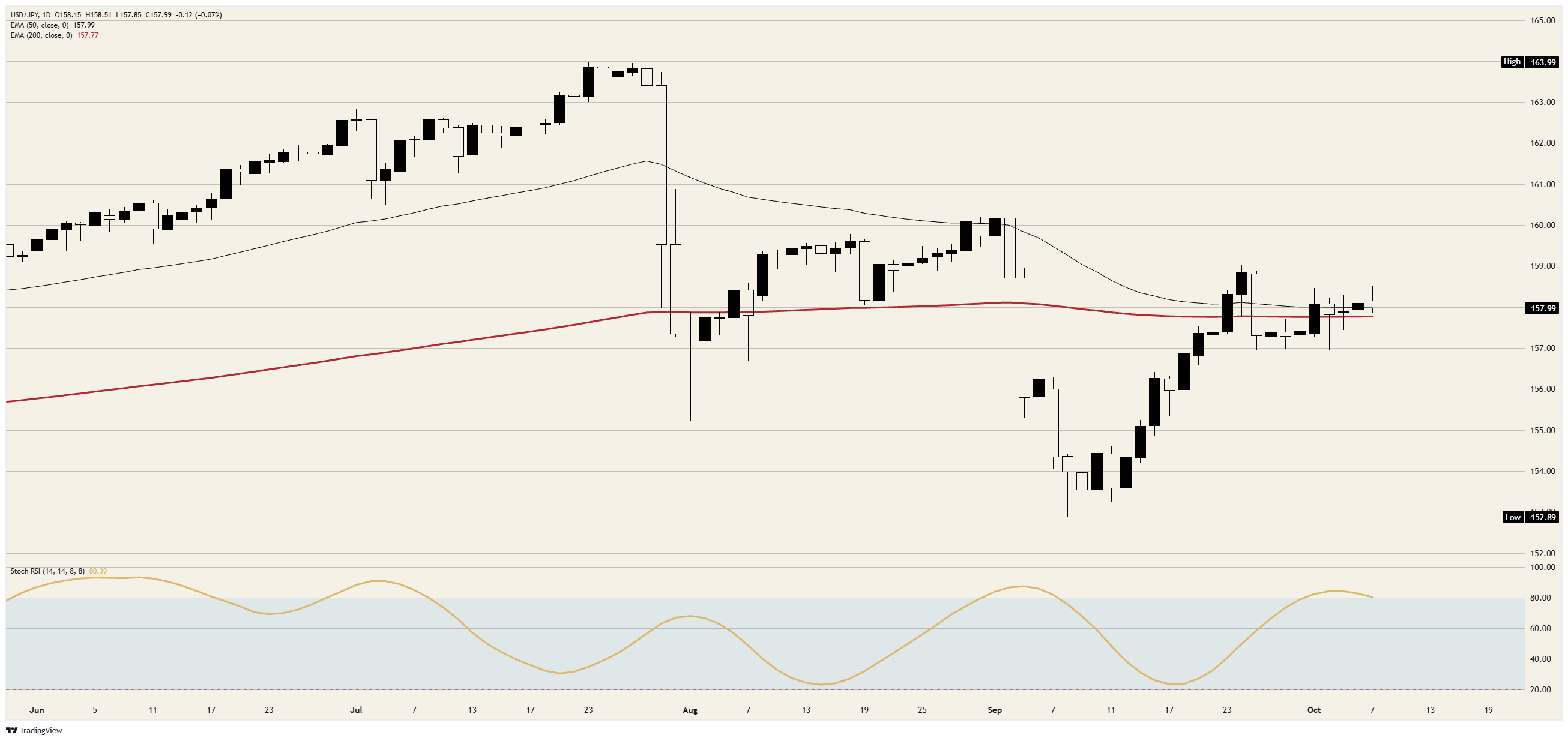
Resistance: Wednesday's high, just above 158.50, was the highest since September 25 and faded within the session. 159.00 stopped the September rebound on September 24.
Support: The 200-day Exponential Moving Average (EMA), just under 158.00, has been below every daily close since October 1. Monday's low, just under 157.50, is the line the long rests on.
Bias: The lean stays long while 157.50 holds on a closing basis, with 158.50, touched by a pip on Wednesday, still the first objective and 159.00 the second. The Stochastic Relative Strength Index (Stoch RSI) on the daily chart has turned down from about 85 to near 80, so a dip toward 157.50 would fit the call. A daily close below 157.00 takes the long off.
USD/JPY daily chart
Japanese Yen FAQs
The Japanese Yen (JPY) is one of the world’s most traded currencies. Its value is broadly determined by the performance of the Japanese economy, but more specifically by the Bank of Japan’s policy, the differential between Japanese and US bond yields, or risk sentiment among traders, among other factors.
One of the Bank of Japan’s mandates is currency control, so its moves are key for the Yen. The BoJ has directly intervened in currency markets sometimes, generally to lower the value of the Yen, although it refrains from doing it often due to political concerns of its main trading partners. The BoJ ultra-loose monetary policy between 2013 and 2024 caused the Yen to depreciate against its main currency peers due to an increasing policy divergence between the Bank of Japan and other main central banks. More recently, the gradually unwinding of this ultra-loose policy has given some support to the Yen.
Over the last decade, the BoJ’s stance of sticking to ultra-loose monetary policy has led to a widening policy divergence with other central banks, particularly with the US Federal Reserve. This supported a widening of the differential between the 10-year US and Japanese bonds, which favored the US Dollar against the Japanese Yen. The BoJ decision in 2024 to gradually abandon the ultra-loose policy, coupled with interest-rate cuts in other major central banks, is narrowing this differential.
The Japanese Yen is often seen as a safe-haven investment. This means that in times of market stress, investors are more likely to put their money in the Japanese currency due to its supposed reliability and stability. Turbulent times are likely to strengthen the Yen’s value against other currencies seen as more risky to invest in.
Author

Joshua Gibson
FXStreet
Joshua joins the FXStreet team as an Economics and Finance double major from Vancouver Island University with twelve years' experience as an independent trader focusing on technical analysis.