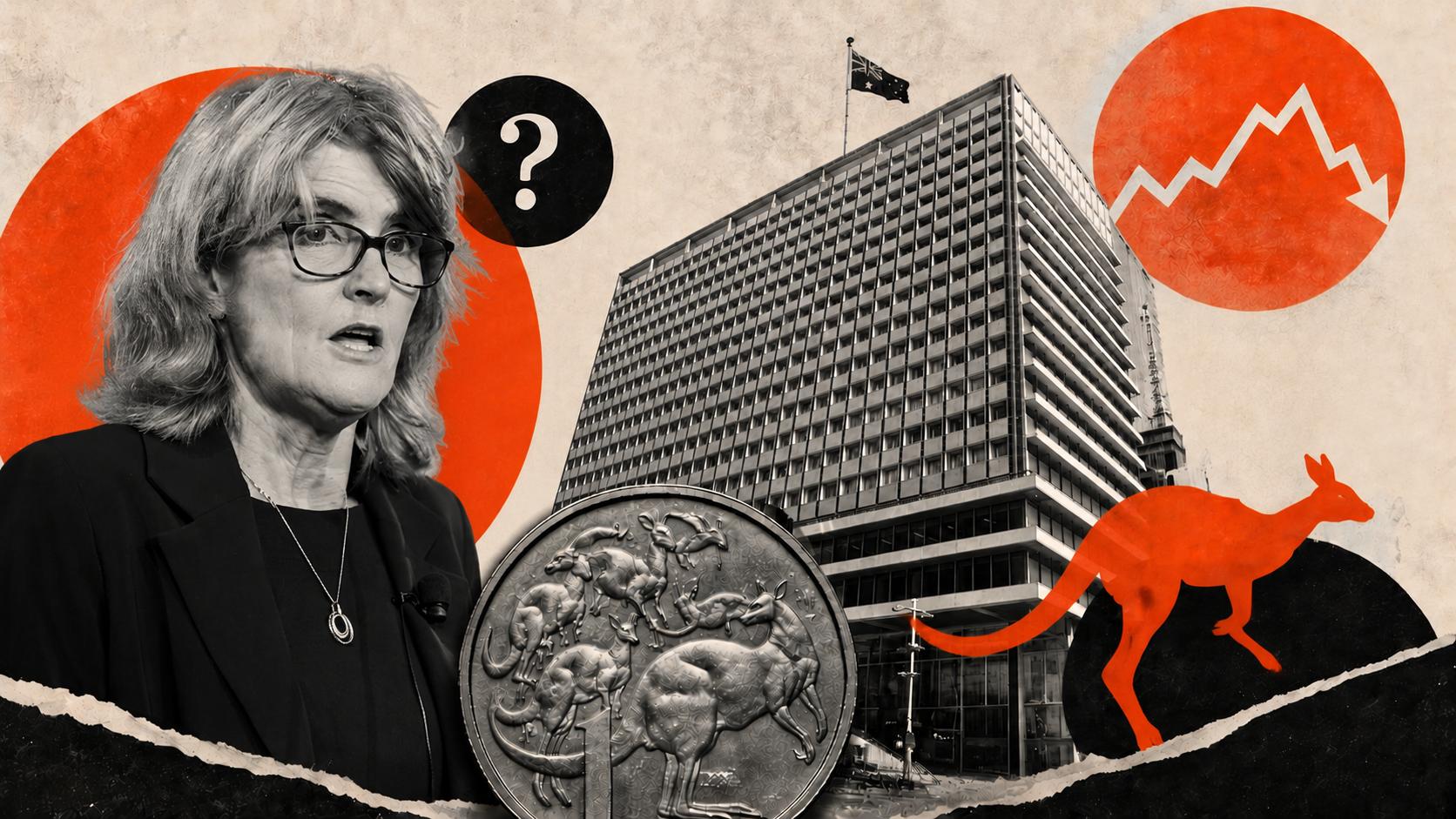
RBA set to hike interest rate amid persistent inflation
- The Reserve Bank of Australia is set to raise the interest rate to 4.85% in November.
- RBA Governor Michele Bullock noted upside risks to inflation have materialized.
- The Australian Dollar is weak ahead of the announcement despite a better market mood.

The Reserve Bank of Australia (RBA) will announce its monetary policy decision on Tuesday and is widely anticipated to raise the Official Cash Rate (OCR) by 25 basis points (bps) to 4.85% from 4.6%. If the RBA delivers as expected, it will be the fifth interest rate hike of 2026, and the OCR will hit an 18-year high.
The decision will be announced at 03:30 GMT, accompanied by the Monetary Policy Statement, and followed by RBA Governor Michele Bullock’s press conference at 04:30 GMT.
Ahead of the announcement, the Australian Dollar (AUD) struggles to retain the 0.7000 mark against the US Dollar (USD).
Focus stays on inflation
Continued inflationary pressures are behind rate hikes in 2026, and Australia is no exception. In fact, the RBA hiked the OCR for the first time in February, before the Middle East war hit global energy prices. As previously noted, the central bank already delivered four hikes, yet, according to the latest available data, Australia’s annual inflation rate stood at 3.9% in Q3, well above the central bank’s 2–3% goal. Additionally, the RBA’s preferred gauge, the core Trimmed Mean Consumer Price Index (CPI), accelerated to 3.7% year-on-year, up from 3.6% in Q2.
RBA Governor Bullock recently appeared before Parliament and noted that “Some of the international and domestic upside risks to inflation have materialized or are materializing.”
“It’s important for the economy that inflation does not diverge from the target for too long,” Bullock added, “since that risks it becoming embedded in inflation expectations, which feeds through to price and wage setting decisions.”
Hot inflation, alongside Bullock’s words, pretty much calls for a rate hike at the Board's meeting. Yet, with a rate hike already priced in, the focus will shift to the press conference led by Governor Bullock, and any hint she gives about what’s next in monetary policy. Bullock is likely to retain her hawkish tone and leave the door open for additional hikes, pushing AUD higher.
How will the Reserve Bank of Australia’s decision impact AUD/USD?
If the RBA delivers the anticipated 25 bps rate hike, the Aussie is likely to find near-term support, although gains will depend on how hawkish the accompanying statement and Governor Bullock’s words are. A larger-than-anticipated hike could trigger a near-term AUD rally, supported by a risk-on mood ahead of the announcement and a weaker Greenback. An on-hold decision is unlikely, but such a move would see the AUD plummeting.
Valeria Bednarik, FXStreet Chief Analyst, notes: “From a technical point of view, the AUD/USD pair is at risk of falling. On the daily chart, the pair found resistance at the start of the week around a flat 100-day Simple Moving Average (SMA) at 0.7030, the immediate resistance level. Last week’s peak at 0.7067 comes next, with the 200-day SMA a handful of pips below the level and also attracting sellers. The same chart shows technical indicators turning south, although holding above their midlines, reflecting the ongoing weakness but falling short of anticipating a steeper decline ahead.”
Bednarik adds: “A slide below 0.6990 will likely trigger additional slides as buyers will be more keen to give up. The slide, then, could extend towards the 0.6640 region. On the contrary, steady gains beyond 0.7070 could end with the pair re-conquering the 0.7100 mark.”
RBA FAQs
The Reserve Bank of Australia (RBA) sets interest rates and manages monetary policy for Australia. Decisions are made by a board of governors at 11 meetings a year and ad hoc emergency meetings as required. The RBA’s primary mandate is to maintain price stability, which means an inflation rate of 2-3%, but also “..to contribute to the stability of the currency, full employment, and the economic prosperity and welfare of the Australian people.” Its main tool for achieving this is by raising or lowering interest rates. Relatively high interest rates will strengthen the Australian Dollar (AUD) and vice versa. Other RBA tools include quantitative easing and tightening.
While inflation had always traditionally been thought of as a negative factor for currencies since it lowers the value of money in general, the opposite has actually been the case in modern times with the relaxation of cross-border capital controls. Moderately higher inflation now tends to lead central banks to put up their interest rates, which in turn has the effect of attracting more capital inflows from global investors seeking a lucrative place to keep their money. This increases demand for the local currency, which in the case of Australia is the Aussie Dollar.
Macroeconomic data gauges the health of an economy and can have an impact on the value of its currency. Investors prefer to invest their capital in economies that are safe and growing rather than precarious and shrinking. Greater capital inflows increase the aggregate demand and value of the domestic currency. Classic indicators, such as GDP, Manufacturing and Services PMIs, employment, and consumer sentiment surveys can influence AUD. A strong economy may encourage the Reserve Bank of Australia to put up interest rates, also supporting AUD.
Quantitative Easing (QE) is a tool used in extreme situations when lowering interest rates is not enough to restore the flow of credit in the economy. QE is the process by which the Reserve Bank of Australia (RBA) prints Australian Dollars (AUD) for the purpose of buying assets – usually government or corporate bonds – from financial institutions, thereby providing them with much-needed liquidity. QE usually results in a weaker AUD.
Quantitative tightening (QT) is the reverse of QE. It is undertaken after QE when an economic recovery is underway and inflation starts rising. Whilst in QE the Reserve Bank of Australia (RBA) purchases government and corporate bonds from financial institutions to provide them with liquidity, in QT the RBA stops buying more assets, and stops reinvesting the principal maturing on the bonds it already holds. It would be positive (or bullish) for the Australian Dollar.
Economic Indicator
RBA Interest Rate Decision
The Reserve Bank of Australia (RBA) announces its interest rate decision at the end of its eight scheduled meetings per year. If the RBA is hawkish about the inflationary outlook of the economy and raises interest rates it is usually bullish for the Australian Dollar (AUD). Likewise, if the RBA has a dovish view on the Australian economy and keeps interest rates unchanged, or cuts them, it is seen as bearish for AUD.
Read more.Next release: Tue Nov 03, 2026 03:30
Frequency: Irregular
Consensus: 4.85%
Previous: 4.6%
Source: Reserve Bank of Australia
Author

FXStreet Team
FXStreet
Composed of a group of economic journalists and FX experts, the FXStreet content team produces and oversees all content published on FXStreet. It provides a purely journalistic approach to the Forex market.