Australian Dollar climbs above 0.7000 as US-Iran diplomatic hopes weigh on the US Dollar
- The Australian Dollar rises 0.43% as hopes of a diplomatic breakthrough between the US and Iran improve market sentiment.
- Reports suggest Washington and Tehran have given preliminary approval to a compromise proposal presented by Pakistan.
- Concerns surrounding the artificial intelligence sector are reducing the appeal of the US Dollar.

AUD/USD advances on Tuesday, trading around 0.7010, up 0.43% on the day at the time of writing. The Australian Dollar (AUD) benefits from renewed optimism surrounding a potential diplomatic breakthrough between the United States (US) and Iran, alongside continued weakness in the US Dollar (USD) and US Treasury yields amid growing concerns about valuations in the Artificial Intelligence (AI) sector.
According to Israel's Channel 12 News, Washington and Tehran have reportedly given preliminary approval to a compromise proposal presented by Pakistan's army chief to senior Iranian officials. The proposal aims to prevent further military escalation and bring both sides back to the negotiating table, supporting risk appetite and benefiting risk-sensitive currencies such as the Australian Dollar.
The US Dollar also remains under pressure after reaching elevated levels last week. The US Dollar Index (DXY), which measures the Greenback's performance against a basket of six major currencies, declines by 0.28% on Tuesday, trading around 101.70 at the time of press, after approaching 103 last week, its highest level since April 2025.
The US Dollar has become particularly sensitive to developments in the AI sector. Significant foreign capital inflows into AI-related US equities have helped support the currency in recent months. However, the recent correction in technology stocks and fading optimism surrounding AI are now reducing the Greenback's appeal.
This pressure is reinforced by declining US Treasury yields. The benchmark 10-year US Treasury yield stands around 5.08%, compared with approximately 5.36% earlier this month. This decline reduces the yield advantage offered by USD-denominated assets, indirectly supporting the Australian Dollar.
However, the Aussie's gains remain relatively limited against other major currencies following the People's Bank of China's (PBoC) monetary policy decision. The Chinese central bank kept its one-year Loan Prime Rate (LPR) unchanged at 3.00% and its five-year rate steady at 3.50% on Tuesday, in line with expectations.
The decision confirms the cautious approach adopted by Chinese monetary authorities as investors assess the growth outlook for the world's second-largest economy. Given Australia's heavy reliance on exports to China, particularly commodities, Chinese economic prospects remain a key driver of the Australian Dollar.
On the US side, however, the potential for further US Dollar weakness remains limited by rising inflation risks linked to energy prices. West Texas Intermediate (WTI) Oil approaches $100 on Tuesday, reaching its highest level in more than a month. Houthi attacks on Saudi energy infrastructure and an increasing number of incidents targeting vessels in the Strait of Hormuz are fueling concerns about potential disruptions to global Oil supplies.
Higher energy prices could reignite inflationary pressures in the United States (US), prompting the Federal Reserve (Fed) to maintain restrictive monetary policy for longer than previously expected or even raise interest rates again before the end of the year.
According to a Reuters poll published on Tuesday, 94 out of 100 economists expect the Fed to keep interest rates unchanged within the 3.75%-4.00% range at its October 27-28 meeting, following the 25-basis-point (bps) increase delivered in September. However, all economists surveyed anticipate another rate hike in December.
This outlook could limit US Dollar weakness and cap further gains in AUD/USD, despite the current support provided by declining Treasury yields and concerns surrounding the US technology sector.
AUD/USD technical analysis
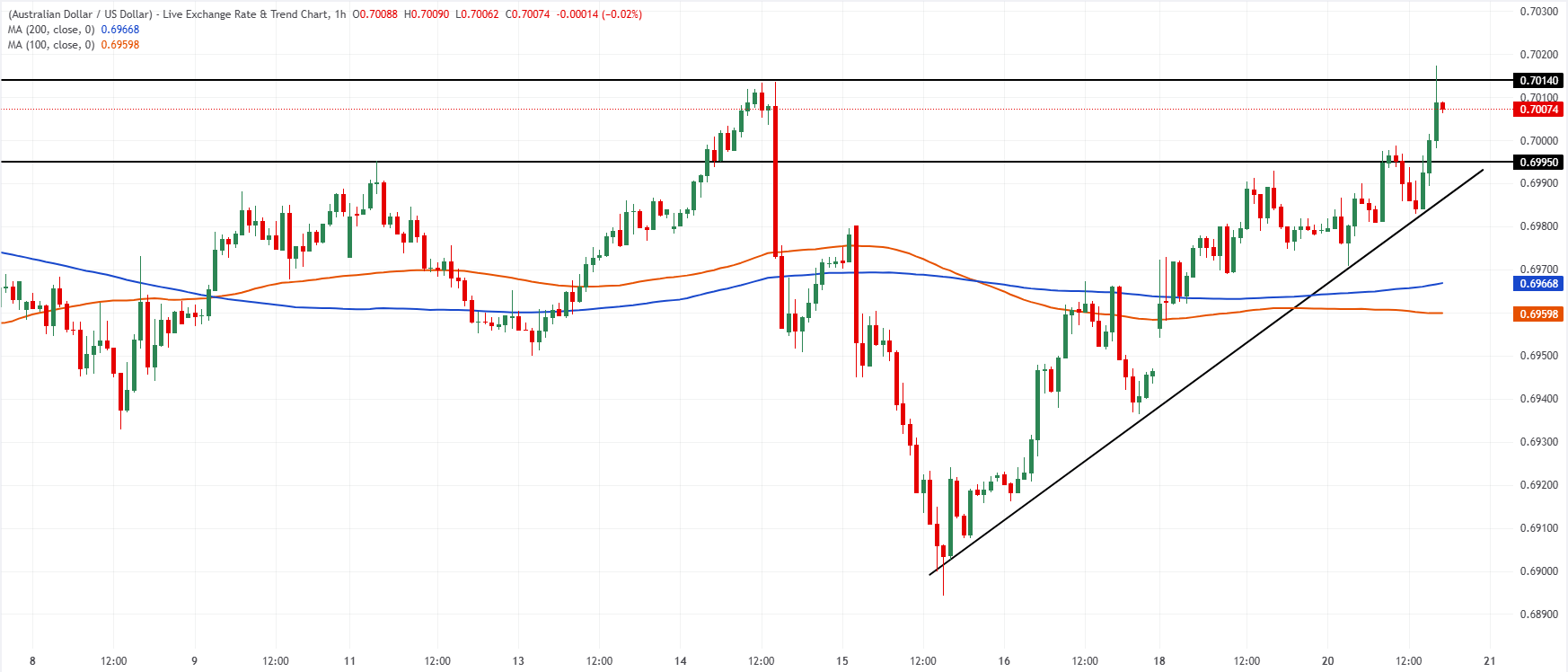
In the one-hour chart, AUD/USD trades at 0.7007, holding a bullish near-term bias as it remains above the 100-period simple moving average (SMA) at 0.6960 and the 200-period SMA at 0.6967. The pair also trades over an upward-sloping trend-line support coming in around 0.6989, while the Relative Strength Index (14) at 67 suggests firm bullish momentum, edging toward overbought territory and hinting at the risk of a pause or shallow correction before any sustained extension higher.
On the downside, immediate support is seen at the horizontal level near 0.6995, followed by the rising trend-line around 0.6989, with deeper floors provided by the 200-period SMA at 0.6967 and the 100-period SMA at 0.6960. On the topside, initial resistance aligns at 0.7014, ahead of a higher barrier at 0.7040, where a clear break would open the way for a continuation of the broader intraday advance.
(The technical analysis of this story was written with the help of an AI tool. Know more.)
Author

Ghiles Guezout
FXStreet
Ghiles Guezout is a Market Analyst with a strong background in stock market investments, trading, and cryptocurrencies. He combines fundamental and technical analysis skills to identify market opportunities.