What is Leverage in Forex and How Does it Work?

It seems that every day the stock market is becoming more challenging for the retail investor to participate in, with increased volatility, wild swings and violent down days becoming the normal. And yet on top of that, we are seeing historically high prices which are simply increasing the risk of participation and reducing the potential rewards at the same time, making it harder than ever for most investors to meet their goals.
This weekend past, I had the pleasure of teaching a brand-new two-day class in the Online Trading Academy Tampa location entitled Trading for Income. As well as discussing the Online Trading Academy core strategy, we looked at alternative investments to stocks to make our money work harder and increase potential returns. The lessons quickly turned to the world of Forex trading and the power this market offers in the form of leverage. Leverage is a powerful tool when used responsibly, but also comes with risks if abused.
Most people are used to paying cash prices for their stocks and assets. For example, if I had $500 in my investing account and I wanted to purchase as many shares as possible of a $50 stock, I would be able to purchase 10 shares in total using the cash I had (10 x $50 = $500). Obviously, the more cash you have, the more shares you can buy. This is a highly limiting factor for those with lower account balances but also limits purchase power of those with higher sums of principal too.
What Is Leverage?
In trading and investing, the term leverage is used to describe when a speculator uses a small amount of money to control a larger amount. To be able to use leverage, you need to apply for a margin account for your trading. In a margin account, the broker effectively loans you a sizable portion of the cash required to buy assets. For example, in a stock margin account let’s say you had been granted the maximum 4:1 leverage, this means that every dollar on your account can purchase $4 worth of the stock.
Using the same example as above, with just $500 you would be able to buy $2000 of stock. Looking at it another way, instead of only being able to buy 10 shares of a $50 stock with your $500, you could in theory buy 40 shares of the same stock as you would be paying only $12.50 per share ($50 / 4 = $12.50). Brokers are willing to offer this leverage to traders because it encourages trading activity and therefore, they earn more regular commissions.
How Leverage Works in Forex
In the world of Forex trading, brokers offer more generous levels of leverage than when trading stocks. When trading Forex, the smallest amount we can buy or sell is $1000 worth of currency, and positions increase in $1000 increments. The physical cash required to buy or sell currency is called the margin. Typically, $20 of cash margin in your account will cover $1000 valued Forex trade and this increases in line with the trade size itself.
Forex Leverage Table
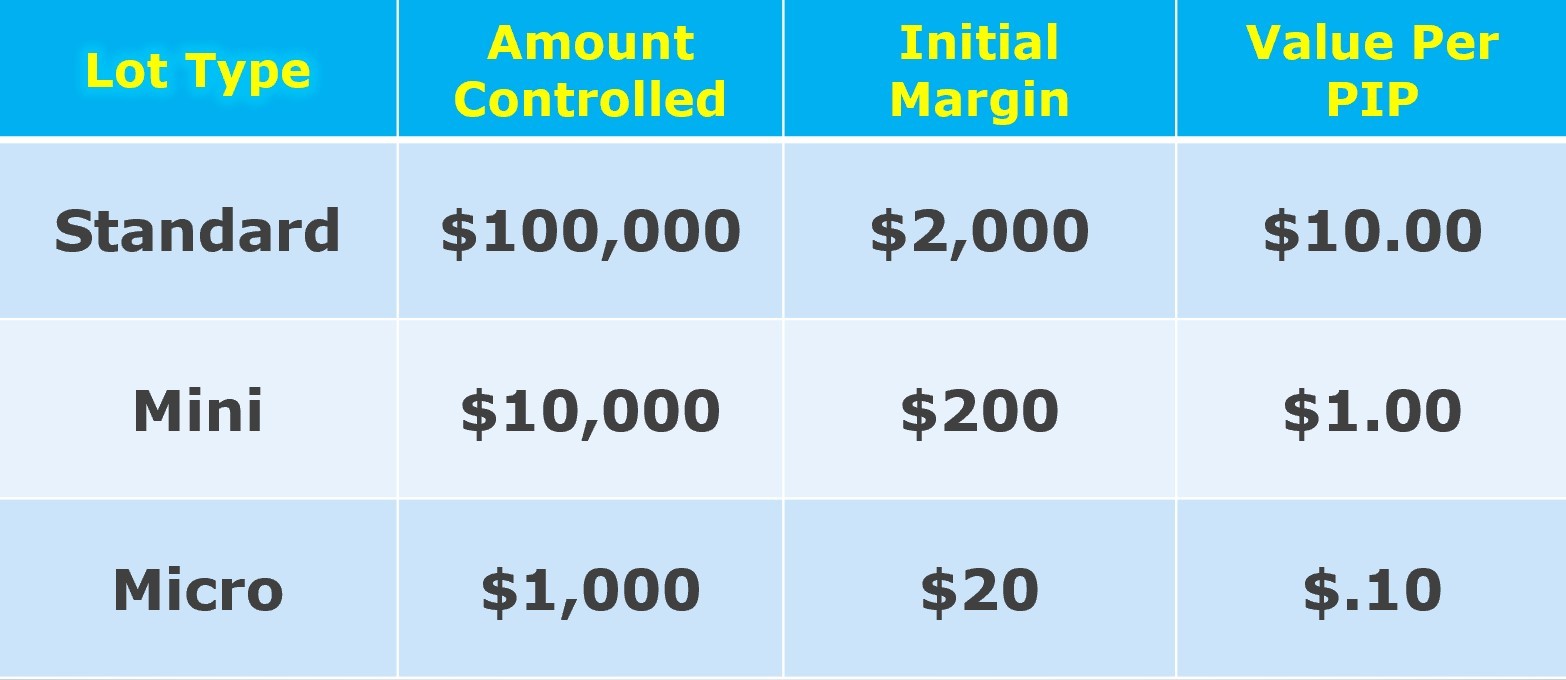
The chart above demonstrates that for every thousand dollars’ worth of Currency a trader would like to buy or sell, the broker will require another $20 down. The margin is held in escrow by the broker for the duration of the trade and when the trade is closed, the margin amount will be returned to the trader’s account, minus their loss or plus their profit depending how the trade works out. If there is not enough money in their account to cover the margin, the broker will not allow them to open the trade or will shut down an existing trade if losses exceed the margin amount.
As you can see above, most brokers typically offer margin ratios of 50:1, which is more than adequate for today’s markets. To make sure leverage is used responsibly, it is vital for traders to make use of stop loss orders to protect themselves and exit trades when they are not working in their favor.
Example of a Leveraged Forex Trade
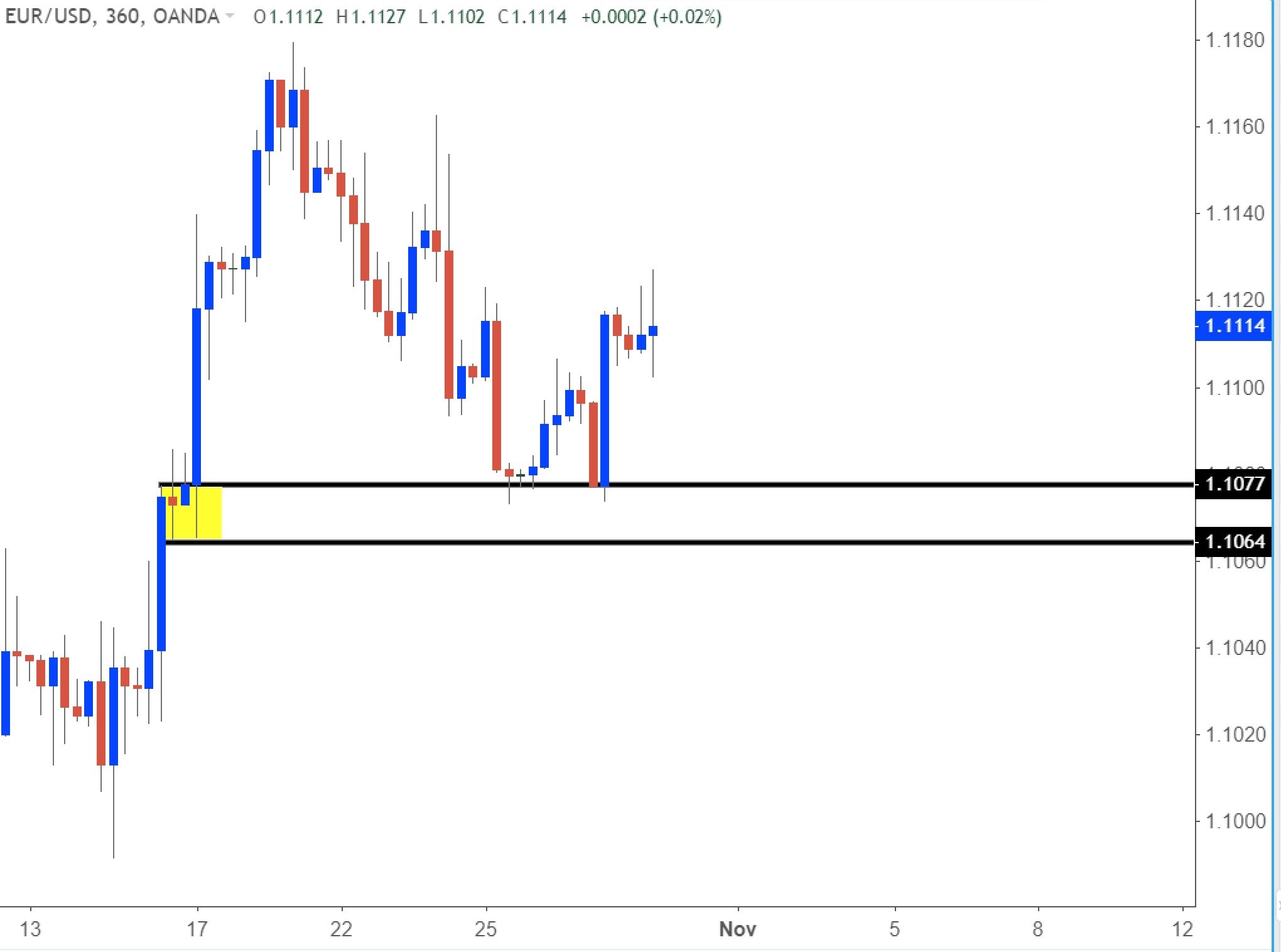
It is Possible to track the profit and loss on Forex trades by measuring the PIPs movement on the position. For example, in the EURUSD pair chart above, having bought the currency at a Demand zone, the trader is getting a nice reaction in price as it moves to the upside. Let’s assume they bought at 1.1077 for their entry. The price is currently 1.1114. This means they have a total of 37 pips of profit. If they had bought a position of $100,000, they would see a pip value of $10 per pip, as show in the Forex leverage table above. This would see the trade with a current profit of $370. The FX broker would only be holding $2000 of the trader’s account equity in margin, however, meaning they could have taken this trade on an account of $2000 or more, which is a huge Return on Investment.
The Risk of Using Leverage When Trading Forex
If the trade was going against them and the EURUSD was trading at say 1.1040, they would be seeing a loss of 37 pips, or $370, which is a large percentage of a $2000 account! A 100-pip loss would see them losing $1000, meaning accounts can be blown up very quickly. While traders can make a lot of money using leverage in FX, they can also lose a lot of money too.
Here at Online Trading Academy our focus is always on responsible risk management first. It is a good practice for traders to risk no more than 0.5-1% of their accounts when starting out, meaning a $2000 account balance would allow trade risks of no more than $10 to $20 per trade. Therefore, starting with $1000 micro lots is ideal for the newer speculator. Remember this simple approach and you will be well on your way to a responsible exposure in the world of leveraged Forex.
Author

Sam Evans
Bustamante & Co
Starting his career in the London Film, Music and Radio Industry, Sam was a novice in the ways of the Markets. Almost 17 years ago, he jumped to Trader, Fund Manager and Lead Instructor in the Financial Markets.