Prop Trading for scalpers: Getting the most out of high-leverage trading

Scalping and high-leverage trading are often seen as a natural fit.
Short-term strategies rely on small price movements, and leverage allows those moves to become meaningful. Prop firms, in turn, offer access to capital, making them an attractive option for scalpers looking to scale their approach and prove themselves.
On paper, it looks like a perfect match. But, in reality, many scalpers struggle as soon as they step into a prop firm environment. The issue is rarely the strategy itself, but rather how it interacts with the firm's rules, conditions, and structure.
Prop firms introduce drawdown limits, consistency rules, and execution constraints that can interfere with short-term trading. A system that performs well in a personal account can behave very differently under these conditions.
There is also a deeper layer to consider. Research into retail trading behaviour has shown that most traders underperform, often due to overtrading, poor risk management, and overconfidence. Environments that combine high leverage with strict rules and time pressure can amplify these behaviours.
For scalpers, success in prop trading is not just about accessing leverage. It is about using it effectively within the right environment while maintaining control over execution and behaviour.
The Scalper’s edge: Why capital efficiency matters more than high leverage
High leverage is often marketed as the main advantage of prop trading. It attracts traders who want to maximise small price movements. That is only part of the story. Experienced scalpers focus on capital efficiency.
Scalping is built on extracting value from small, frequent moves. To make that work, traders need sufficient buying power without exposing their own capital to unnecessary risk. Prop firms provide that access.
The problem is that leverage amplifies everything. Strong execution becomes more valuable, but mistakes become more costly. A small lapse in discipline or timing (not just the entries and exits, but understanding the rules around news trading, etc.) can have a disproportionate effect under strict drawdown conditions and quickly lead traders to fail prop challenges.
For scalpers, the advantage is not leverage itself. It is the ability to use capital efficiently within a structured environment while maintaining control.
How to select a platform that fits a scalping strategy
This is where many traders go wrong. The focus tends to be on account size, fees, and profit splits. These are easy to compare, but they do not determine whether a scalping strategy will hold up in real trading conditions.
For scalpers, performance is shaped by execution. The speed of order entry, the quality of fills, and the consistency of costs all play a direct role. Small inefficiencies can compound quickly across a high number of trades.
Rule structure matters just as much. Tight daily drawdowns, restrictive loss limits, permissions around news trading and payout conditions influence how trades are managed and how risk is distributed.
Comparison tools can help organise this process, but only if they are used properly.
Platforms like Propinder approach selection by starting with the trader, understanding that not every trader is the same. By incorporating trading style, experience, location, and risk tolerance, Propinder aims to narrow the field before a deeper comparison begins.
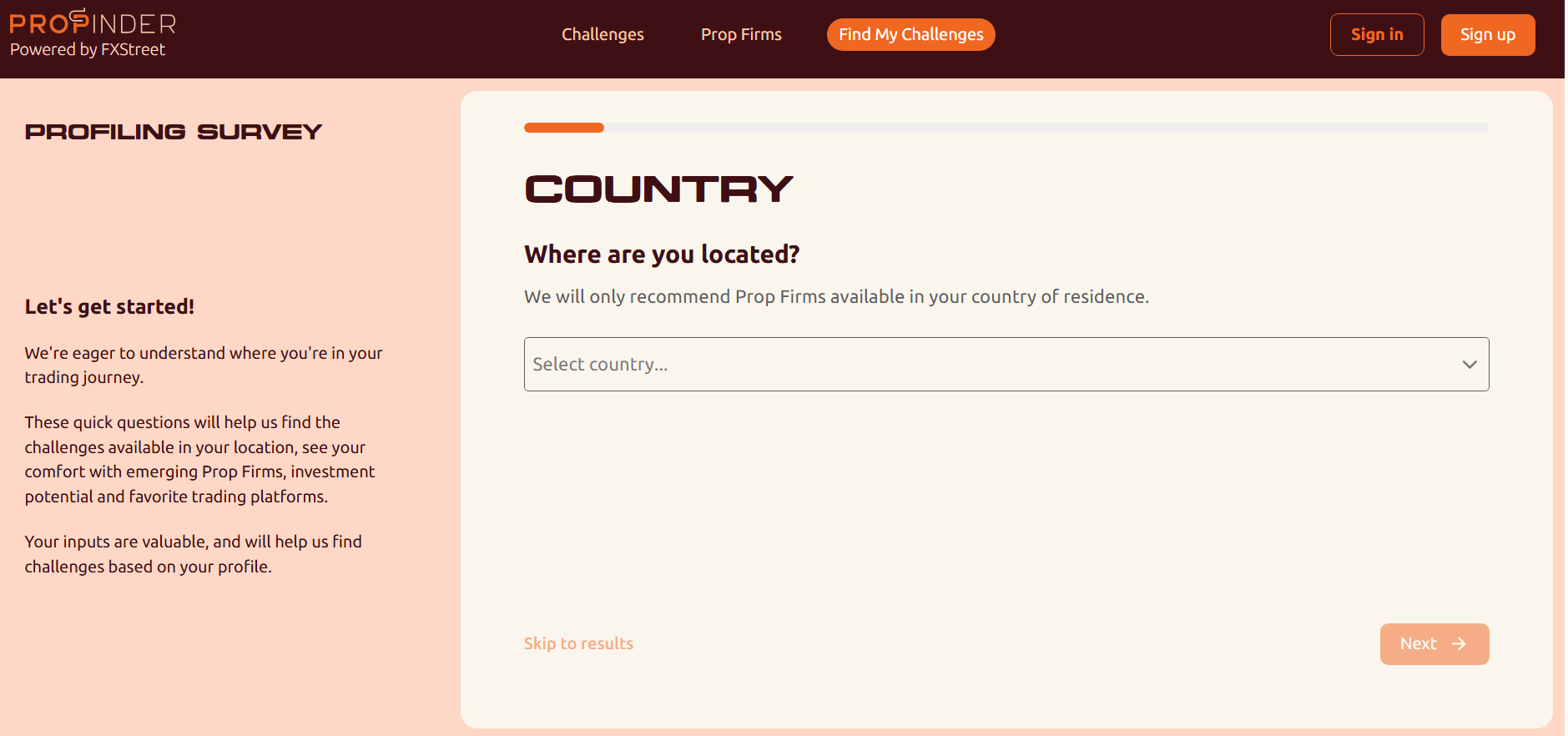
Propinder helps by bringing clarity to what is otherwise a complex market. It reduces the time spent reviewing firms that are unlikely to fit a scalping approach.
At the same time, expectations should remain realistic. The results behave more like a guided filter than a fully adaptive system. Similar profiles can still produce overlapping recommendations, particularly where firms operate within comparable models.
When Propinder’s profiling survey or challenge filters are used effectively, they will help reduce noise. For scalpers, the platform is particularly useful because execution style and rule compatibility matter more than broad comparisons between firms.

Dodging the “Consistency Trap”: Where scalpers lose their edge
Consistency rules are one of the most common friction points in prop trading. They are designed to promote discipline and limit excessive risk. In practice, they can clash with how scalping strategies generate returns.
Short-term trading is not always smooth. A single strong session can account for a large share of total profit. This is not poor trading, but rather how opportunity appears in fast-moving markets. Problems arise when firms restrict how profits are generated.
Limits on daily contribution, expectations of steady growth, and payout conditions tied to distribution can all work against scalpers. These rules can penalise valid performance simply because it does not follow a linear pattern.
This is what many traders experience as the consistency trap, where they meet profit targets but still face challenges with payouts or progression. A trader may hit the profit target and still struggle to progress or withdraw funds because their performance does not align with the firm’s expectations. These are the same behavioural patterns identified in trading research as key drivers of poor performance.
Understanding these rules in advance is critical. It is not just about profitability, but compatibility.
Why execution speed and platform stability outweigh big capital
A large funded account looks impressive, but for scalpers, it is rarely the deciding factor. For them, the most important variable to consider is execution quality.
Scalping depends on precision. Entries and exits need to be accurate and timely. Delays, slippage, or platform instability can quickly turn a consistent strategy into an unpredictable one.
This becomes even more important during active sessions, where market conditions are moving quickly and opportunities are short-lived.
Platforms such as MetaTrader 5 and cTrader are widely used across prop firms. They offer familiarity and flexibility, but performance depends heavily on infrastructure and server stability. To understand how orders are handled, the best is to read the terms and conditions carefully.
A smaller account with stable conditions will often outperform a larger account where execution is inconsistent.
Scaling up: From passing a challenge to managing larger funds
Passing a prop firm challenge is often treated as the finish line. In reality, it is the starting point.
The transition from evaluation to funded trading introduces a new layer of pressure. Traders are now managing larger capital while operating under the same, or sometimes stricter, rules. Scaling is not about increasing risk. It is about maintaining consistency as position sizes grow. This is where many traders lose their edge.
Larger capital can lead to overtrading, unnecessary adjustments, or a shift from a process-driven, carefully thought-out plan to an outcomes-only focus. These behaviours are well documented in trading research and tend to intensify under pressure.
Successful scalpers approach scaling differently. They treat it as a continuation of the same process. They maintain discipline, control trade frequency, and avoid forcing trades simply because more capital is available.
Managing larger funds is not about doing more. It is about doing the same things well, with greater consistency.
Final Thoughts: Understanding the trade-off behind the opportunity
Prop trading lets scalpers use more capital while keeping their own risk low, usually just the cost of the challenge. If successful, traders gain access to funds that might take years to save on their own, enabling them to use their scalping strategy on a larger scale.
But success is not just about having more leverage or a bigger account. It comes down to how well you trade, follow the firm's rules, use a stable platform, and stay consistent. If something goes wrong, you usually only lose the cost of the challenge. If you manage the account well and respect the rules, you can earn real returns with any strategy.
Traders who understand this and choose firms that fit their scalping trading style can use prop trading as a clear and scalable way to grow.
Author

Louise Carr
FXStreet
Louise Carr is an experienced Futures and Forex trader/analyst with over 15 years in the financial markets. Her career began in 2009 after transitioning from a successful role in financial services.