Bitcoin Weekly Forecast: Bulls hold the line
- Bitcoin trades near $64,200 on Friday, remaining firmly above the 200-week SMA despite a modest weekly decline.
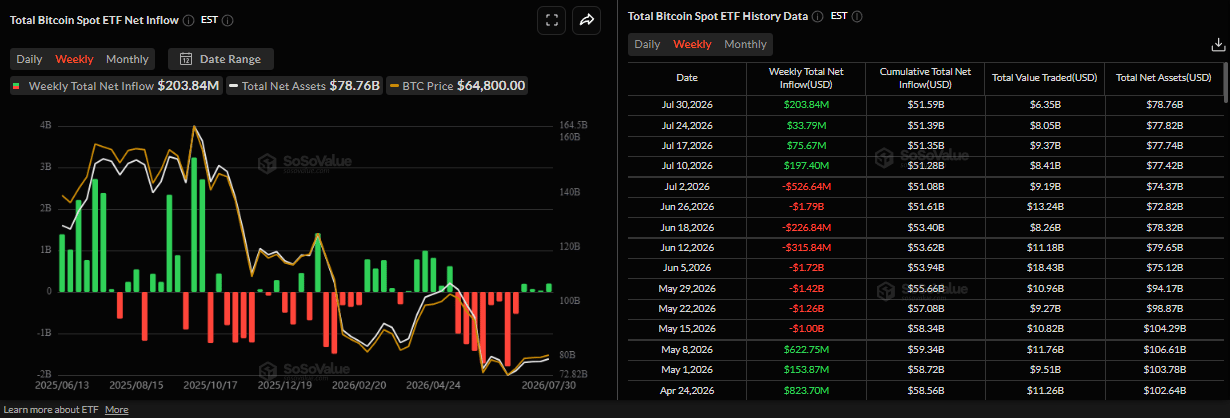
- US-listed BTC spot ETFs attracted $203.84 million through Thursday, pointing to the fourth consecutive week of inflows.
- Escalating US-Iran tensions keep inflation concerns elevated, limiting BTC’s upside potential.

Bitcoin (BTC) edges slightly lower, trading at $64,300 at the time of writing on Friday but holding firmly above a key support zone. US-listed spot Bitcoin Exchange Traded Funds (ETFs) support BTC as they continued to attract institutional flows through Thursday, pointing to the fourth consecutive week of net inflows. Despite BTC’s resilience, escalating US-Iran tensions keep inflation concerns elevated, limiting the Crypto King’s upside.
Middle East tensions cap BTC
Traders continue to price in the possibility of further monetary policy tightening as inflation risks are amplified by rising geopolitical tensions in the Middle East. The ongoing US-Iran conflict has fueled volatility in crude Oil prices, with concerns centered on potential disruptions surrounding crucial shipping chokepoints – the Strait of Hormuz and the Bab el-Mandeb.
In the latest developments, the US military announced it had completed a heavy wave of strikes against Iran, in response to Iranian missile attacks on its forces in the Middle East. Meanwhile, Iran rejected Oman's plan for a 50-50 joint management, which would see Tehran partially control the Strait of Hormuz and collect voluntary fees for using the waterway.
On the other hand, Saudi Arabia is building an international coalition to protect key shipping routes in the Bab al-Mandab Strait, the Red Sea, and the Gulf of Aden from repeated attacks by Yemen's Houthi militias. This raises the risk of a wider regional conflict, keeping the geopolitical risk premium in play and supporting crude oil prices.
Investors remain worried that rising energy prices would revive inflationary pressure and force the Federal Reserve (Fed) to adopt a hawkish stance, which in turn would dampen risk appetite and risky assets such as BTC.
Institutional demand continues to strengthen
Institutional demand continues to show signs of strength so far this week. SoSoValue data show that spot BTC ETFs recorded an inflow of $203.84 million through Thursday. If Friday shows positive flows, BTC is about to enter its fourth week of steady inflows.
These positive flows suggest institutional investors are gradually returning to the market. However, the magnitude remains modest compared with the heavy outflows recorded from mid-May to early July. If the trend extends through the end of the week, continued ETF demand could help cushion Bitcoin’s downside despite persistent geopolitical headwinds.
What's there for BTC in August?
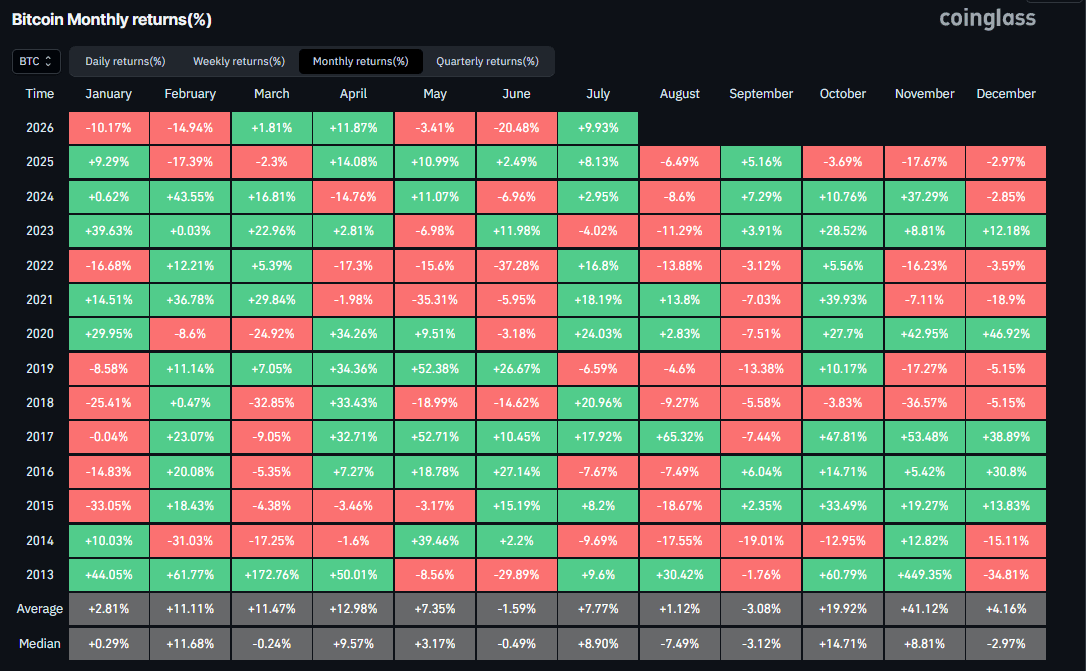
Bitcoin is about to close the month with nearly 10% gains in July, breaking a two-month streak of negative returns.
Historical data also favors the bulls, with August delivering average gains of 1.12%. Sustaining that momentum, however, will likely depend on a recovery in institutional inflows and further progress on the CLARITY Act, which could provide greater regulatory clarity and improve sentiment toward digital assets.
Bitcoin technical outlook: Holds above key support zones
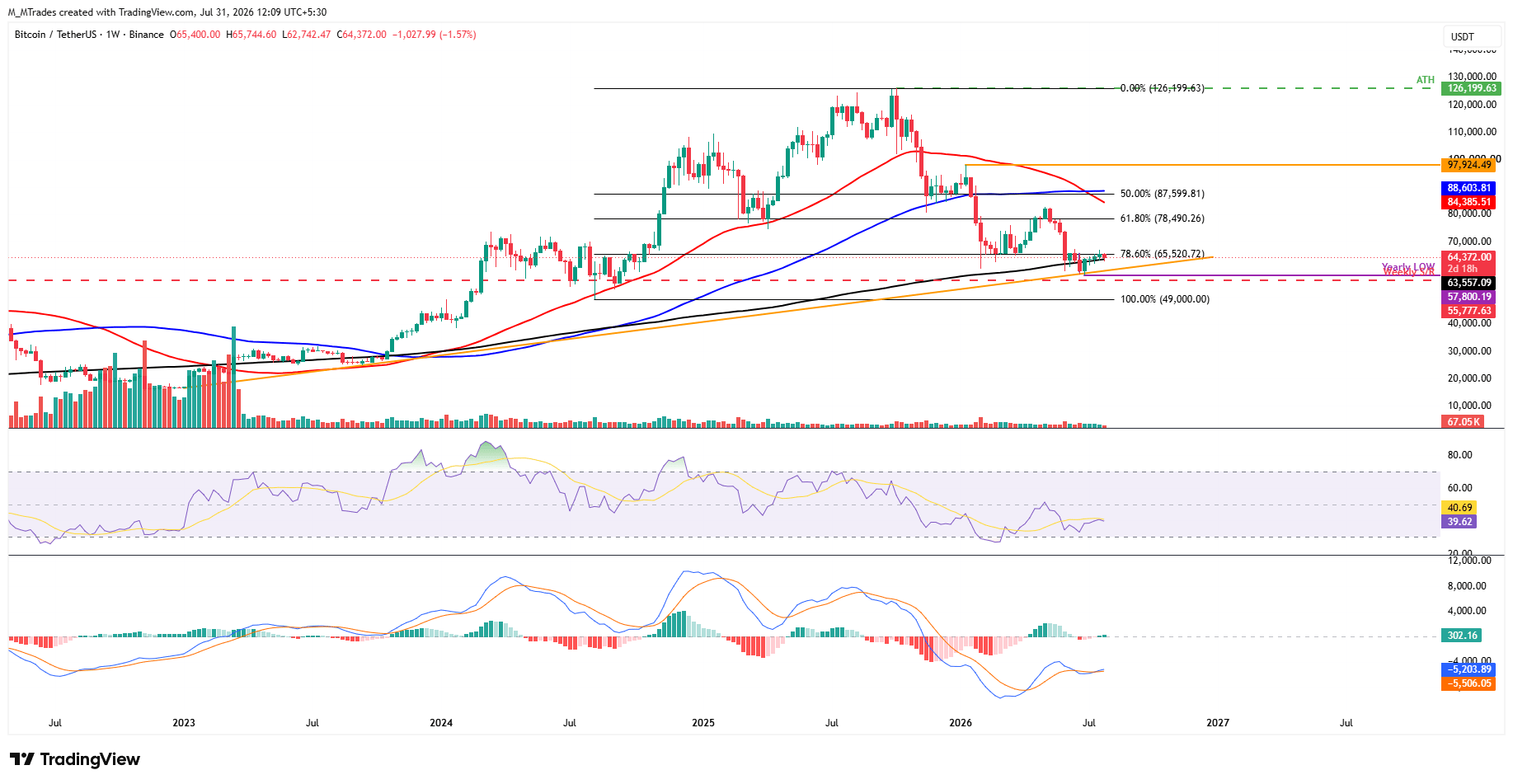
Bitcoin price has fallen slightly so far this week, trading around $64,300 at the time of writing on Friday after extending four consecutive weeks of gains since the end of June. BTC is finding support around the 200-week Simple Moving Average (SMA) at $63,557.
If the Crypto King holds above the 200-week SMA at $63,557 and closes above the immediate resistance at the 78.6% Fibonacci retracement level at $65,520 (drawn from the August 2024 low of $49,000 to the October 2025 record high at $126,199), then BTC could extend the recovery toward the 61.8% Fibonacci retracement level at $78,490.
Momentum indicators on the weekly chart show mild signs of easing bearish sentiment. The Relative Strength Index (RSI) is trending higher toward the neutral 50 level, with a reading of 39 on Friday. Meanwhile, the Moving Average Convergence Divergence (MACD) bullish crossover in mid-July remains intact, supporting a positive outlook.
However, if BTC fails to find support around the 200-week SMA at $63,557 and closes below it on a weekly basis, it could extend the losses toward the ascending trendline support, roughly around $59,500.
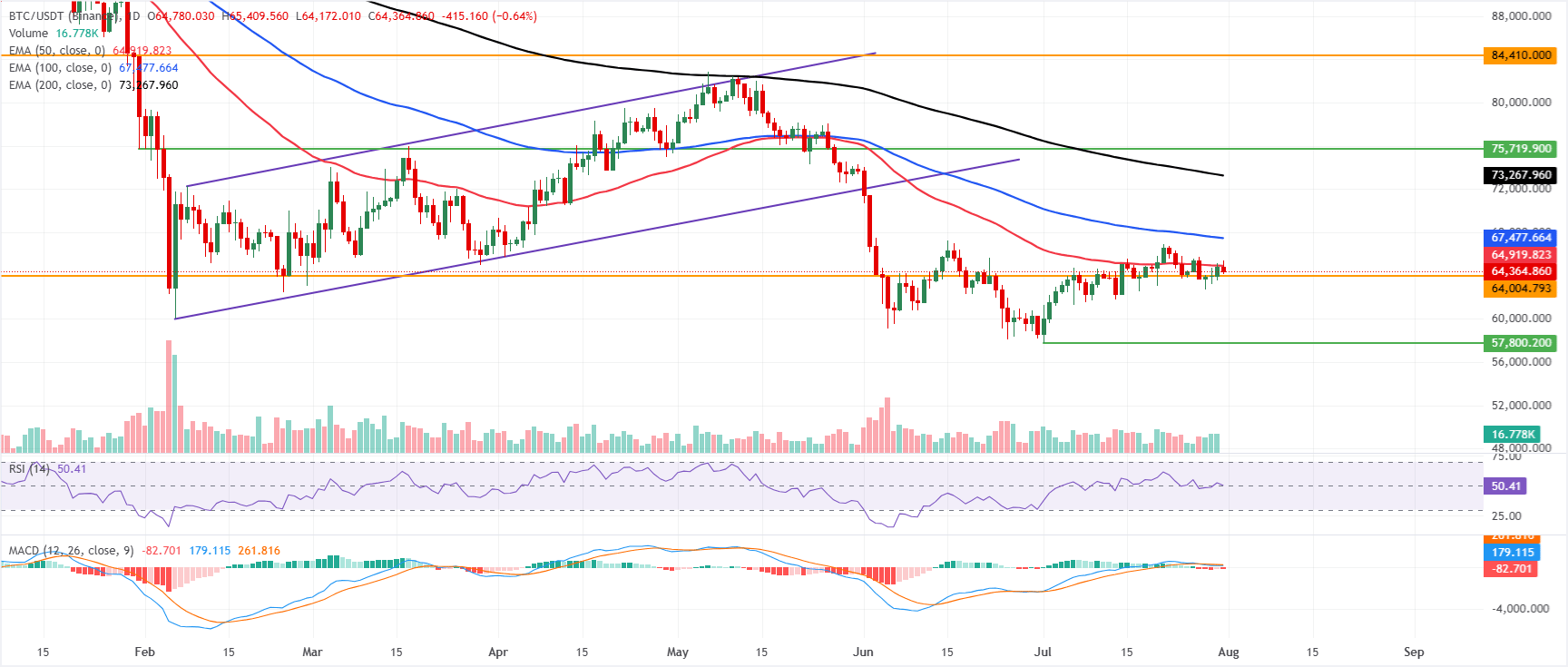
On the daily chart, Bitcoin is keeping a bearish near-term tone as it holds below the 50-day, 100-day and 200-day Exponential Moving Averages (EMAs), which all sit overhead as a layered cap. The RSI on the daily chart hovers around the neutral 50 line. At the same time, MACD histogram remains in negative territory, suggesting weak momentum that so far fails to challenge the dominant overhead EMA structure.
On the topside, initial resistance is seen at the 50-day EMA near $64,919, followed by the 100-day EMA around $67,477 and the 200-day EMA near $73,267 before the major horizontal barrier at $84,410.
On the downside, immediate support emerges at the horizontal level around $64,004, where a sustained break lower would expose further weakness beyond the current charted levels.
(The technical analysis of this story was written with the help of an AI tool. Know more.)
Bitcoin, altcoins, stablecoins FAQs
Bitcoin is the largest cryptocurrency by market capitalization, a virtual currency designed to serve as money. This form of payment cannot be controlled by any one person, group, or entity, which eliminates the need for third-party participation during financial transactions.
Altcoins are any cryptocurrency apart from Bitcoin, but some also regard Ethereum as a non-altcoin because it is from these two cryptocurrencies that forking happens. If this is true, then Litecoin is the first altcoin, forked from the Bitcoin protocol and, therefore, an “improved” version of it.
Stablecoins are cryptocurrencies designed to have a stable price, with their value backed by a reserve of the asset it represents. To achieve this, the value of any one stablecoin is pegged to a commodity or financial instrument, such as the US Dollar (USD), with its supply regulated by an algorithm or demand. The main goal of stablecoins is to provide an on/off-ramp for investors willing to trade and invest in cryptocurrencies. Stablecoins also allow investors to store value since cryptocurrencies, in general, are subject to volatility.
Bitcoin dominance is the ratio of Bitcoin's market capitalization to the total market capitalization of all cryptocurrencies combined. It provides a clear picture of Bitcoin’s interest among investors. A high BTC dominance typically happens before and during a bull run, in which investors resort to investing in relatively stable and high market capitalization cryptocurrency like Bitcoin. A drop in BTC dominance usually means that investors are moving their capital and/or profits to altcoins in a quest for higher returns, which usually triggers an explosion of altcoin rallies.
Author

Manish Chhetri
FXStreet
Manish Chhetri is a crypto specialist with over four years of experience in the cryptocurrency industry.