XRP sustains bearish bias as price lingers below $1.10
- XRP remains below the critical $1.10 level as bears tighten their grip, aiming for lows toward $1.00.
- US-listed spot XRP ETF inflows above $7 million through Thursday.
- Technical outlook remains weak, with XRP trading below falling moving averages and momentum indicators deteriorating.

Ripple (XRP) retains a bearish near-term tone on Friday, falling toward the psychological support at $1.00. This follows renewed inflation concerns in the United States (US) after the Federal Reserve (Fed) left interest rates unchanged, as two members of the committee dissented in favor of a 25 basis point hike.
“Three policymakers, Hammack, Kashkari and Logan, voted for an immediate 25bp hike, reinforcing concerns that inflation remains restrictive enough to keep the Committee biased toward tighter policy,” analysts at Crypto Finance highlighted.
XRP ETFs post inflows despite weak sentiment
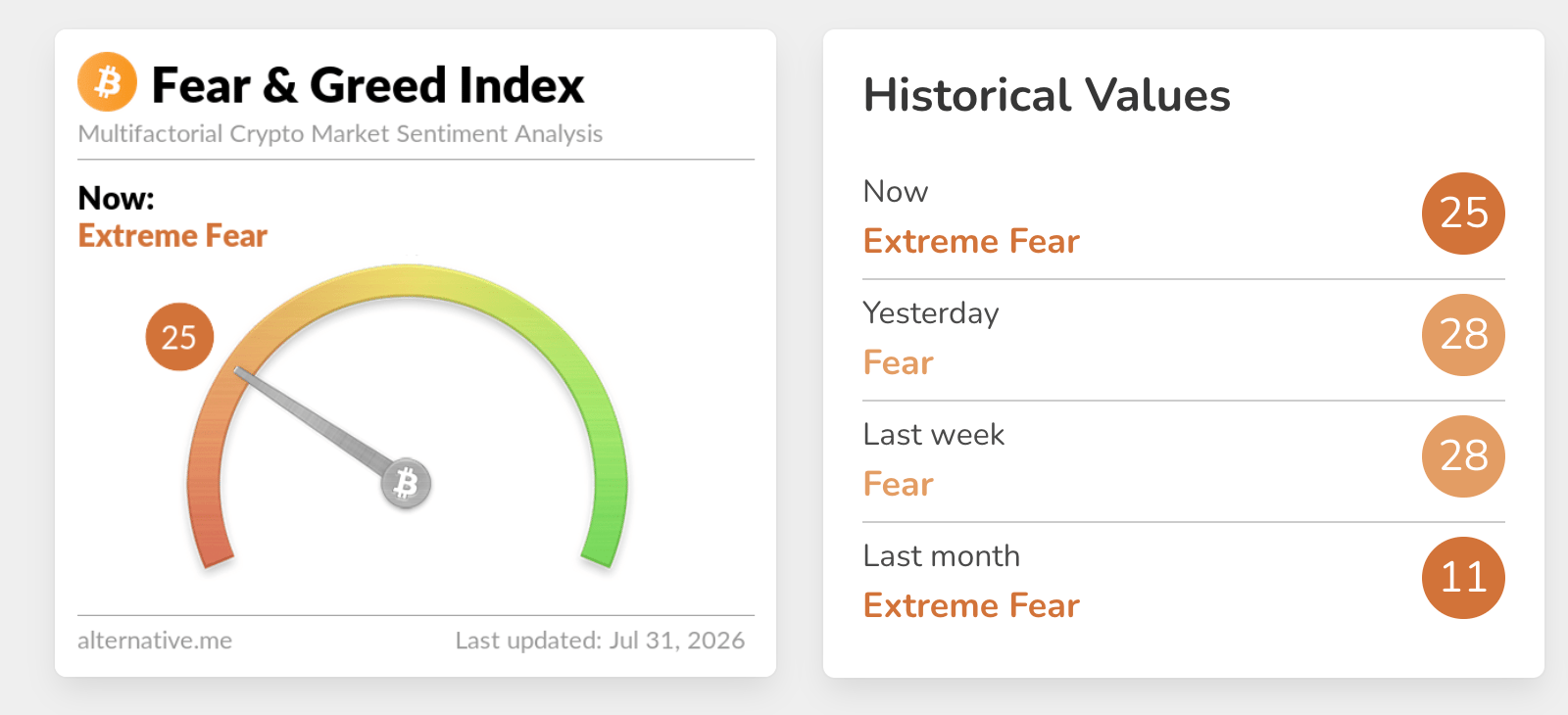
Risk appetite continues to wane this week, with the Fear & Greed Index slipping to 25, firmly in Fear territory, down from 28 just a day earlier. Sustained risk-off sentiment may keep XRP’s upside capped, further encouraging selling among investors.
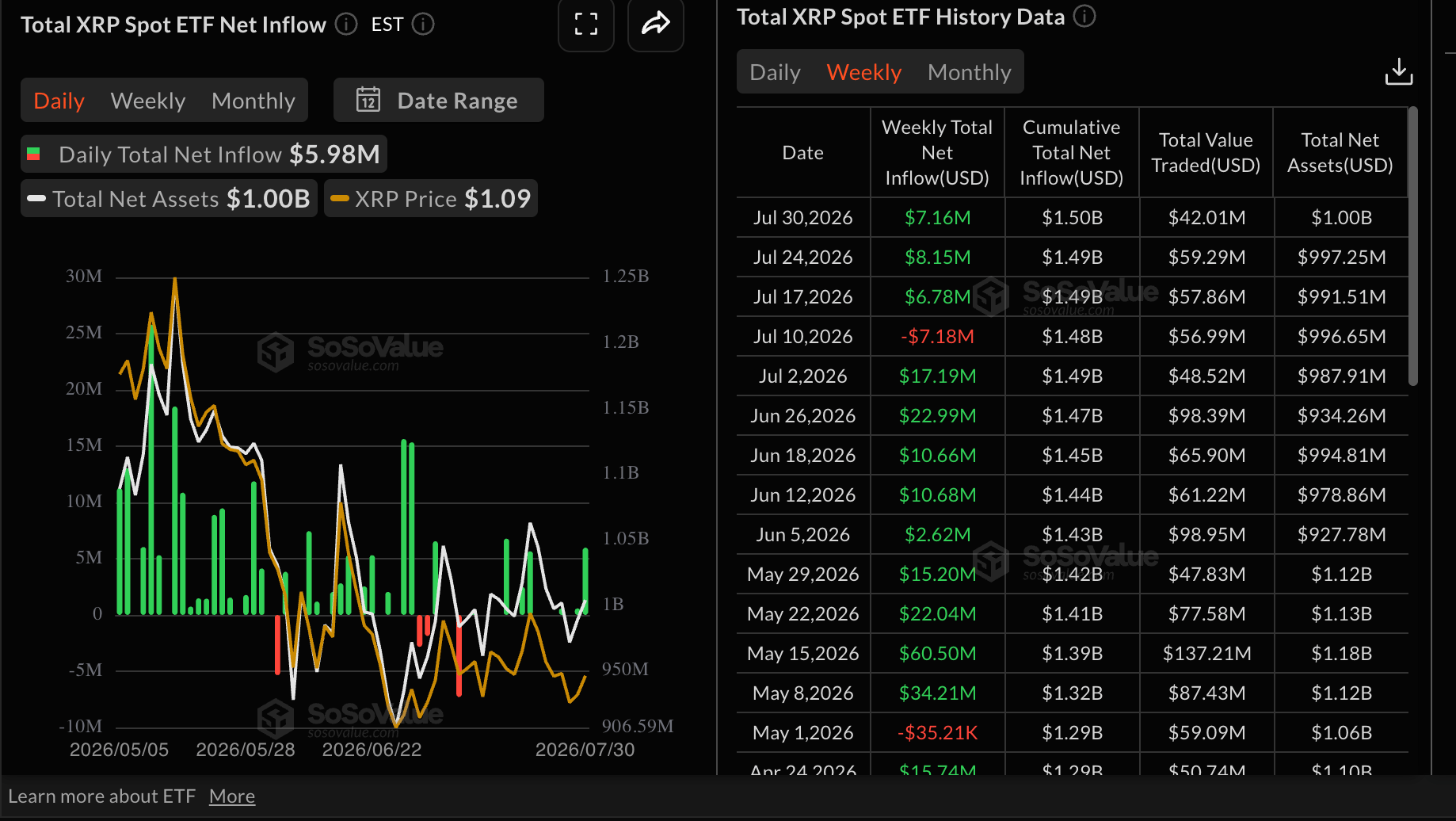
XRP spot Exchange-Traded Funds (ETFs) inflows surged to nearly $6 million on Thursday, up from a mere $585,000 the day before. So far this week, cumulative inflows stand slightly above $7 million through Thursday. The surge underpins targeted risk-on sentiment for XRP investment products, despite the overall crypto market’s dull outlook due to geopolitical tensions and macroeconomic uncertainty.
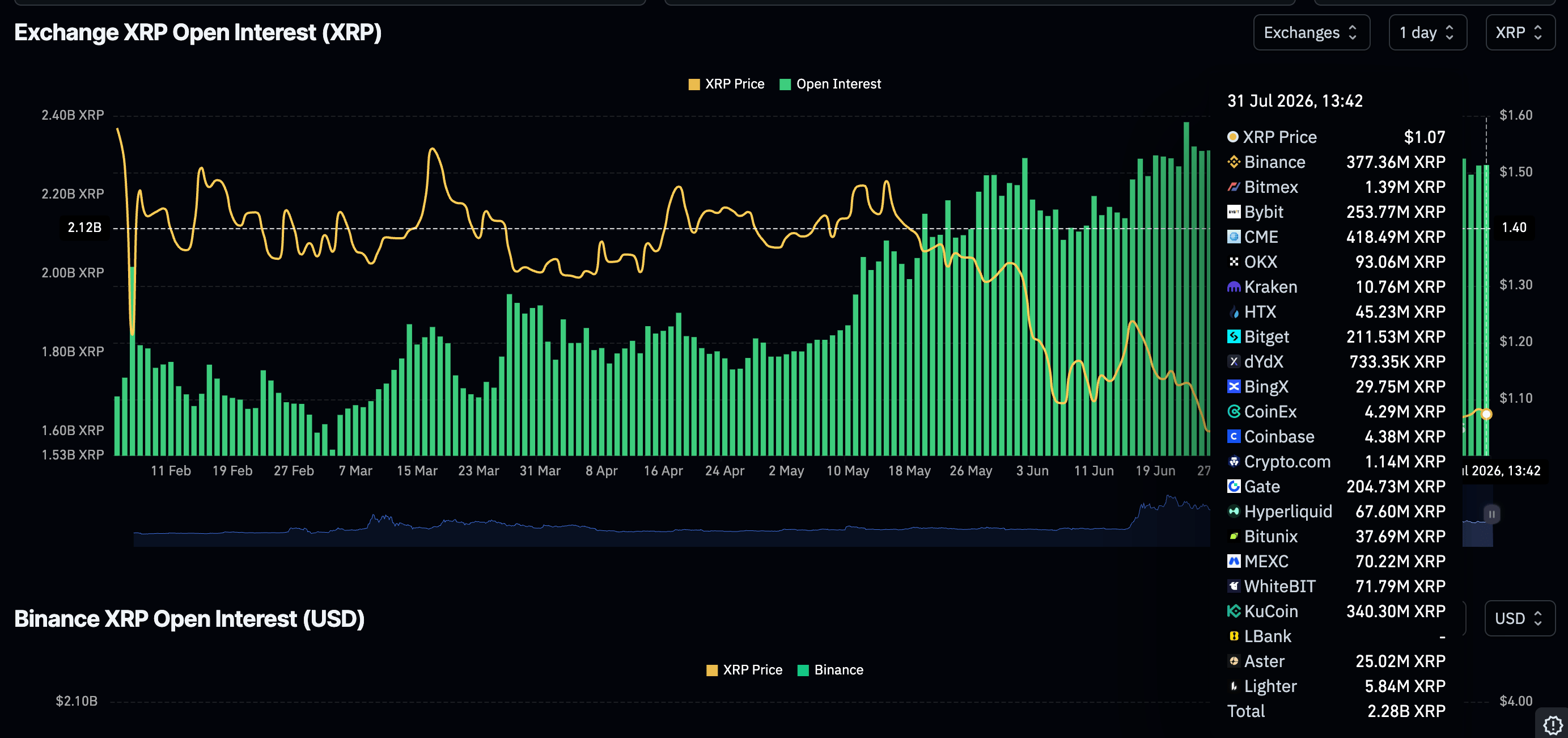
Meanwhile, retail demand is holding steady, with perpetual futures Open Interest (OI) averaging 2.28 billion XRP on Friday, up only marginally from 2.27 billion the previous day. If sustained, this gradual increase from 2.10 billion XRP on July 13 would absorb selling pressure, creating a suitable environment for an upside move above the resistance at $1.10.
Technical Analysis: XRP bears tighten grip
XRP trades at $1.07, keeping a bearish near-term tone as price holds well below the 50-day, 100-day and 200-day Exponential Moving Averages (EMAs). The cluster formed by the 78.6% Fibonacci retracement around $1.12 and the 50-day EMA at $1.13 sits just overhead as the first cap, reinforcing the downside bias.
At the same time, the Relative Strength Index (RSI) around 44 leans soft without being oversold, while the Moving Average Convergence Divergence (MACD) histogram remains slightly negative, hinting that bearish momentum is present but not particularly aggressive.
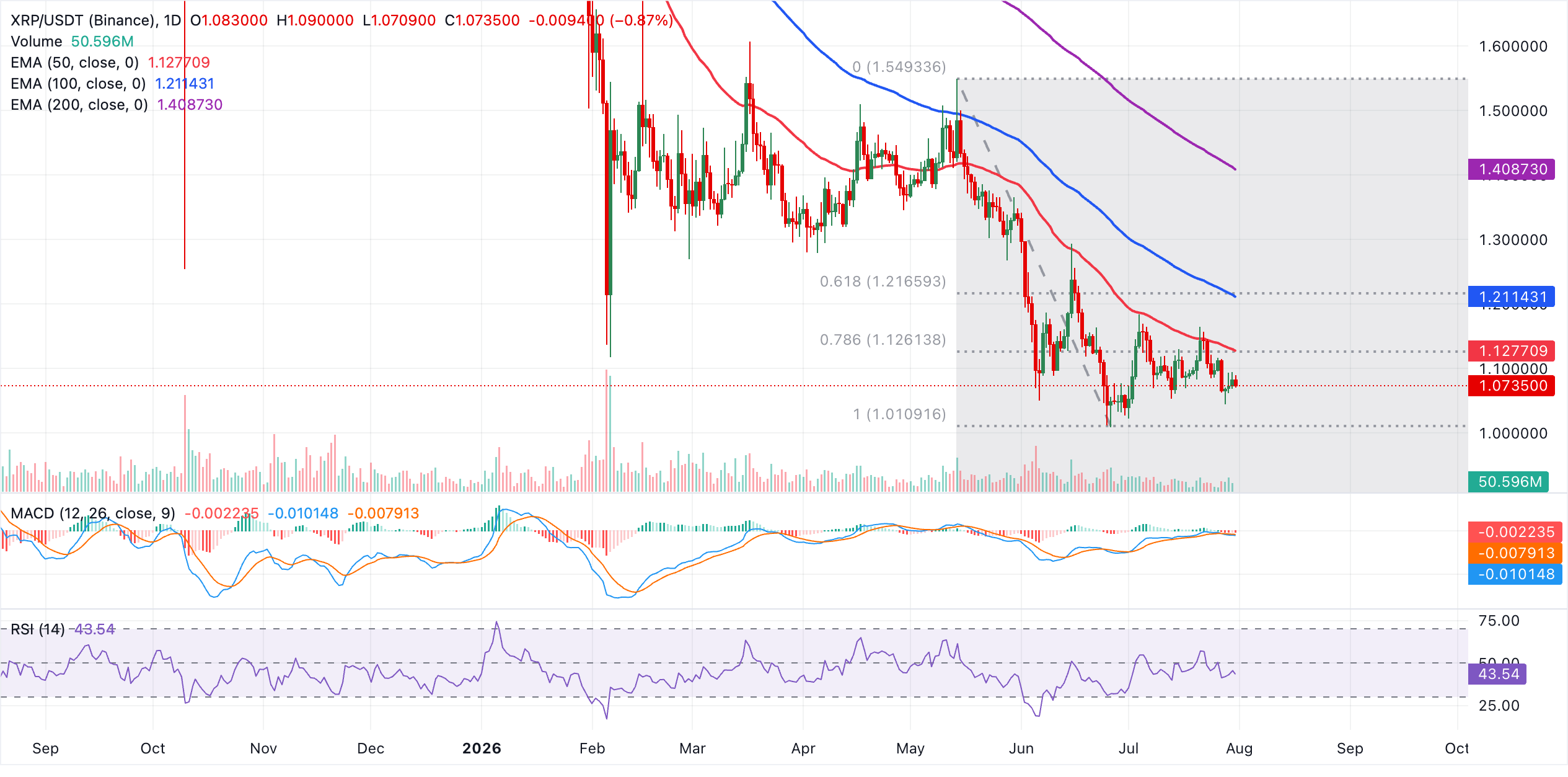
On the topside, initial resistance lies at the 78.6% Fibonacci retracement roughly at $1.12, followed closely by the 50-day EMA at $1.13, with the 100-day EMA at $1.21 and the 61.8% Fibonacci retracement at $1.22 marking a broader supply band if buyers attempt a stronger rebound. Further up, additional barriers align at the 50% Fibonacci retracement near $1.28 and the 38.2% level at $1.34, ahead of the 200-day EMA around $1.41 and the 23.6% Fibonacci retracement at $1.42.
On the downside, the next notable support emerges at the prior swing low and 100% Fibonacci anchor around $1.01, where sellers could hesitate if the pair extends its slide.
(The technical analysis of this story was written with the help of an AI tool. Know more.)
Ripple FAQs
Ripple is a payments company that specializes in cross-border remittance. The company does this by leveraging blockchain technology. RippleNet is a network used for payments transfer created by Ripple Labs Inc. and is open to financial institutions worldwide. The company also leverages the XRP token.
XRP is the native token of the decentralized blockchain XRPLedger. The token is used by Ripple Labs to facilitate transactions on the XRPLedger, helping financial institutions transfer value in a borderless manner. XRP therefore facilitates trustless and instant payments on the XRPLedger chain, helping financial firms save on the cost of transacting worldwide.
XRPLedger is based on a distributed ledger technology and the blockchain using XRP to power transactions. The ledger is different from other blockchains as it has a built-in inflammatory protocol that helps fight spam and distributed denial-of-service (DDOS) attacks. The XRPL is maintained by a peer-to-peer network known as the global XRP Ledger community.
XRP uses the interledger standard. This is a blockchain protocol that aids payments across different networks. For instance, XRP’s blockchain can connect the ledgers of two or more banks. This effectively removes intermediaries and the need for centralization in the system. XRP acts as the native token of the XRPLedger blockchain engineered by Jed McCaleb, Arthur Britto and David Schwartz.
Author

John Isige
FXStreet
John Isige is a seasoned cryptocurrency journalist and markets analyst committed to delivering high-quality, actionable insights tailored to traders, investors, and crypto enthusiasts. He enjoys deep dives into emerging Web3 tren