ZEC Price Forecast: ZEC slips below $500 support ahead of Ironwood network upgrade
- ZEC loses $500 key support level, aligning with cooling momentum in the broader crypto market.
- Zcash will activate its Ironwood network upgrade on Tuesday, introducing new privacy and quantum recoverability features.
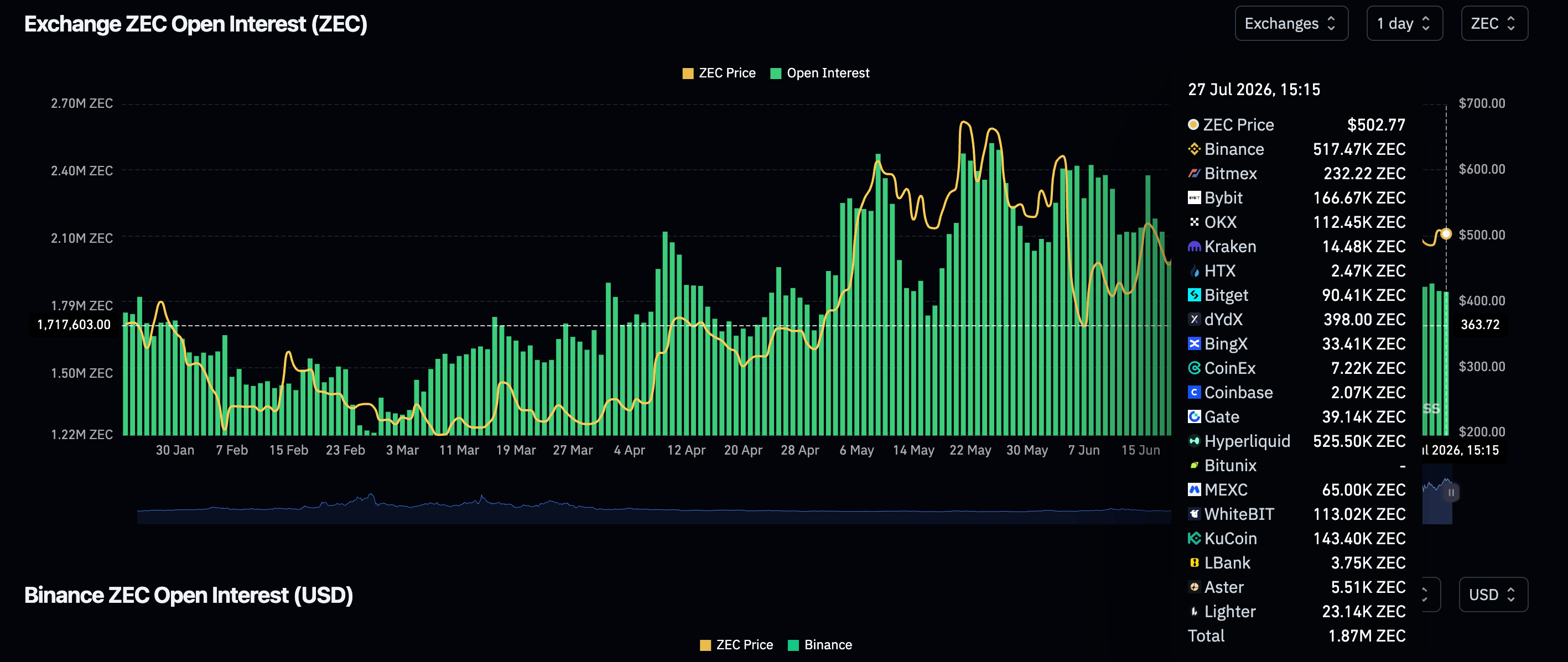
- ZEC faces fading retail demand as futures Open Interest falls to 1.87 million ZEC.

Zcash (ZEC) is trimming gains below $500 on Monday, weighed down by broader cryptocurrency market headwinds. The privacy-oriented token hit highs around $589 in mid-July, supported by increasing retail appetite and a robust technical structure.
Zcash eyes quantum recoverability with Ironwood network upgrade
Zcash has announced that its Ironwood network upgrade will go live on Tuesday. Ironwood will introduce a new shielded pool to address a pivotal counterfeiting vulnerability discovered in the existing Orchard shielded pool by researcher Taylor Hornby on May 29.
Following the software upgrade, new shielded transactions and outputs will be routed directly to Ironwood with verified soundness, a separate commitment tree and value pool tracking.
Node operators will be able to independently verify ZEC’s circulating supply by adding active pools. Ironwood bounds the 21 million ZEC maximum supply immediately upon activation while providing evidence whether exploitation occurred during migration. This means that counterfeit funds will be locked or exposed when trying to exit.
Ironwood notes are stored in a quantum-recoverable plaintext format by default. If quantum computers compromise current cryptographic methods, the pool can be suspended to facilitate user fund recovery. However, this feature does not make Zcash itself quantum-secure today.
With Ironwood, Zcash is expected to restore security and trust, following the headwinds the network faced in May. It is worth mentioning that user funds have not been affected, as there is no evidence of exploitation. The upgrade is meant to safeguard Zcash’s edge in privacy-oriented and verifiable transactions.
Despite the positive outlook of Ironwood’s software upgrade, retail demand continues to fade, as reflected in futures Open Interest (OI), which averaged 1.87 million ZEC on Monday, down from 1.90 million ZEC the day before. The persistent drop in retail appetite could limit ZEC’s recovery potential.
Price analysis: ZEC tests critical support
ZEC trades below $500, while still holding a constructive bullish bias as price remains above the short, medium and long-term Exponential Moving Averages (EMAs) clustered between roughly $490 and $411. The SuperTrend indicator at $436 also sits well below the market, reinforcing an underlying support zone after the recent rebound from sub-$490 levels.
Momentum has cooled with the Relative Strength Index (RSI) slipping below the midline on the daily chart and the Moving Average Convergence Divergence (MACD) histogram staying negative, which suggests the advance is losing steam but not yet reversing while price action holds over these supports.
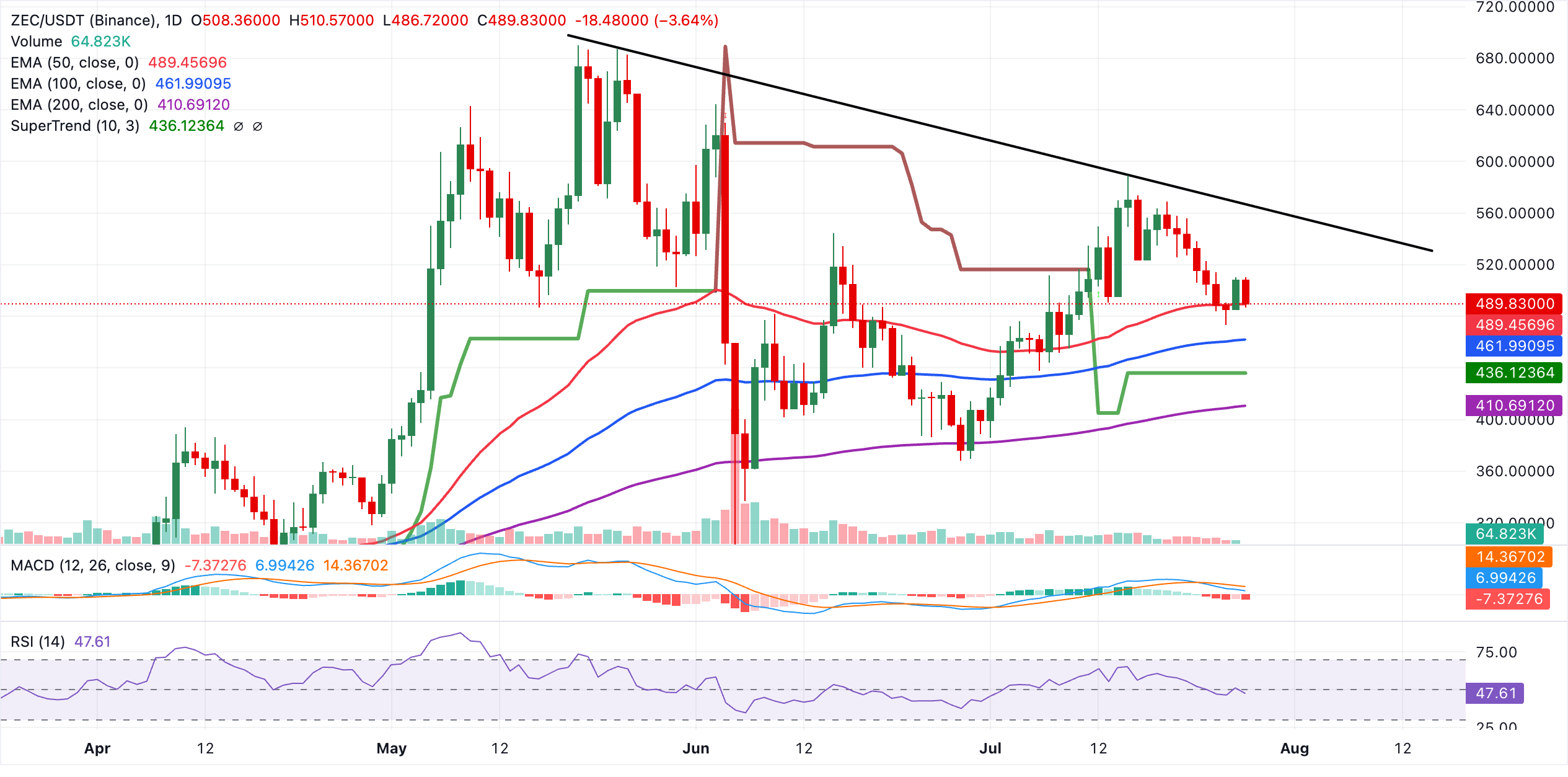
Initial resistance is defined by the psychological supply at $520, followed by the descending trendline break area near $566, where prior rallies have repeatedly stalled. A clear daily close above this barrier would be needed to reopen the path toward higher highs. On the downside, immediate support lies at the 50-day EMA around $490, followed by the 100-day EMA at $462 and the SuperTrend line at $436. A sustained move below these layers would weaken the current bullish structure and expose the 200-day EMA at $411 as the next key downside target.
(The technical analysis of this story was written with the help of an AI tool. Know more.)
Open Interest, funding rate FAQs
Higher Open Interest is associated with higher liquidity and new capital inflow to the market. This is considered the equivalent of increase in efficiency and the ongoing trend continues. When Open Interest decreases, it is considered a sign of liquidation in the market, investors are leaving and the overall demand for an asset is on a decline, fueling a bearish sentiment among investors.
Funding fees bridge the difference between spot prices and prices of futures contracts of an asset by increasing liquidation risks faced by traders. A consistently high and positive funding rate implies there is a bullish sentiment among market participants and there is an expectation of a price hike. A consistently negative funding rate for an asset implies a bearish sentiment, indicating that traders expect the cryptocurrency’s price to fall and a bearish trend reversal is likely to occur.
Author

John Isige
FXStreet
John Isige is a seasoned cryptocurrency journalist and markets analyst committed to delivering high-quality, actionable insights tailored to traders, investors, and crypto enthusiasts. He enjoys deep dives into emerging Web3 tren