XRP slides as retail demand cools, shrugs off Ripple's MiCA license approval
- XRP extends its decline, trading around $1.13 on Tuesday, weighed down by fading retail demand.
- Ripple has secured full MiCA authorization in Luxembourg, opening the door to expansion across the 27 European Economic Area countries.
- XRP’s technical outlook remains relatively weak, with the RSI sliding while major moving averages cap the upside.

Ripple (XRP) edges lower while trading around $1.13 at the time of writing on Tuesday. The remittance token upholds a broader bearish bias, attributed to softening retail interest and the lack of strong catalysts to prevent rallies from being sold as investors appear to prefer short-term gains.
Ripple eyes European region expansion with MiCa’s license
Ripple announced on Monday that it had been granted authorization for a Crypto Asset Service Provider (CASP) license from Luxembourg’s Commission de Surveillance du Secteur Financier (CSSF).
This authorization, building on the preliminary approval granted in June 2026, affirms Ripple's full compliance with the Markets in Crypto-Assets (MiCA) regulation.
Ripple’s comprehensive, regulated crypto payments solution is now accessible to financial institutions, corporations, and enterprises throughout the 30-nation European Economic Area (EEA).
“This CASP authorisation means Ripple enters the post-transitional MiCA era fully compliant and ready to scale,” said Cassie Craddock, Managing Director, United Kingdom & Europe at Ripple.
Falling retail demand constrains XRP’s outlook
The XRP derivatives market continues to face persistent cooling in retail demand, as reflected in the perpetual futures Open Interest (OI). According to CoinGlass data, the OI has cooled further to $2.38 billion on Tuesday, down from $2.39 billion on Monday and $2.58 billion on Sunday.
An expanded outlook indicates that current retail activity pales significantly in comparison to the OI peak of $10.94 billion on July 22. If this weakness sustains, recovery could remain a pipe dream in the short term amid investor exhaustion.
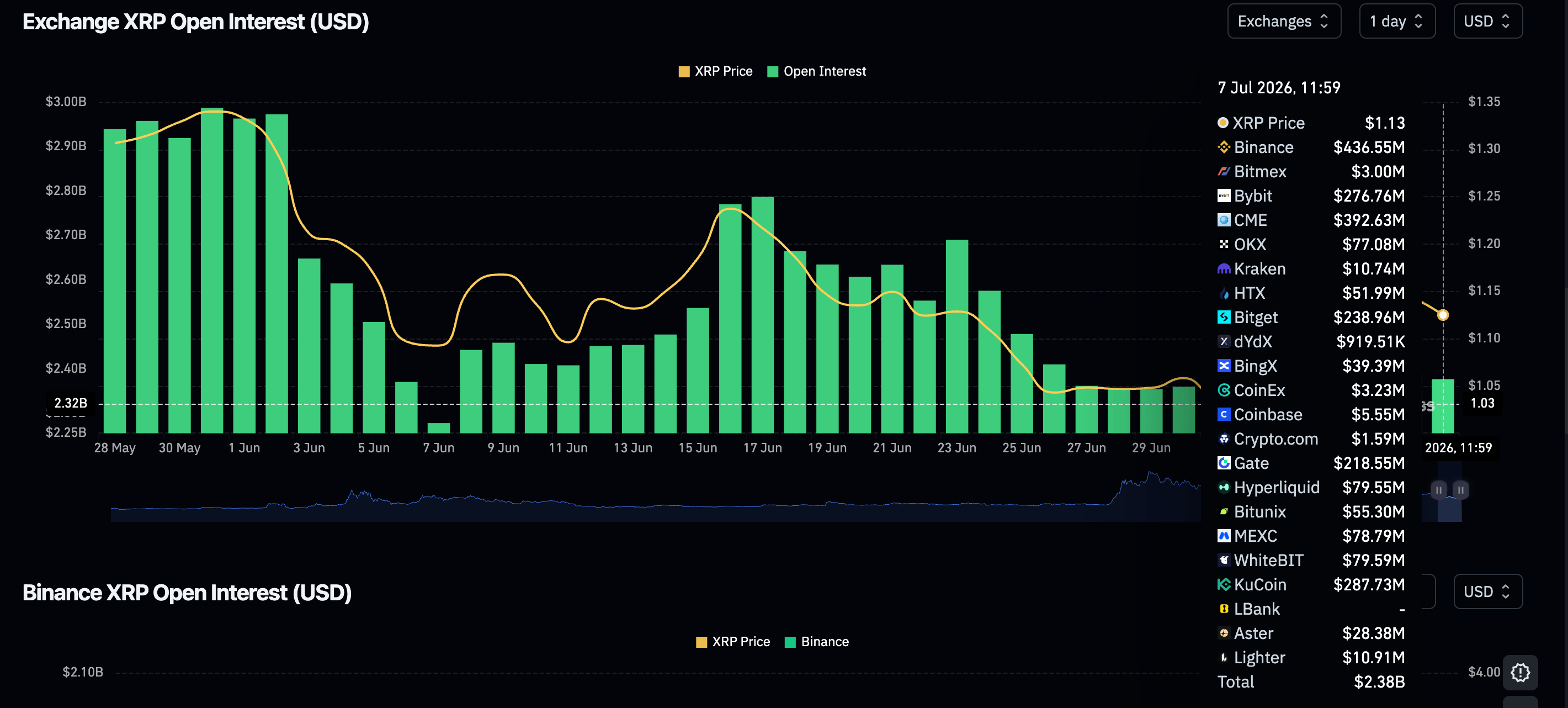
Price analysis: XRP retains a near-term bearish bias
XRP holds inside a downward parallel channel with a bearish near‑term bias as price remains capped beneath the 50-day, the 100-day and the 200-day Moving Average Exponential (EMA) cluster. The Parabolic SAR at $1.02 sits below spot, hinting at tentative underlying support, while the Relative Strength Index (RSI) has cooled back toward the mid-40s, suggesting fading bullish momentum after the recent bounce.
Meanwhile, the Moving Average Convergence Divergence (MACD) histogram is marginally positive but flattening on the daily chart, which reinforces the view of a waning recovery rather than a sustained uptrend.
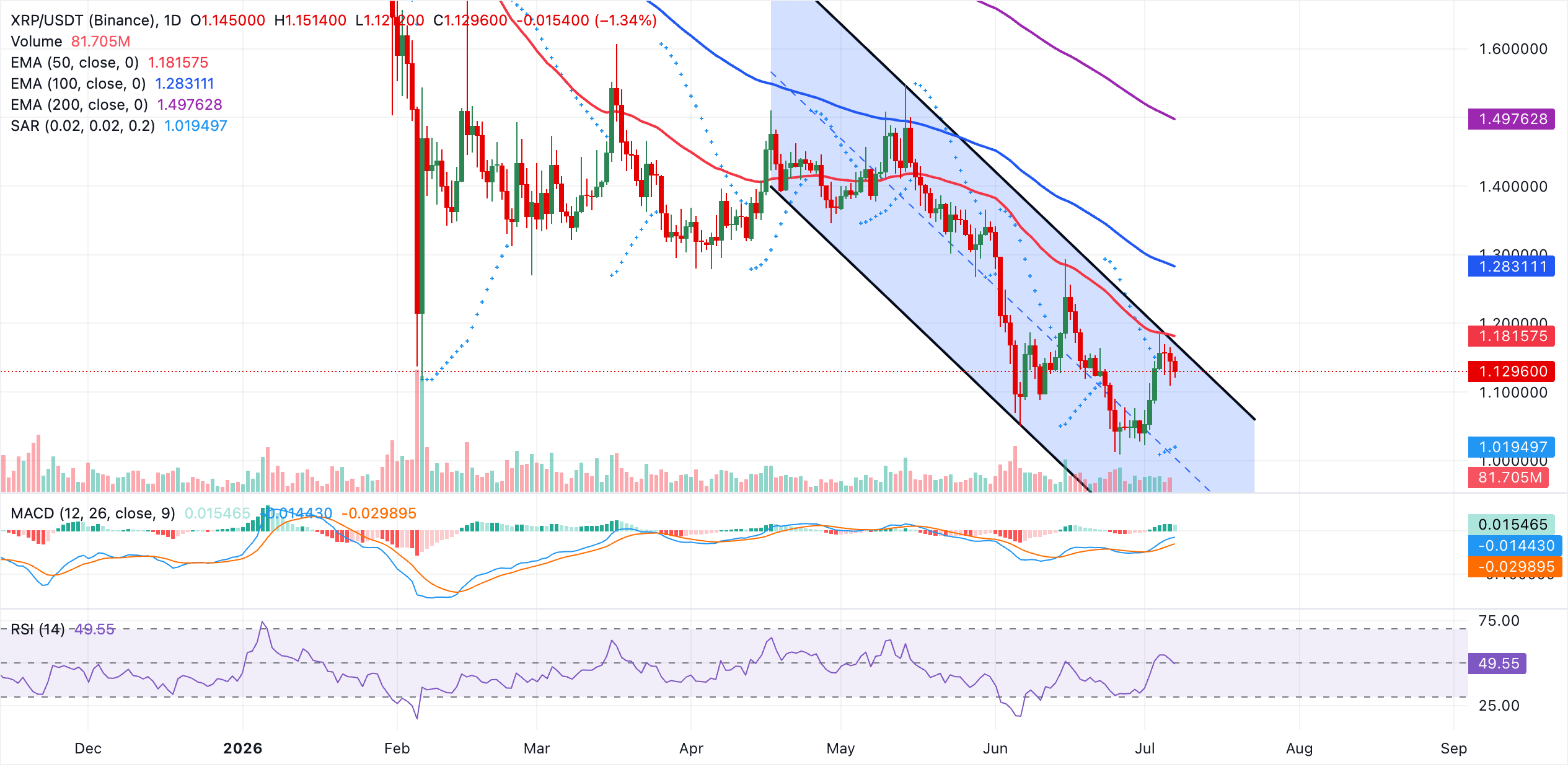
On the topside, initial resistance is aligned with the channel top near $1.17, followed by the 50-day EMA at $1.18, with the 100-day EMA at $1.28 and the distant 200-day EMA at $1.50 marking progressively stronger barriers within the broader downtrend. On the flip side, immediate support is seen near the recent pivot around the current price region, ahead of the Parabolic SAR at $1.02, while a deeper slide would expose the channel floor toward $0.84 as the next major demand zone.
(The technical analysis of this story was written with the help of an AI tool. Know more.)
Cryptocurrency metrics FAQs
The developer or creator of each cryptocurrency decides on the total number of tokens that can be minted or issued. Only a certain number of these assets can be minted by mining, staking or other mechanisms. This is defined by the algorithm of the underlying blockchain technology. On the other hand, circulating supply can also be decreased via actions such as burning tokens, or mistakenly sending assets to addresses of other incompatible blockchains.
Market capitalization is the result of multiplying the circulating supply of a certain asset by the asset’s current market value.
Trading volume refers to the total number of tokens for a specific asset that has been transacted or exchanged between buyers and sellers within set trading hours, for example, 24 hours. It is used to gauge market sentiment, this metric combines all volumes on centralized exchanges and decentralized exchanges. Increasing trading volume often denotes the demand for a certain asset as more people are buying and selling the cryptocurrency.
Funding rates are a concept designed to encourage traders to take positions and ensure perpetual contract prices match spot markets. It defines a mechanism by exchanges to ensure that future prices and index prices periodic payments regularly converge. When the funding rate is positive, the price of the perpetual contract is higher than the mark price. This means traders who are bullish and have opened long positions pay traders who are in short positions. On the other hand, a negative funding rate means perpetual prices are below the mark price, and hence traders with short positions pay traders who have opened long positions.
Author

John Isige
FXStreet
John Isige is a seasoned cryptocurrency journalist and markets analyst committed to delivering high-quality, actionable insights tailored to traders, investors, and crypto enthusiasts. He enjoys deep dives into emerging Web3 tren