Two theories why GBTC sticks to high fees despite bleeding billions

Grayscale may be sticking to high fees for its spot Bitcoin (BTC $70,434) exchange-traded fund to keep “stuck” holders from cashing out while betting that Bitcoin’s price will continue to rocket upward, according to one market analyst.
The Grayscale Bitcoin Trust (GBTC) has seen daily outflows since its launch on Jan. 11 — totaling over $14 billion as of March 25.
Many, including Bianco Research founder and former Wall Street analyst Jim Bianco, have pointed to GBTC’s fees as “the problem.” In a March 25 X post, he speculated at least half of GBTC outflows were those moving to lower-fee ETFs.
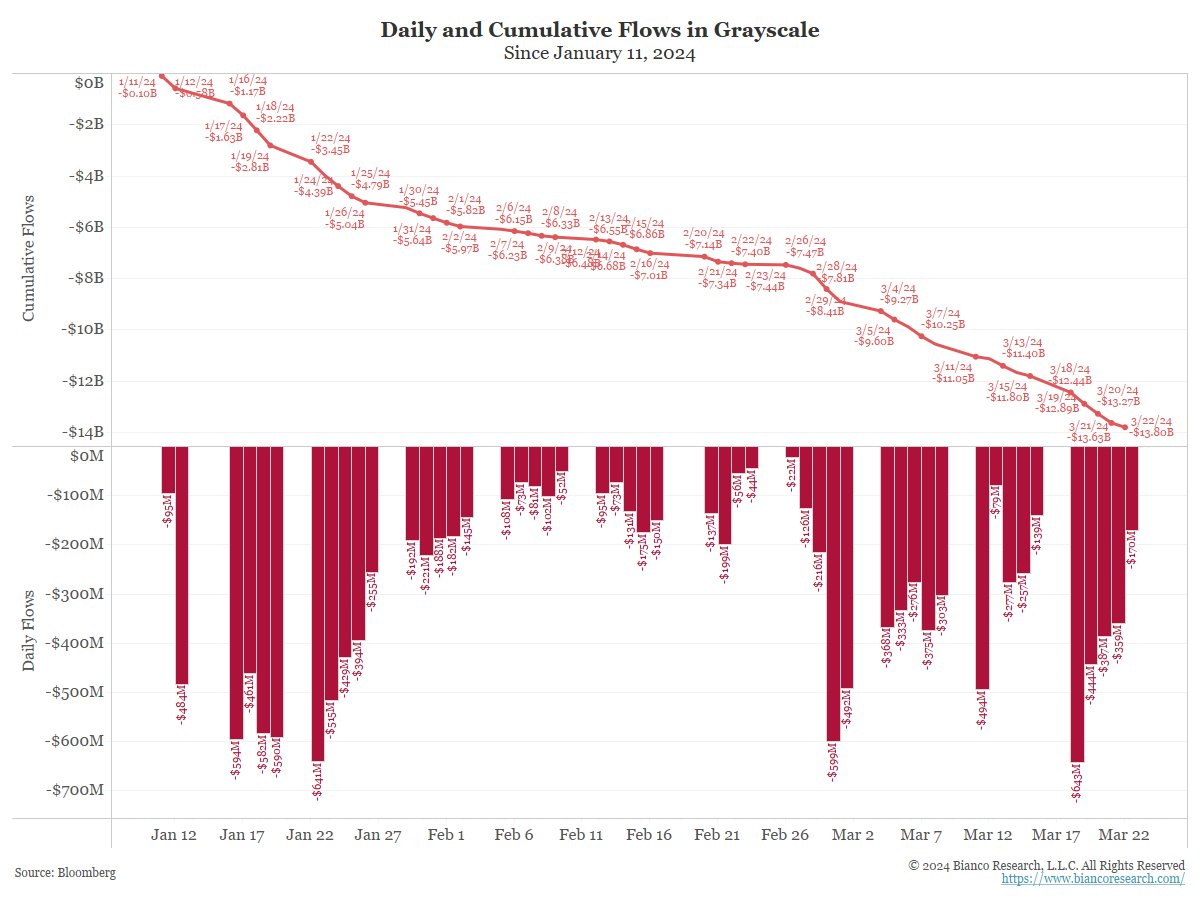
Chart showing GBTC net outflows from Jan. 11 up to March 22. Source: Jim Bianco/X
Grayscale’s ETF charges a 1.5% per year management fee, five times that of the 0.30% average of the other spot Bitcoin ETFs.
Bianco said two possible reasons why Grayscale doesn’t drop the fee. Firstly, it could be a bet that GBTC holders won’t leave as the asset manager “analyzed its holders’ tax bill [...] And concluded they are ‘stuck’ as it is too costly to leave until they need the money.”
GBTC wields assets under management of nearly $24.7 billion as of March 25, per YCharts data.
Bianco also believes Grayscale’s firmness on its fees could result from optimism that Bitcoin’s price “will moon well over $100k in the next year or two.”
“Under this scenario, [Grayscale] are betting the price of BTC will rise enough to increase their assets (for which they charge a fee) to “offset” most or all their outflows,” Bianco wrote.
If BTC falls, he added, “then this strategy could prove disastrous” as GBTC selling could ramp up “and ‘stuck’ tax bill holders find these bills shrink enough that they can leave and never return to GBTC again.”
Expect GBTC to be a constant selling source until it’s held by dead people, those who forgot they owned it, or those “trapped” with giant tax bills if they sell it.
Bloomberg ETF analyst Eric Balchunas posted in response to Bianco’s theory that “there may never be an inflow to GBTC ever.”
“My guess is we see a few more big outflow days and then a slow trickle into eternity,” Balchunas added. “If BTC price goes up [...] They’ll be just fine revenue-wise.”
Why sue the SEC just to bleed?
United States spot Bitcoin ETFs only came about due to Grayscale winning a lawsuit against the Securities and Exchange Commission last year which forced it to review Grayscale’s bid to convert GBTC to an ETF.
“Why did GBTC spend all the time and effort to sue the SEC to allow it to convert to an ETF and only manage it like this (so that it will slowly bleed out)?” Bianco asked.
Answering, Balchunas speculated that Grayscale maybe knew that even if GBTC were to “bleed out every last investor,” the ETF hype would “pump BTC enough” to offset the losses, and its assets under management would remain stable.
Grayscale had also long said it would convert GBTC, so it “had to follow through” and didn’t lower fees as it’s “TOUGH to kill 80% of your revenue stream in one shot,” Balchunas added.
Grayscale likely “underestimated just how brutally competitive” the U.S. ETF market is, Balchunas said, and maybe wasn’t expecting the cutthroat fee war issuers started in a bid to gain market share.
Bloomberg ETF analyst James Seyffart postulated another reason could be that Grayscale was acting to try to help bankrupt crypto lender Genesis — both are subsidiaries of crypto conglomerate Digital Currency Group (DCG).
Genesis had over 62 million GBTC shares used to collateralize loans made by Gemini Earn users and the two companies were in a long legal fight over them.
“There was 100% a selfish interest in just being able to get out of those positions at [net asset value],” said Seyffart.
Author

Cointelegraph Team
Cointelegraph
We are privileged enough to work with the best and brightest in Bitcoin.