Swiss-based Taurus gives banks access to Hedera via unified digital asset platform
- Taurus enables over 40 banks, including Deutsche Bank and State Street, full access to the Hedera network.
- The digital asset platform allows banks to custody, stake HBAR, issue tokens and deploy smart contracts.
- Hedera remains pressured below key moving averages but also maintains stability around $0.0650.

Taurus, a Switzerland-based digital asset infrastructure provider, announced on Wednesday that it has extended its services, targeting banks and regulated financial institutions on the Hedera (HBAR) network.
Meanwhile, HBAR is paring losses, trading above $0.0650 at the time of writing. The token shows signs of stability amid a broader bearish trend.
Taurus provides access to Hedera’s full technology stack
Taurus press release said that more than 40 banks and regulated financial institutions across the world, including Deutsche Bank, State Street and CACEIS, can now access the Hedera network’s full product suite.
The platform, developed in collaboration with Swiss-based The Hashgraph Association, was built in phases, with the final phase, smart contract capability, completed.
Users can access custody services, take the network’s native token HBAR as well as issue tokens. They can also run programmable products, including tokenized bonds, funds and stablecoins, all within the same platform, environment and risk framework.
Taurus said that its infrastructure platform makes it possible for banks and institutions to plan not only for the products they are offering now, but also for future tokenization plans.
“Full Hedera coverage inside Taurus removes that risk, expanding into new digital asset products becomes a configuration decision rather than a procurement exercise. Institutions are not asked to commit to advanced use cases upfront; the infrastructure is already in place for whenever their strategy matures,” the press release highlights.
The integration covers Taurus platforms, including Taurus-PROTECT, Taurus-EXPLORER and Taurus-CAPITAL.
Technical analysis: HBAR eyes short-term recovery
HBAR remains under a bearish bias as the price holds below the short and medium-term Exponential Moving Averages (EMAs). The 50-day EMA at $0.0724, the 100-day EMA at $0.0784 and the 200-day EMA at $0.0928 are all acting as overhead resistance.
Still, HBAR hovers just above the Bollinger Bands middle line at $0.0691, suggesting mild nearby support, while the Relative Strength Index (RSI) near 48 on the daily chart and a slightly positive Moving Average Convergence Divergence (MACD) histogram hint at stabilizing but still fragile momentum rather than a clear upside impulse.
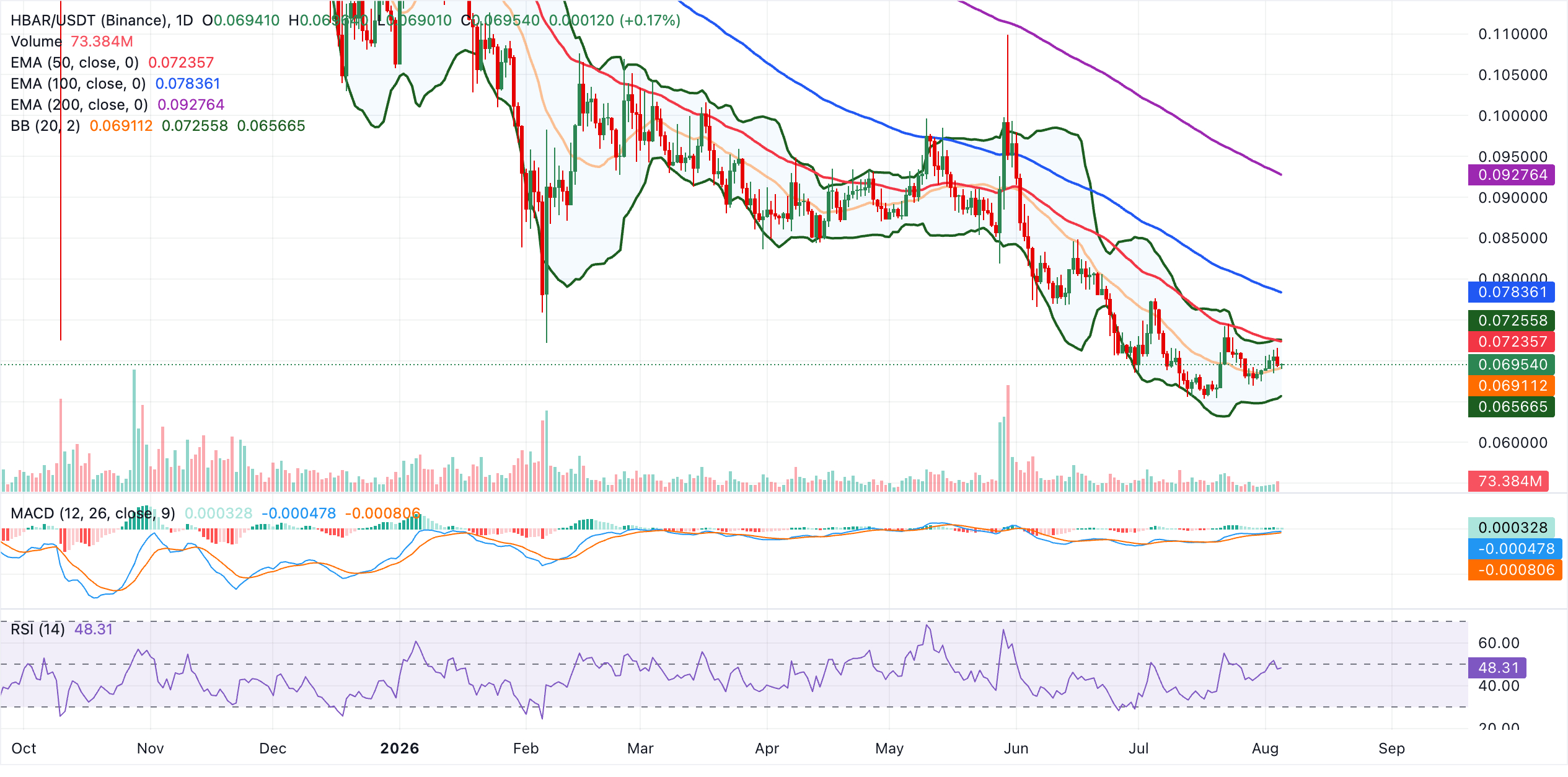
Initial resistance is clustered around the 50-day EMA at $0.0724 and the Bollinger upper boundary at roughly $0.0726. A daily close above this zone would be needed to alleviate immediate downside pressure and open the way toward the 100-day EMA at $0.0784, ahead of the more distant 200-day EMA near $0.0928. On the flip side, the Bollinger middle layer at $0.0691 is the first support to watch, with a break lower exposing the lower band support around $0.0657, where sellers could look to extend the prevailing corrective phase.
(The technical analysis of this story was written with the help of an AI tool. Know more.)
Bitcoin, altcoins, stablecoins FAQs
Bitcoin is the largest cryptocurrency by market capitalization, a virtual currency designed to serve as money. This form of payment cannot be controlled by any one person, group, or entity, which eliminates the need for third-party participation during financial transactions.
Altcoins are any cryptocurrency apart from Bitcoin, but some also regard Ethereum as a non-altcoin because it is from these two cryptocurrencies that forking happens. If this is true, then Litecoin is the first altcoin, forked from the Bitcoin protocol and, therefore, an “improved” version of it.
Stablecoins are cryptocurrencies designed to have a stable price, with their value backed by a reserve of the asset it represents. To achieve this, the value of any one stablecoin is pegged to a commodity or financial instrument, such as the US Dollar (USD), with its supply regulated by an algorithm or demand. The main goal of stablecoins is to provide an on/off-ramp for investors willing to trade and invest in cryptocurrencies. Stablecoins also allow investors to store value since cryptocurrencies, in general, are subject to volatility.
Bitcoin dominance is the ratio of Bitcoin's market capitalization to the total market capitalization of all cryptocurrencies combined. It provides a clear picture of Bitcoin’s interest among investors. A high BTC dominance typically happens before and during a bull run, in which investors resort to investing in relatively stable and high market capitalization cryptocurrency like Bitcoin. A drop in BTC dominance usually means that investors are moving their capital and/or profits to altcoins in a quest for higher returns, which usually triggers an explosion of altcoin rallies.
Author

John Isige
FXStreet
John Isige is a seasoned cryptocurrency journalist and markets analyst committed to delivering high-quality, actionable insights tailored to traders, investors, and crypto enthusiasts. He enjoys deep dives into emerging Web3 tren