SEC plans to push tokenized stock trading as CLARITY Act advances to Senate floor
- The US Securities and Exchange Commission is ready to deploy an “innovation exemption” for tokenized stock trading.
- The on-chain shift will test current regulatory standards, as advancing CLARITY Act would position CFTC as the primary regulatory authority.
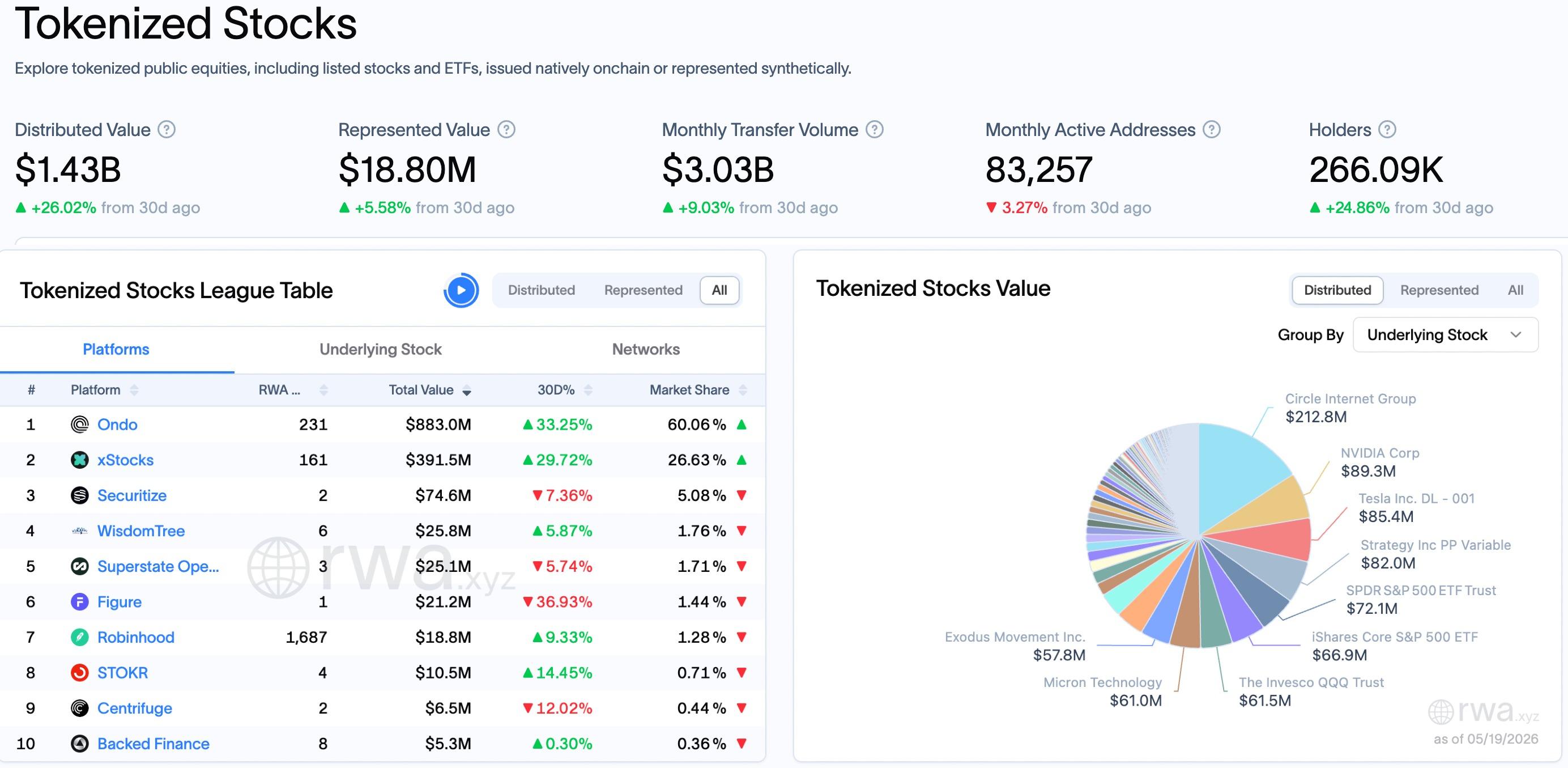
- Ondo leads tokenized stocks platform with a 60% market share, while Circle, NVIDIA, and Tesla are the leading stocks.


The US Securities and Exchange Commission (SEC) is expected to release an “innovation exemption” framework for tokenized stock trading, which could create a 24/7, decentralized vertical. The Digital Asset Market Clarity Act (CLARITY Act), advancing to a full Senate vote, paves the way for tokenized trading by positioning the Commodity Futures Trading Commission (CFTC) as the primary regulator for such crypto activity.
Ondo is leading the narrative with 60% market share in tokenized stocks, which mainly include the on-chain versions of Circle Group (CIRCLE), NVIDIA Corp. (NVIDIA), and Tesla Inc. (TESLA).
SEC to push for an around-the-clock, tokenized trading future
According to Bloomberg, US SEC Chairman Paul Atkins could roll out an “innovation exemption” framework for tokenized stock trading. The plan likely includes trading in tokenized stocks issued by or on behalf of issuers, as well as third-party tokenized stocks that are not directly affiliated with the issuers.
The on-chain shift in traditional stock trading could ensure fair pricing, investor protection, and greater transparency on a 24/7, decentralized platform. This shift is part of the Real World Asset (RWA) tokenization, which creates a digital representation of real estate, bonds, private credit, and more.
RWA.xyz data shows that the distributed value of tokenized stocks is up 26% over the last 30 days, reaching $1.43 billion, while monthly transfer volume is up 9% to $3.03 billion. Additionally, over 266,000 holders and 83,257 monthly active wallets reaffirm the rising adoption of the crypto versions of traditional stocks.
Ondo, built on Ethereum, is dominating 60% of the on-chain stock market. On the other hand, tokenized stocks of Circle Group (CIRCLE), NVIDIA Corp. (NVIDIA), and Tesla Inc. (TESLA) are worth roughly $212 million, $89.3 million, and $85.4 million, respectively. These stocks account for more than 25% of all tokenized stocks.
Supporting the on-chain push, the CLARITY Act is likely to advance to a full Senate vote in June or July after clearing the US Senate Banking Committee with a bipartisan 15–9 vote.
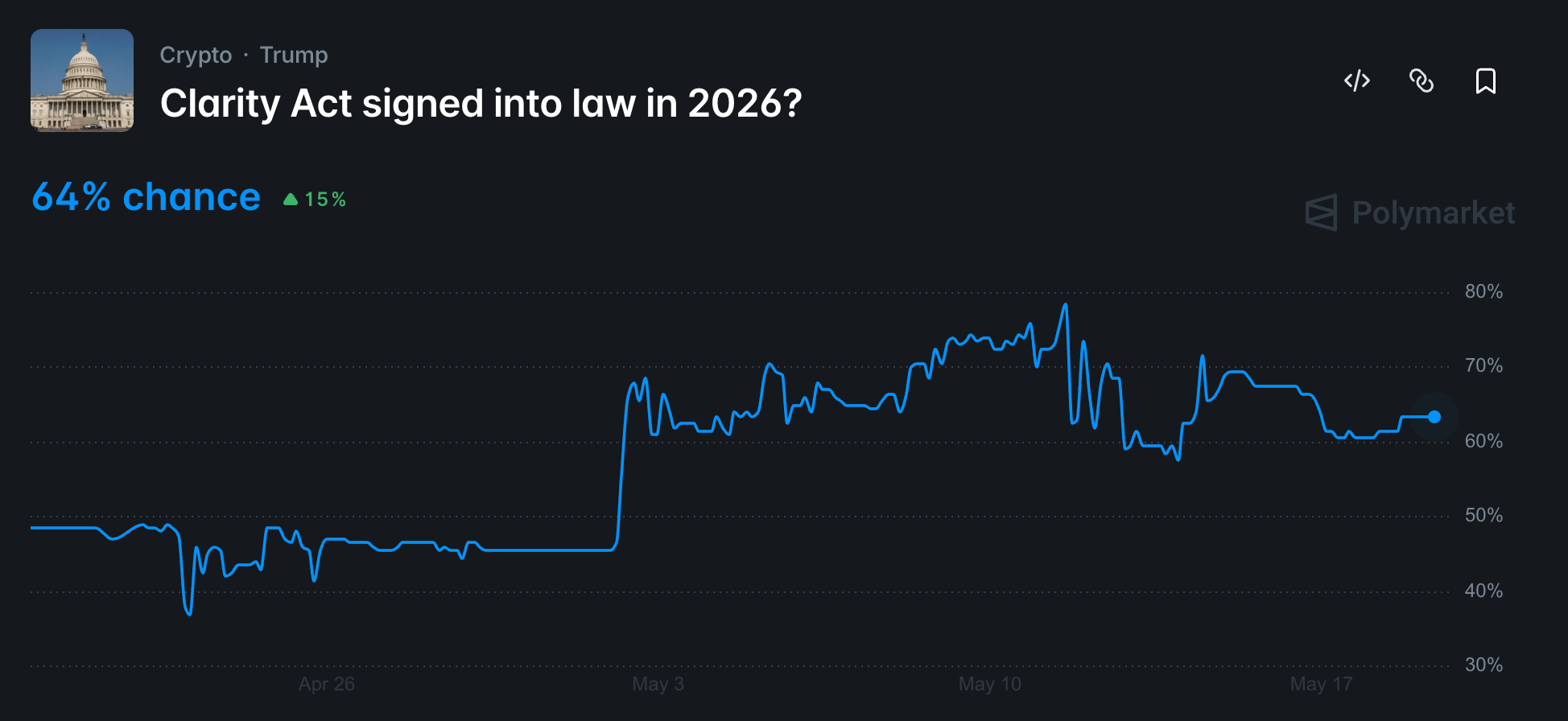
Polymarket data shows the market anticipates a 64% likelihood that the CLARITY Act will be voted on in 2026, which could pave the way for greater tokenized stock trading. This signing would require 60 votes on the floor, where Republicans hold 43 seats, suggesting that the pro-crypto players need to secure at least 17 Democratic votes.
If passed, the CLARITY Act would shift regulatory oversight of such crypto trading activities from the SEC to the CFTC, except for oversight of digital securities.
Author
Vishal Dixit
FXStreet
Vishal Dixit holds a B.Sc. in Chemistry from Wilson College but found his true calling in the world of crypto.