XRP holds EMA support but soft derivatives cap recovery
- XRP holds support at the 50-day EMA, but the 200-day EMA may limit recovery.
- XRP derivatives market softens as perpetual futures Open Interest falls to 2.12 billion XRP.
- XRP bulls battle to regain control, while momentum indicators remain downward, weighing on price action.

Ripple (XRP) remains in bearish hands on Thursday, trading near $1.30 while bulls defend a short-term moving average support cluster. Since Monday’s uptick to $1.50, the token has continued to face headwinds, primarily because the United States (US) Senate failed to advance the CLARITY Act and the Federal Reserve (Fed) raised interest rates by 25 basis points to the 3.75%-4.00% range.
Despite the regulatory setback, Ripple said XRP is legally grounded thanks to its long court battle with the Securities and Exchange Commission (SEC), whose ruling established that the token is not a security.
“The bottom line is straightforward: Ripple and XRP stand on settled ground. That legal clarity is a very meaningful advantage for Ripple, particularly as the broader US digital asset market continues to operate without a durable statutory framework that the CLARITY Act could have provided,” Ripple stated in a recent article.
XRP derivatives soften as recovery struggles
The uptake of XRP derivatives has dwindled in the last few days, with futures Open Interest (OI) falling to 2.12 billion XRP on Thursday, down from 2.25 billion the day before. This decline comes against a backdrop of a steady uptrend, with OI reaching 2.78 billion on August 15, undermining prevailing retail demand.
If cooling continues, recovery could become an uphill task, leaving XRP vulnerable to headwinds amid macro uncertainty and reduced upside catalysts in the broader crypto market.
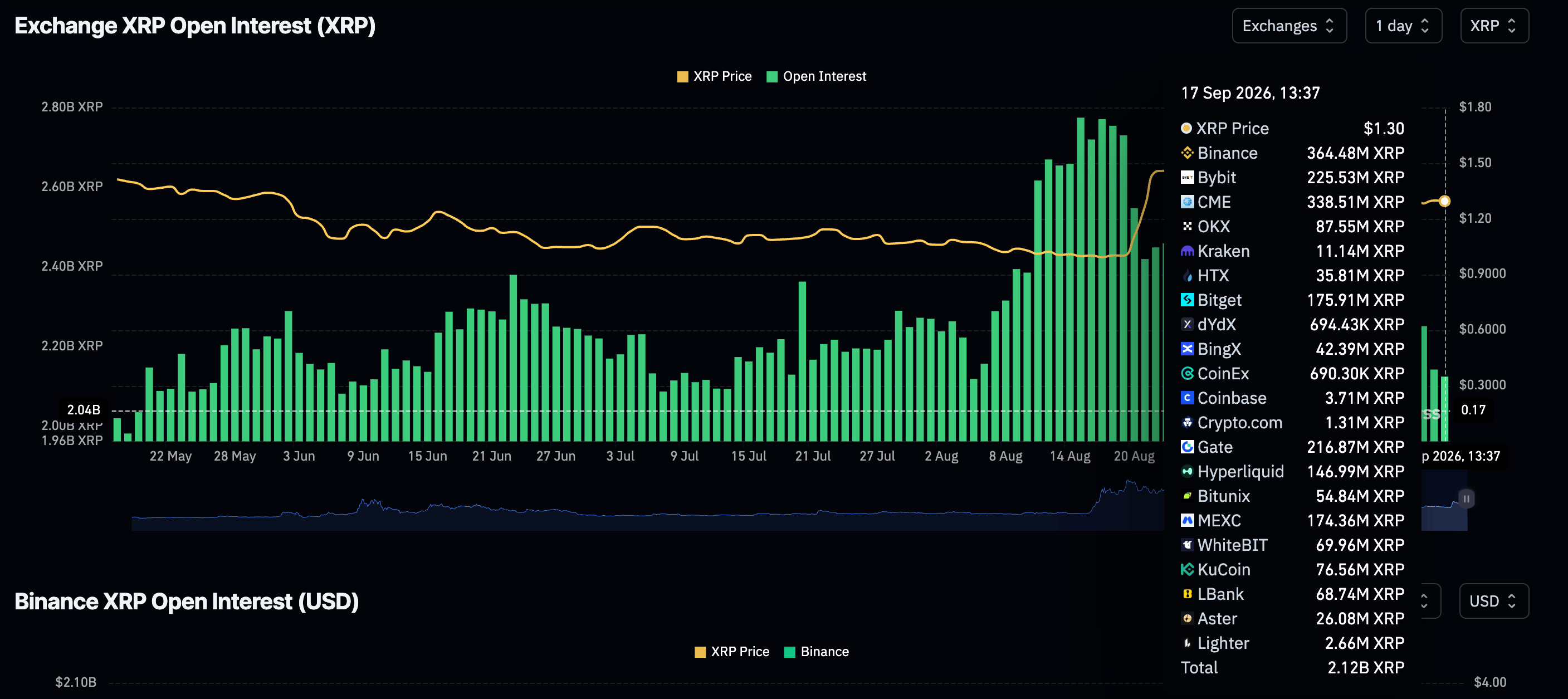
Still, XRP shows resilience after the expected Fed rate hike, which was broadly priced in. Investors should temper expectations of a sharp recovery toward $1.50, as the rate hike's impact could be delayed while risk-asset markets react to higher borrowing costs and potentially lower liquidity.
“The Fed’s growth outlook was revised higher, which suggests policymakers are not seeing an economy that is close to breaking,” Markus Levin, the co-founder of XYO, said in an emailed comment, adding, “if inflation starts moving lower, there is still a path for the Fed to pause without needing to push rates materially higher.”
Technical analysis: XRP bulls defend moving average support
XRP sits above a moving average cluster formed by the 50-day and 100-day Exponential Moving Averages (EMAs) between roughly $1.28 and $1.26, while the 200-day EMA at $1.36 caps upside movement.
The Moving Average Convergence Divergence (MACD) indicator has slipped further below zero, with its line under the signal and a negative, slightly expanding histogram, hinting at waning upside momentum. At the same time, the Relative Strength Index (RSI) at 47 sits near the midline, reinforcing a consolidative bias rather than a directional push.
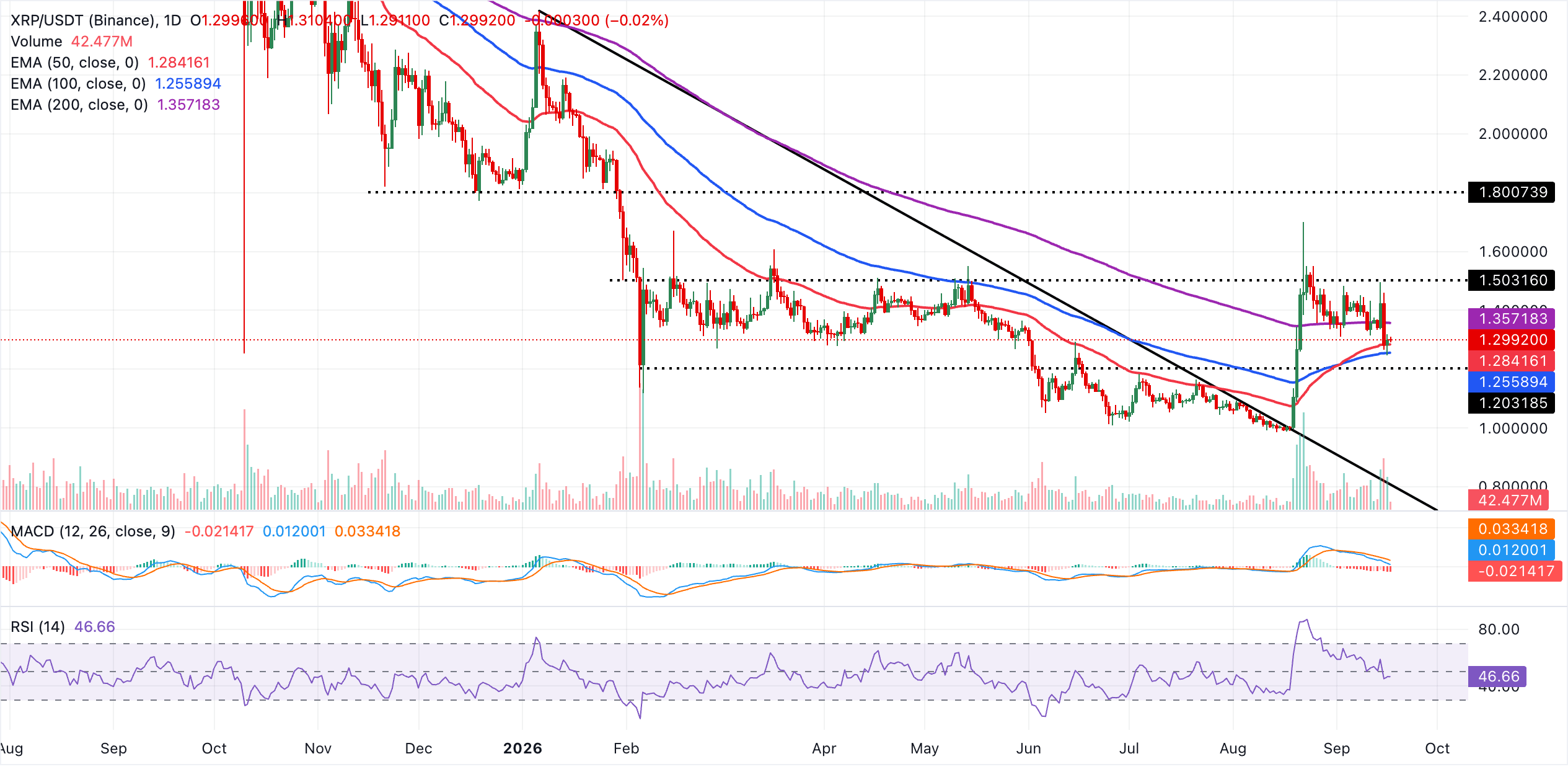
Immediate resistance is defined by the 200-day EMA near $1.36, where sellers are likely to reassert pressure if price extends higher. On the downside, initial support is offered by the 50-day EMA at $1.28, followed by a deeper cushion at the 100-day EMA near $1.26. A daily close below these moving averages would tilt the near-term bias decisively bearish and expose a more pronounced corrective phase.
(The technical analysis of this story was written with the help of an AI tool. Know more.)
Cryptocurrency metrics FAQs
The developer or creator of each cryptocurrency decides on the total number of tokens that can be minted or issued. Only a certain number of these assets can be minted by mining, staking or other mechanisms. This is defined by the algorithm of the underlying blockchain technology. On the other hand, circulating supply can also be decreased via actions such as burning tokens, or mistakenly sending assets to addresses of other incompatible blockchains.
Market capitalization is the result of multiplying the circulating supply of a certain asset by the asset’s current market value.
Trading volume refers to the total number of tokens for a specific asset that has been transacted or exchanged between buyers and sellers within set trading hours, for example, 24 hours. It is used to gauge market sentiment, this metric combines all volumes on centralized exchanges and decentralized exchanges. Increasing trading volume often denotes the demand for a certain asset as more people are buying and selling the cryptocurrency.
Funding rates are a concept designed to encourage traders to take positions and ensure perpetual contract prices match spot markets. It defines a mechanism by exchanges to ensure that future prices and index prices periodic payments regularly converge. When the funding rate is positive, the price of the perpetual contract is higher than the mark price. This means traders who are bullish and have opened long positions pay traders who are in short positions. On the other hand, a negative funding rate means perpetual prices are below the mark price, and hence traders with short positions pay traders who have opened long positions.
Author

John Isige
FXStreet
John Isige is a seasoned cryptocurrency journalist and markets analyst committed to delivering high-quality, actionable insights tailored to traders, investors, and crypto enthusiasts. He enjoys deep dives into emerging Web3 tren