Market Wrap: Sentiment away from risk sends Bitcoin toward $30k

Bitcoin is at risk of breaking its $30K support level.
Bitcoin traded lower on Monday, mirroring declines in traditional markets as investors pull away from risky assets because of concerns about weaker monetary and fiscal stimulus and rising COVID-19 cases, including those caused by the Delta variant.
Bitcoin was trading at around $30,600 at press time and is down about 3% over the past 24 hours. The world’s largest cryptocurrency is up about 4% year to date, compared with a roughly 12% return for the S&P 500 Index.
Latest prices
Cryptocurrencies:
- Bitcoin (BTC) $30755.8, -2.78%
- Ether (ETH) $1825.6, -3.96%
Traditional markets:
- S&P 500: 4258.7, -1.58%
- Gold: $1811, -0.05%
- 10-year Treasury yield closed at 1.2%, compared with 1.294% on Friday
Macro and regulatory headwinds
Regulatory scrutiny regarding stablecoins is also weighing on cryptocurrencies. The People’s Bank of China (PBOC) issued a white paper on Friday outlining initial research for the nation’s digital currency project, which appears to challenge existing cryptocurrencies and stablecoins.
“Cryptocurrencies are mostly speculative instruments, and therefore pose potential risks to financial security and social stability,” the PBOC’s white paper stated.
“Some commercial institutions even plan to launch global stablecoins, which will bring three risks and challenges to the international monetary system, payment and clearing system, monetary policies, cross-border capital flow management, etc.,” the report said.
Another source of selling pressure across risk assets could be the reduction of government stimulus. “Too much stimulus breeds complacency,” MRB Partners wrote in a research note published on Friday.
MRB also noted widespread asset price inflation, which can lead to market imbalances similar to an episode in Japan in the 1980s that preceded a decade of low investment returns.
Bitcoin market parallels
The chart below shows bitcoin’s current range, which is similar to the sideways pattern of between $5,900 and $7,400 in 2018. The previous range, although more volatile than the current pattern, preceded a nearly 45% sell-off, which extended the bear market until prices recovered in mid-2019.
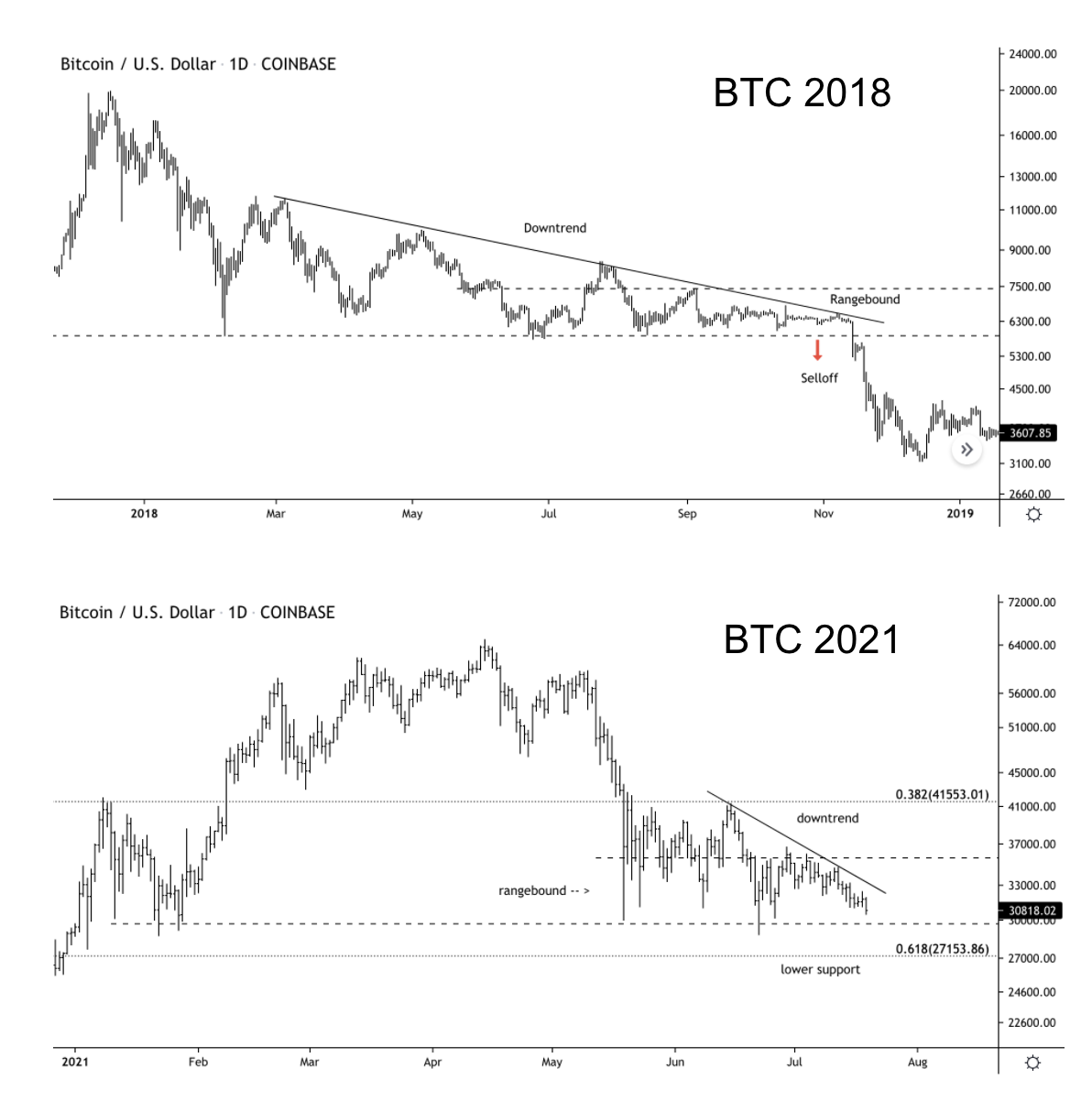
Charts show bitcoin's price range in 2018 and 2021.
Source: TradingView
A decline was also seen in ether (ETH) below the $400 price level in 2018, similar to the drop to below $2,000 last week.
Bitcoin volatility trap
Bitcoin’s near-term volatility is starting to rise after declining from peak levels in June. Some analysts expect selling pressure could increase, causing bitcoin to break below $30,000 support.
“Front-end vols have been hit the hardest, creating a very steep volatility term structure,” QCP Capital wrote in a Telegram chat. “It makes sense to roll short July positions to September given the significant dip in front-end vols.”
“Front-end vols” refers to “short-term volatility.”
“Bitcoin volatility has started to spike up and is trading close to 80% for July expiry,” Pankaj Balani, CEO of Delta Exchange, wrote in an email to CoinDesk. “We can see sharp moves on the downside if BTC breaks below $30,000 convincingly.”
Balani also noted that options sellers have become more aggressive as bitcoin trades in a tight range. There has been more put writing at $30,000 and $32,000 strikes on the downside, he said.
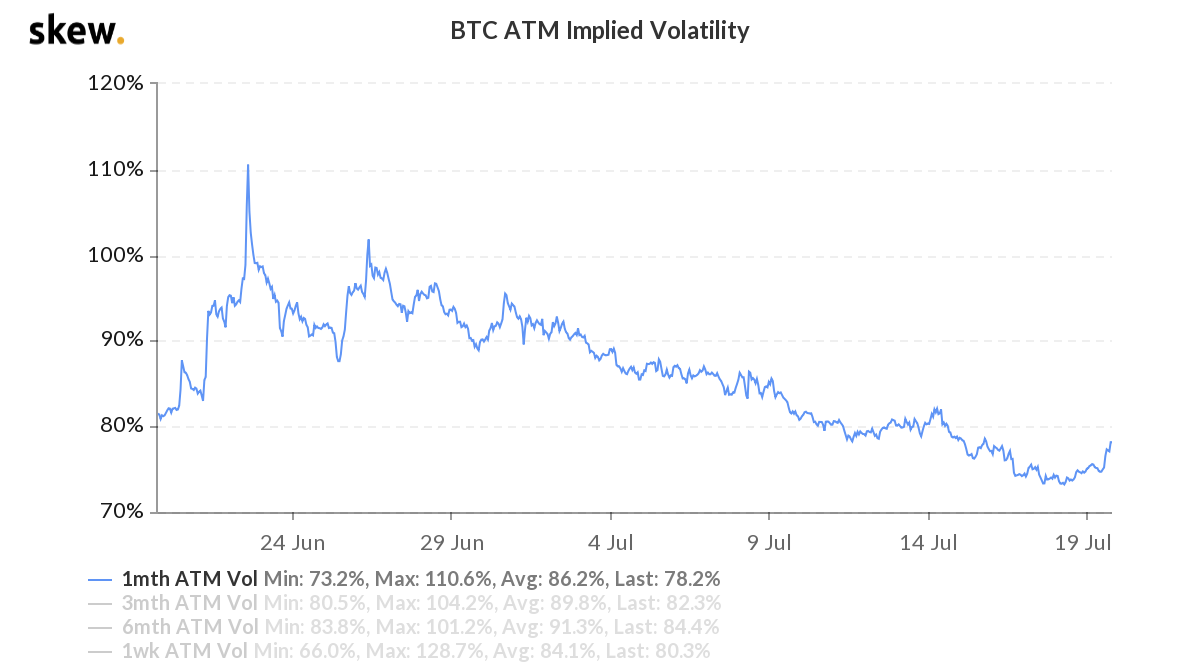
Chart shows the recent uptick in BTC one-month implied volatility.
Source: Skew
Ethereum funds capture inflows
Digital-asset funds have attracted capital over the past two weeks, albeit at a slower pace as investors remain cautious after the crypto crash in May. It appears that investors are warming up to ether, which saw a third consecutive week of inflows, totaling $11.7 million, according to a report by CoinShares.
Stablecoin regulations
As the President’s Working Group on Financial Markets discusses stablecoins at a meeting today, debates about how stablecoins should be regulated heated up. CoinDesk Columnist JP Koning wrote that regulators may have contributed to the fast growth of stablecoin supply because of their failure to close the “pseudonymity loophole” in such financial products earlier.
In an academic paper titled “Taming Wildcat Stablecoins” released Saturday, Yale economist Gary Gorton and U.S. Federal Reserve attorney Jeffery Zhang said that without proper regulation, the world of stablecoins could evolve into one reminiscent of the 19th century’s free banking period in the U.S.
It is not the first time for the analogy to be used, and Nic Carter, another CoinDesk columnist explained why.
Altcoin roundup
- Polygon Launches New Unit: Polygon has launched Polygon Studios, a unit that aims to advance blockchain gaming and non-fungible tokens (NFTs). The unit will help "bridge the gap between Web 2 and Web 3 gaming," according to Polygon. The division will look to attract big brands and franchises looking to launch games and NFTs.
- Grayscale Unveils DeFi Fund: Grayscale, the largest cryptocurrency investment manager, said Monday it has started a fund focused on decentralized finance (DeFi) tokens, based on a new DeFi-specific index produced by CoinDesk’s TradeBlock division. The companies, both subsidiaries of CoinDesk parent Digital Currency Group (DCG), wrote in a joint press release the Grayscale DeFi Fund provides “exposure to a selection of industry-leading DeFi protocols through a market-capitalization weighted portfolio.”
- ARK Investment Increases Square Holdings: ARK Investment Management increased its holdings of payments services firm Square after Jack Dorsey, Square's founder, announced Friday the company is creating an “open developer platform.” Following the announcement, Cathie Wood's New York-based ARK Investment purchased a total of 225,937 shares of Square, according to its daily holding files.
Other markets
All digital assets on CoinDesk 20 ended up lower on Monday.
Notable losers:
the graph (GRT) -8.56%
polkadot (DOT) -7.98%
aave (AAVE) -7.12%
Author

CoinDesk Analysis Team
CoinDesk
CoinDesk is the media platform for the next generation of investors exploring how cryptocurrencies and digital assets are contributing to the evolution of the global financial system.



