Ethereum's monopoly on the NFT market is coming to an end: Three main competitors

After the May correction, the NFT market is actively recovering. The trading volume of NFT tokens in July 2021 returned to the indicators of February, when the popularity of non-interchangeable tokens was approaching peak levels. Whether the market will be able to return to previous indicators or even set records and what factors are holding back the development of the NFT sector will be discussed below.
Ethereum can't cope with the load
The NFT market is recovering and continues to gain popularity. According to the Nonfungible resource, since the beginning of July, 184,604 NFTs have been sold for a total amount of over $ 161 million.
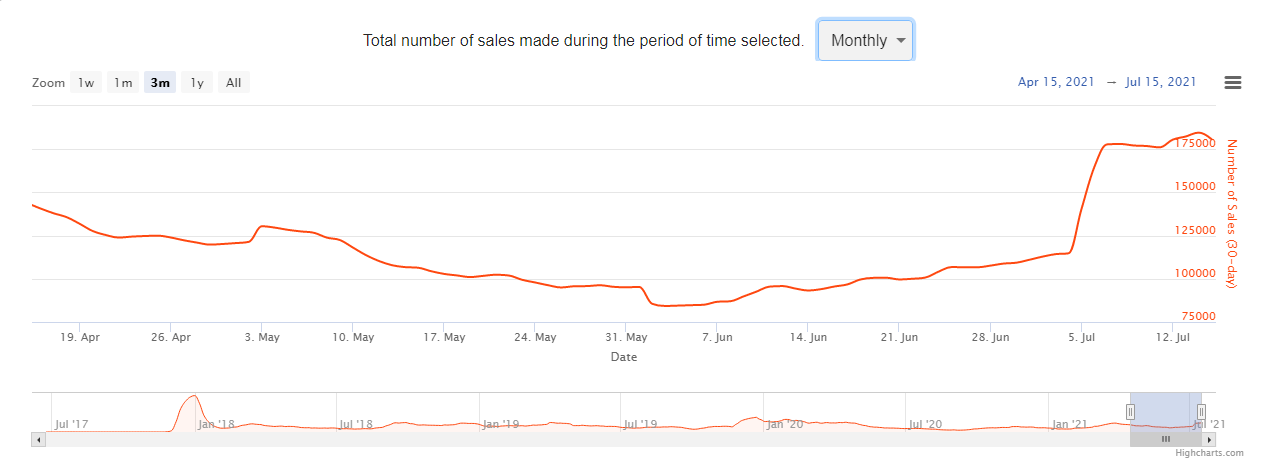
NFT sales have returned to the indicators of March 2021, and the market itself is ready to set a new record for the volume of token sales. But there are several problems that hinder the development of the sector.
One of the main barriers that negatively affects the development of the NFT market remains the congestion of the Ethereum blockchain. Almost all NFTs are minted on the Ethereum blockchain, which was not designed to handle such high transaction volumes as it is experiencing now. The network can process only 15 transactions per second, and as requests keep accumulating in the mempool, and users have to pay higher and higher gas fees to get their token transfers processed. It doesn’t help that the price of ether (and, therefore, gas) more than tripled in 2021.
In April and May 2021, the average Ethereum transaction fee ranged from $8 to $70. The fee for minting an NFT is much higher, since it’s a more complex transaction. Network congestion has gotten worse, too, meaning that creating and trading NFTs has become both very expensive and painfully slow.
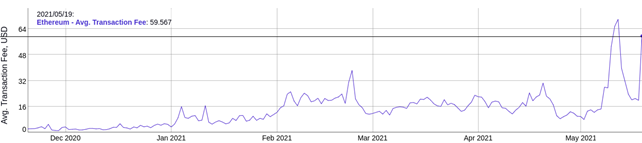
Source: Bitinfocharts
In April and May 2021, the average Ethereum transaction fee ranged from $8 to $70. The fee for minting an NFT is much higher, since it’s a more complex transaction. Network congestion has gotten worse, too, meaning that creating and trading NFTs has become both very expensive and painfully slow.
NFT marketplaces like OpenSea try to solve the problem by offering gasless minting, but you’ll still need to pay gas fees when accepting offers, canceling bids, etc.
Ethereum’s transition to Proof-of-Stake is still a long way away, so for now the only realistic solution is to use other blockchains that support NFTs, such as Polkadot, Binance Smart Chain, Solana, and Elrond.
A possible solution to the problem will be the use of innovative blockchains to create NFTs that will offer minimal gas commissions, as well as favorable terms of cooperation for users and sellers. Already today, at least three other blockchains can become an alternative to Ethereum.
Cheaper and faster: where to sell NFT today
When choosing a platform for creating and selling NFT, it is necessary to take into account the technical characteristics of the blockchain, the amount of commissions, the functionality of the platform, as well as its popularity among users. Ideally, choose NFT sites that have their own ecosystem. We have selected three interesting projects - ranging from a full-scale digital metaverse to an auction protocol – that will soon make NFTs available outside of the Ethereum ecosystem.
Sensorium Galaxy
Sensorium Galaxy is a massive digital metaverse that will feature virtual concerts by the leading artists, dance shows, mindfulness sessions, art exhibitions, quests, and many other activities in its many worlds.
The first world of the digital metaverse, PRISM, will be released in fall 2021, and that’s when the first virtual concerts should take place, too. Today, the project is supported by such celebrities as David Guetta and Armin van Buuren, while the avatars were designed by the well-known 3D artist Jason Ebeyer. A concert setting in the PRISM world
The platform will feature its own NFT marketplace for user-generated NFT content. All the fees for minting NFTs, listing them on the marketplace, accepting bids from other users, etc. will be payable in SENSO.
Burnt Finance (Solana)
Injective Protocol, the team behind the decentralized auction protocol Burnt Finance, chose a very unusual way to attract attention. It bought and burned – literally – a print by the famous artist Banksy and then sold it as an NFT.
The actual BurntFinance protocol will allow users to mint NFTs and launch an unlimited number of decentralized auctions. Solana was chosen due to its fast-growing ecosystem, near-zero fees, and exceptionally high throughput (up to 50,000 tps).
In order to make it possible to use ETH and ERC-20 tokens to buy NFTs, BurntFinance will be integrated with Solana Wormhole, a bidirectional Ethereum bridge. The protocol is expected to launch before the end of 2021.
BSC Station (Binance Smart Chain)
Binance Smart Chain, or simply BSC, rapidly gained traction in 2021 after Ethereum gas fees became too high for many retail users. Unlike Solana and Polkadot, BSC is centralized with a narrow set of 21 validators who have staked at least 10,000 BNB each.
Though the centralization aspect raises some concerns within the blockchain community, BSC is undeniably more cost-efficient and scalable than Ethereum. Moreover, it’s compatible with Ethereum’s virtual machine and with the popular MetaMask wallet, so both developers and end users have no trouble adapting to the BSC environment.
BSC Station is a mixed DeFi and NFT infrastructure that allows users to create three types of NFT auctions: Dutch, English, and sealed bid. It also features an AMM (automated market making) service for swapping between NFTs and BEP-20 assets.
Conclusion
Ethereum is still the primary home of NFTs, but perhaps not for long. As pioneering projects like SENSO begin offering non-fungible tokens in other ecosystems, such as Polkadot and Solana, users will realize that minting and trading NFTs is simply much cheaper and faster elsewhere. At this point, Ethereum may start losing its first-mover advantage – at least until the transition to Proof-of-Stake and Eth 2.0, but that can take a very long time.
Author

Tanvir Zafar
Independent Analyst
Tanveer Zafar is an experienced writer passionate about covering topics about Blockchain, Cryptocurrency and Markets. He has five years of writing experience in these areas of interest.