Dogecoin Price Forecast: DOGE risks broadening fall amid ETF outflows, growing bearish bets
- Dogecoin slides below $0.0800, highlighting a weak technical outlook and support structure.
- Dogecoin spot ETFs recorded mild outflows of $139K on Wednesday, as futures Open Interest moderates.
- Dogecoin continues to face higher bearish odds, defined by declining moving averages and momentum indicators.

Dogecoin (DOGE) extends its correction and trades at $0.0789 amid heavy selling on Thursday. The $0.0800 supply limits the meme coin’s upside and constrains any recovery attempts. Persistent inflation concerns and a lack of compelling market catalysts have also driven investors to reassess their risk appetite.
Dogecoin ETFs see renewed outflows
Hotter-than-expected United States (US) inflation is weighing on digital assets. According to the Consumer Price Index (CPI), headline inflation rose to 3.7% in September, above forecasts of 3.6% and August’s 3.4% print.
With the Federal Reserve’s (Fed) monetary policy decision on the horizon, persistently high inflation, driven by elevated Oil and energy prices, may sustain macroeconomic uncertainty and reinforce risk-off sentiment across the market.
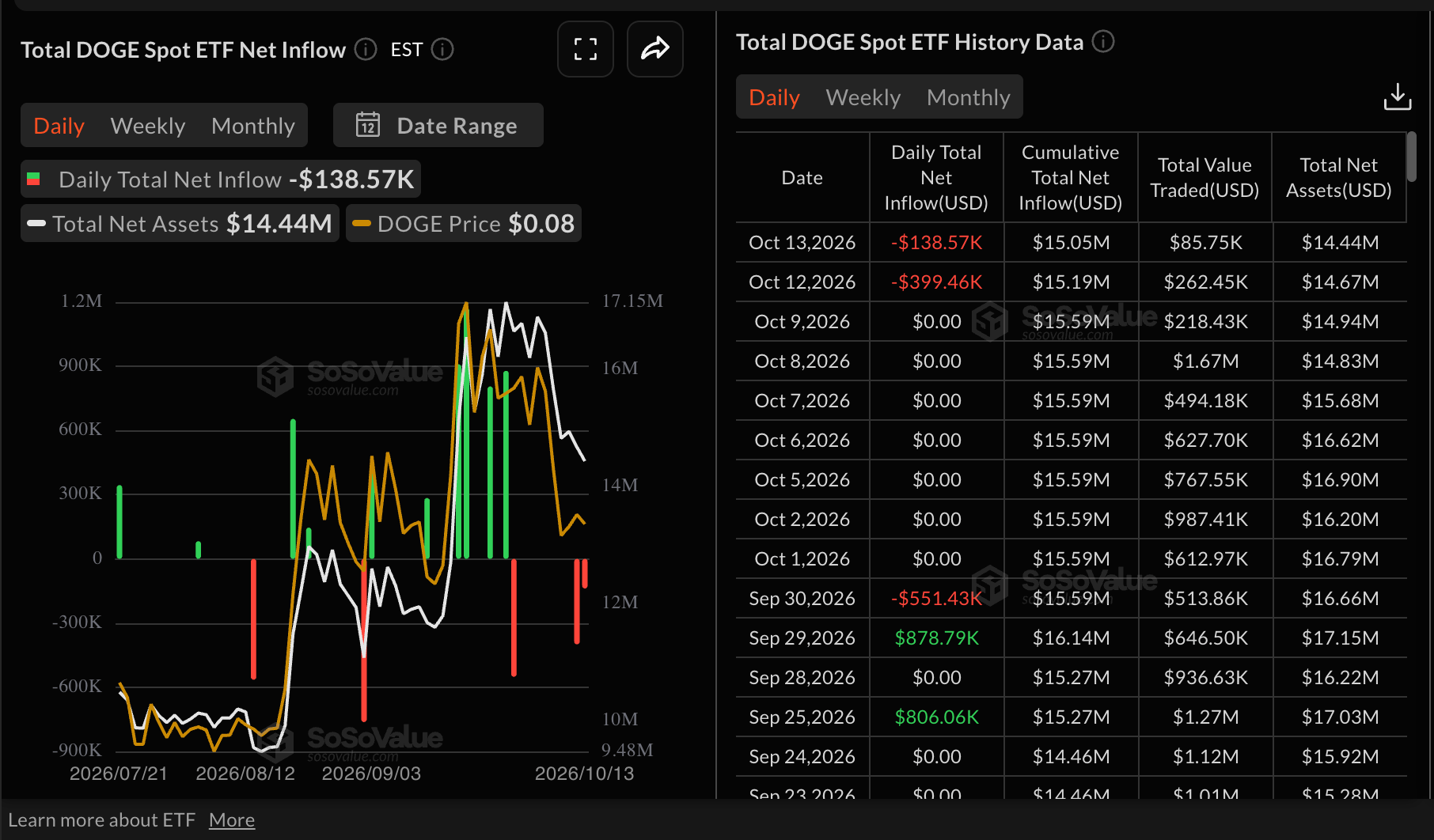
Dogecoin spot Exchange-Traded Funds (ETFs) recorded fresh outflows of roughly $139,000 on Wednesday and $399,000 the day before, reinforcing risk-off sentiment. Despite DOGE ETFs struggling to attract steady demand, cumulative inflows stand at $15 million, with net assets under management at $14 million.
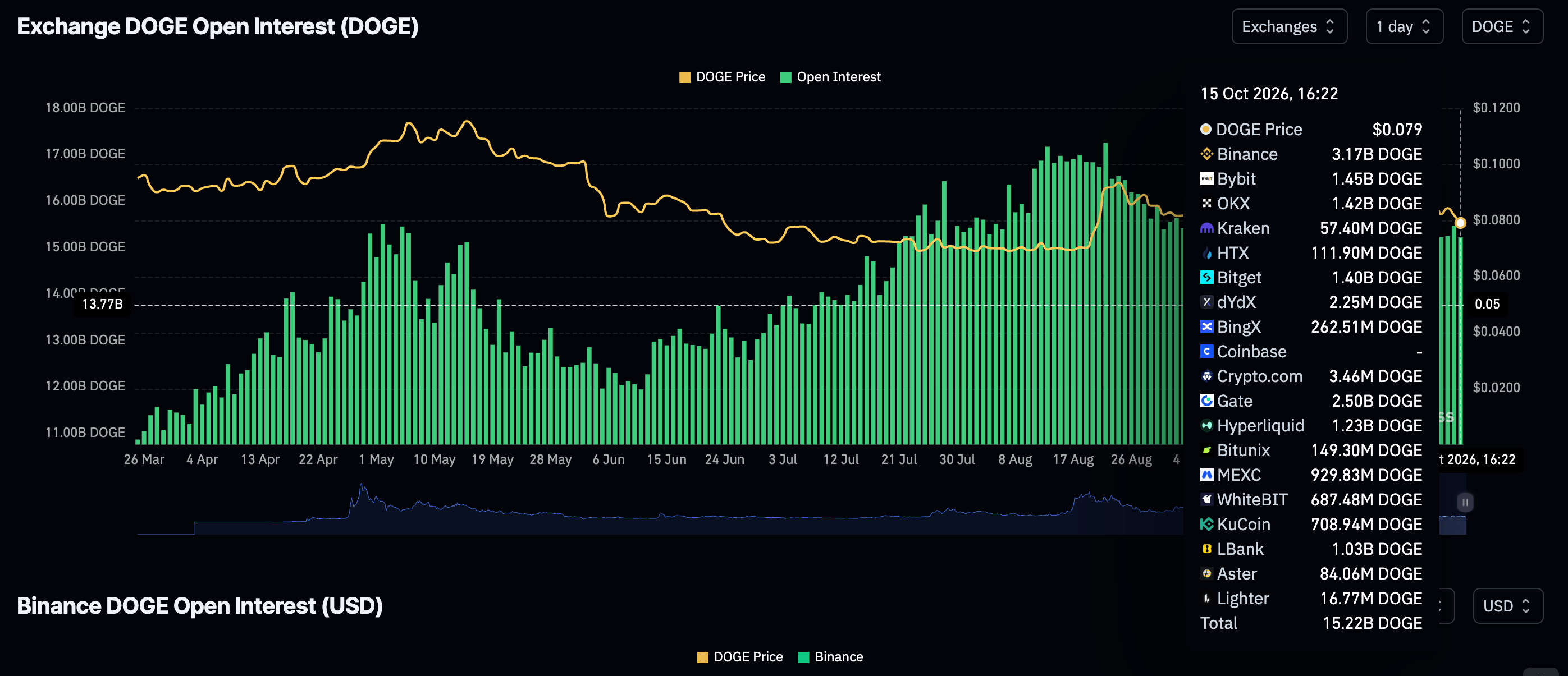
The derivatives market, meanwhile, sends mixed signals, with futures Open Interest (OI) at $15.2 billion DOGE on Thursday, down from 15.5 billion DOGE the day before, according to CoinGlass. Current OI sits below October highs of 16.6 billion DOGE, undermining retail demand.
Technical analysis: Dogecoin sellers retain control
Dogecoin trades at $0.0789, maintaining a bearish near-term bias as price sits beneath all major Exponential Moving Averages (EMAs). The 100-day EMA at $0.0859 and the 50-day EMA at $0.0871 hover overhead, hinting at a capped recovery, while the longer-term 200-day EMA at $0.0928 and the SuperTrend line at $0.0937 reinforce the broader downside structure.
Momentum remains weak, with the Moving Average Convergence Divergence (MACD) below zero and its signal line, and the Relative Strength Index (RSI) sliding toward oversold territory near 35, suggesting persistent selling pressure even if short-term bounces emerge.
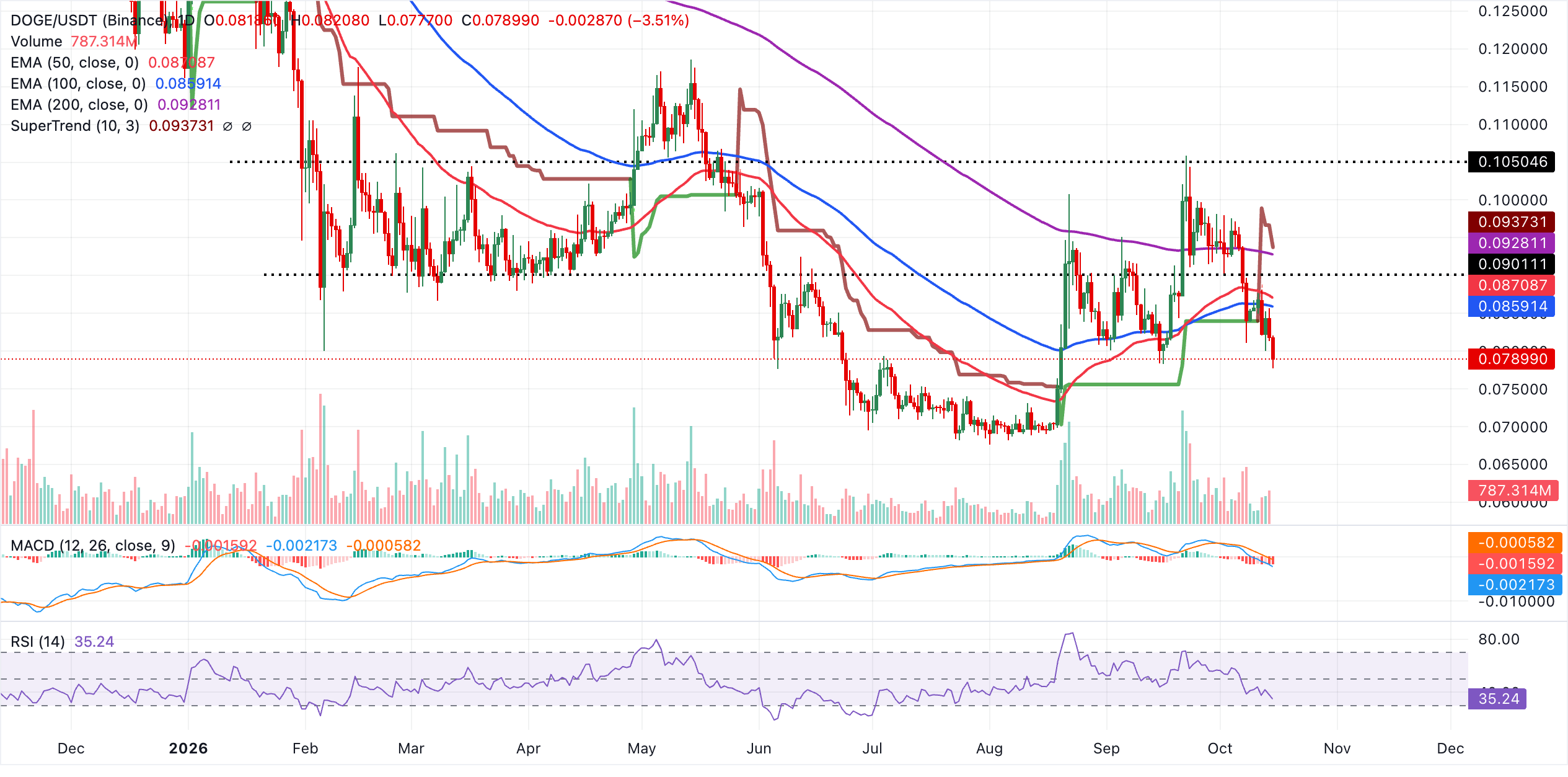
Immediate resistance lies at the 100-day EMA at $0.0859, followed closely by the 50-day EMA at $0.0871, forming a nearby supply band that bulls would need to reclaim to ease the current pressure. A more substantial bullish attempt would face the 200-day EMA at $0.0928 and the SuperTrend barrier at $0.0937, where a rejection would likely preserve the prevailing downtrend.
With no clear technical support levels on the daily chart, traders would need to rely on previously tested psychological levels at 0.0750 and $0.0700.
The bearish theme continues in the weekly timeframe, with Dogecoin holding below the 50‑week EMA at $0.1086, the 100‑week EMA at $0.1310, and the 200‑week EMA at $0.1335, hinting at a capped broader trend.
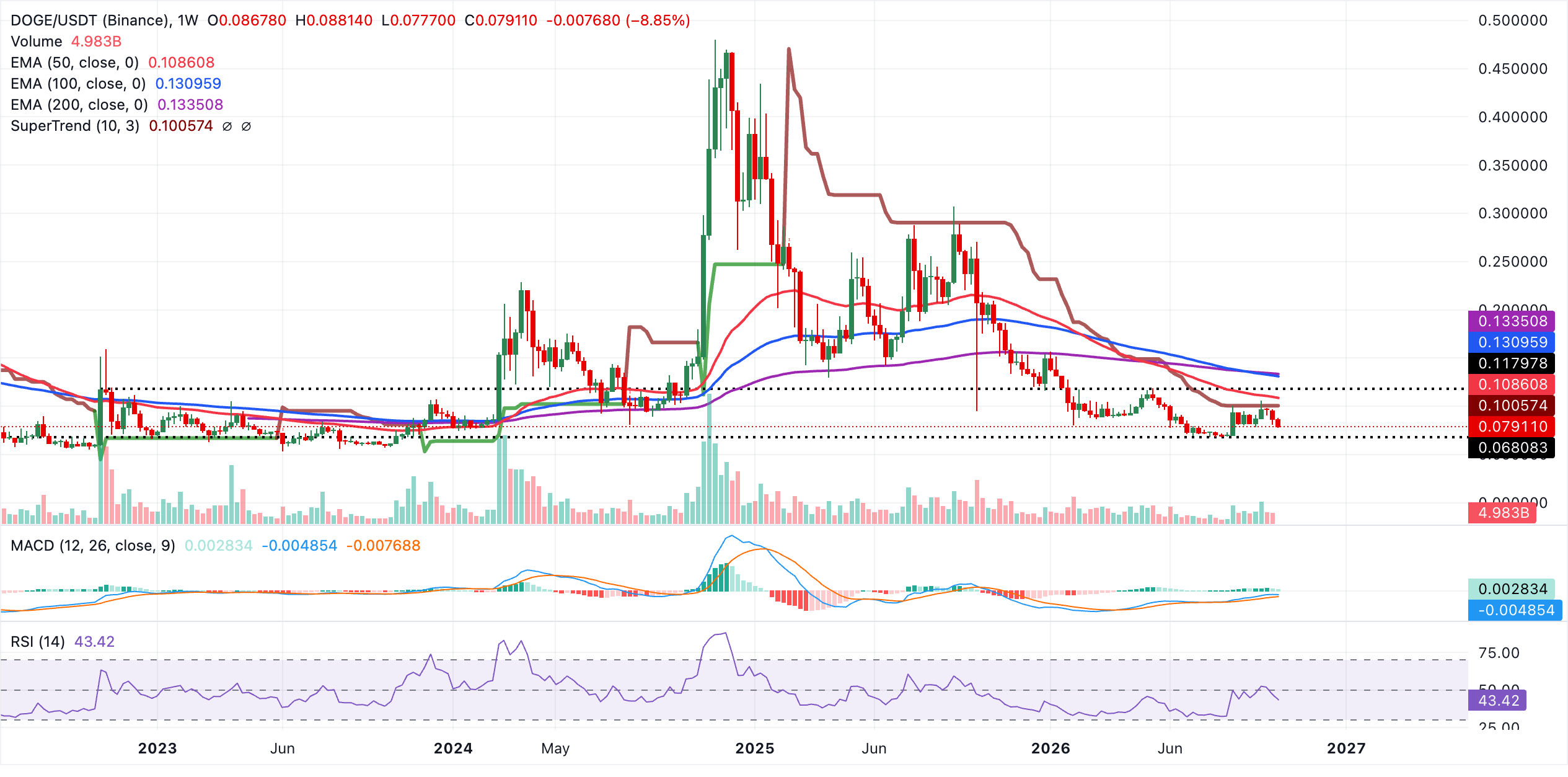
Meanwhile, the MACD remains marginally positive and the RSI hovers in the mid-range near 43, suggesting only modest bearish momentum rather than outright capitulation.
(The technical analysis of this story was written with the help of an AI tool. Know more.)
Crypto ETF FAQs
An Exchange-Traded Fund (ETF) is an investment vehicle or an index that tracks the price of an underlying asset. ETFs can not only track a single asset, but a group of assets and sectors. For example, a Bitcoin ETF tracks Bitcoin’s price. ETF is a tool used by investors to gain exposure to a certain asset.
Yes. The first Bitcoin futures ETF in the US was approved by the US Securities & Exchange Commission in October 2021. A total of seven Bitcoin futures ETFs have been approved, with more than 20 still waiting for the regulator’s permission. The SEC says that the cryptocurrency industry is new and subject to manipulation, which is why it has been delaying crypto-related futures ETFs for the last few years.
Yes. The SEC approved in January 2024 the listing and trading of several Bitcoin spot Exchange-Traded Funds, opening the door to institutional capital and mainstream investors to trade the main crypto currency. The decision was hailed by the industry as a game changer.
The main advantage of crypto ETFs is the possibility of gaining exposure to a cryptocurrency without ownership, reducing the risk and cost of holding the asset. Other pros are a lower learning curve and higher security for investors since ETFs take charge of securing the underlying asset holdings. As for the main drawbacks, the main one is that as an investor you can’t have direct ownership of the asset, or, as they say in crypto, “not your keys, not your coins.” Other disadvantages are higher costs associated with holding crypto since ETFs charge fees for active management. Finally, even though investing in ETFs reduces the risk of holding an asset, price swings in the underlying cryptocurrency are likely to be reflected in the investment vehicle too.
Author

John Isige
FXStreet
John Isige is a seasoned cryptocurrency journalist and markets analyst committed to delivering high-quality, actionable insights tailored to traders, investors, and crypto enthusiasts. He enjoys deep dives into emerging Web3 tren




