Ethereum holders could be in trouble if Voyager sells $151 million ETH in its holdings
- Bankrupt crypto lender platform Voyager has reportedly offloaded $350 million worth of assets over the last six weeks.
- The company still has $151 million in ETH and roughly $50 million in Shiba Inu Coin, which could hit the exchanges, triggering another sell-off.
- On-chain metrics show a strong selling pressure for the smart contract token was noted on the US exchange Coinbase as opposed to Binance.

Ethereum (ETH) price faces considerable downside pressure due to the bearish market sentiment. The bankrupt crypto lender Voyager is creating additional sell-side pressure by offloading its crypto holdings. A recent report from Arhkham Intel noted that the defunct crypto platform has been on a selling spree for the last six weeks. Currently, its wallets include $151 million worth of Ether (ETH) and $50 million worth of Shiba Inu Coin (SHIB) tokens, both of which will likely be sold in the coming days, considering its six-week history.
Also read: Why bankrupt crypto lender Voyager sold Ethereum while sitting on 5.17 Trillion Shiba Inu holdings?
Voyager to sell $151 million Ether
The defunct crypto lender Voyager has been offloading its holdings for the last six weeks, and it is likely going to continue doing so. As noted by Arkha, Intel, the company sold $100 million worth of ETH in March, $25 million SHIB and $11 million worth of the platform’s native token VGX.
As of March 11, Voyager holds $750 million worth of assets in its coffers, with Circle’s USDC stablecoin making up $488 million. Additionally, the lender holds $151.22 million in ETH, $49.53 million in VGX, and $41.4 million in SHIB, all of which are at risk of a sell-off.

Voyager holdings
The bankrupt crypto lender seems to have begun its selling activity long before the US Bankruptcy Judge Michael Wiles approved Binance’s $1.3 billion bid to purchase Voyager. The restructuring deal with Binance will allow customers to withdraw their funds using the Binance US exchange.
Also read: SEC files objection to Binance – US bid for Voyager assets
Will Ethereum price crash again?
Currently, Ethereum price has slid below the 200-day Exponential Moving Average (EMA) and hovers at $1,419, which is just above the 200-day Simple Moving Average (SMA) at $1,385. Additionally, ETH has dipped into the weekly Fair Value Gap (FVG), extending from $1,501 to $1,296.
This inefficiency was created as a result of buying pressure imbalance in early January which resulted in a 27% upswing in under a week. As ETH retraces its steps and dips into this FVG, it will rebalance the inefficiency.
Considering that there is more room for rebalance, the chances of a quick recovery go out the window, at least for another week. Factoring in Voyager’s selling spree, Ethereum price is more than likely to tag the 200-day SMA at $1,385.
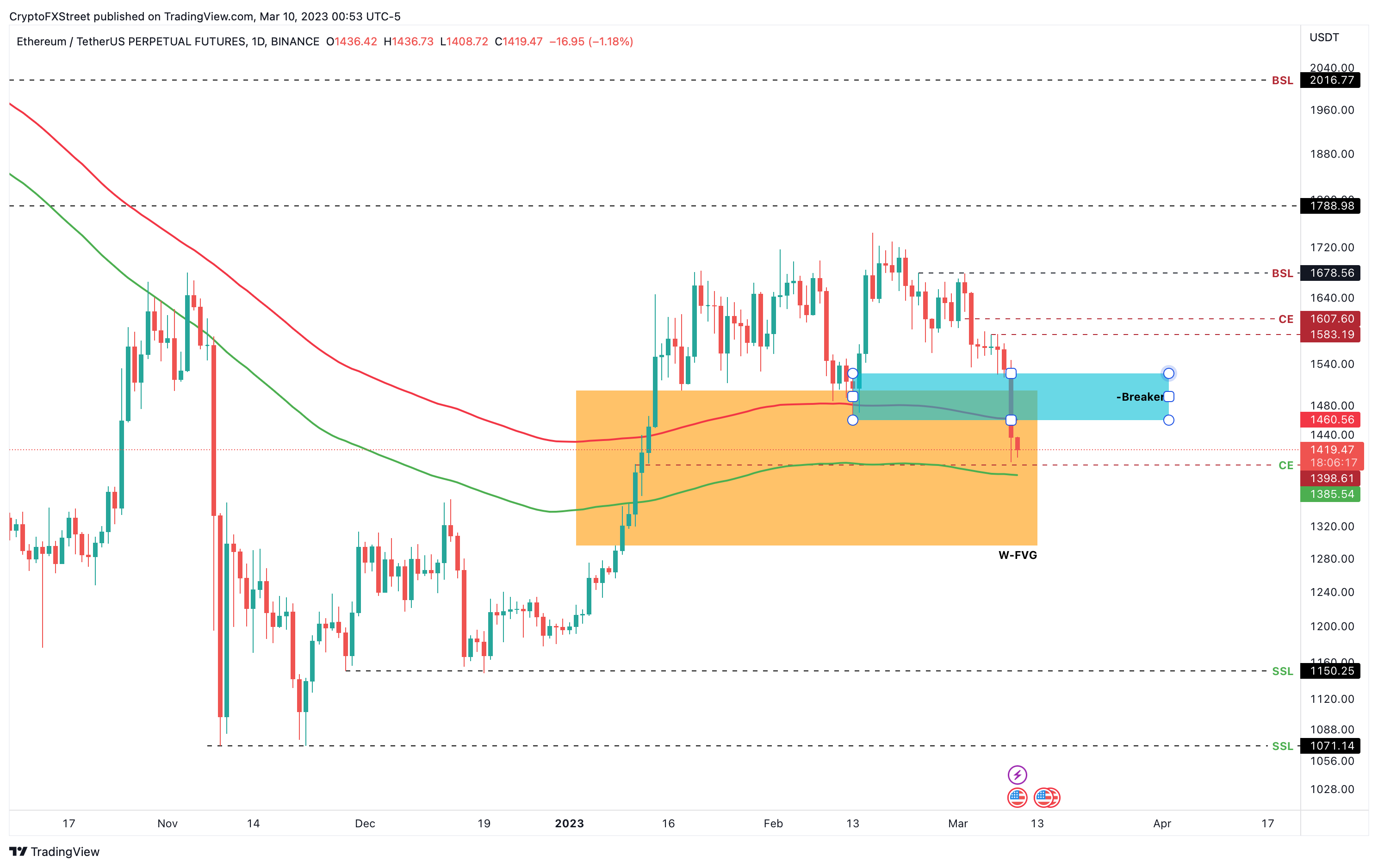
ETH/USDT 1-day chart
Ethereum selling pressure originates in Coinbase
Ethereum price crashed 9% on March 9, and it can be speculated that Voyager's $100 million selling spree could be one of the reasons for this crash. A clear sign can be noted by looking at the Ethereum premium metric by CryptoQuant. This index is the percent difference between the ETH-USD pair on Coinbase Pro and ETH-USDT pair on Binance price. A low premium indicates that the US investors are selling via Coinbase.
On March 10, this on-chain metric noted a drop to -0.282, indicating high selling pressure on Coinbase.
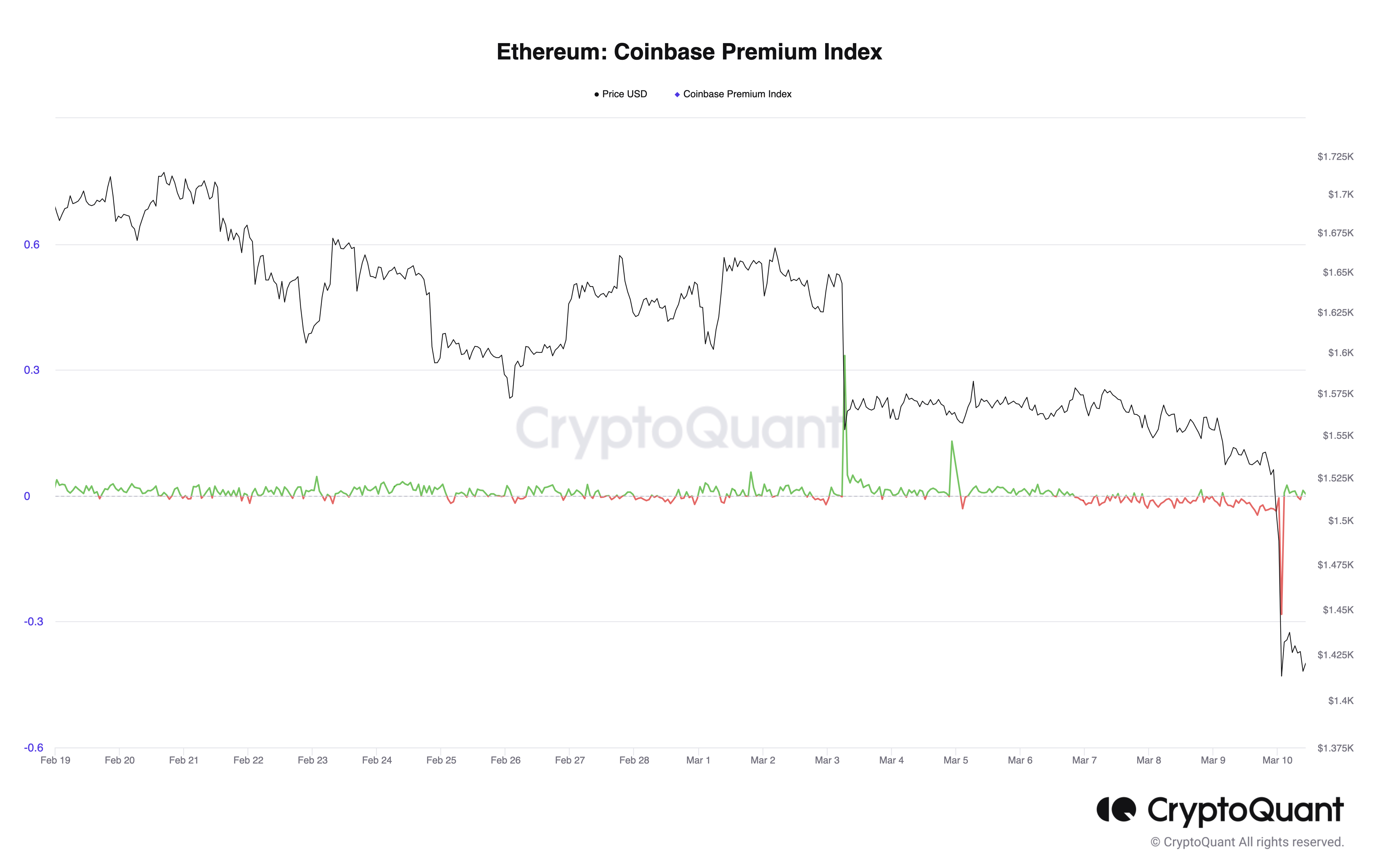
Ethereum Coinbase premium index
TRON founder Justin Sun moved $60 million in Ethereum-based stablecoins from his accounts on March 10 from the troubled Huobi exchange. The said funds were moved to Aave, a DeFi platform around the same time, the two exchanges under his control - Huobi and Poloniex announced plans to merge. Shortly after this news, Huobi token plummeted 73%.
Justin Sun has withdrawn ~$60 million in ethereum stablecoins from Huobi in the last 24 hours pic.twitter.com/4PE4iimp9z
— Nansen (@nansen_ai) March 10, 2023
Also read: Can Justin Sun's $100 million save Huobi exchange from FTX's fate?
Author

Akash Girimath
FXStreet
Akash Girimath is a Mechanical Engineer interested in the chaos of the financial markets. Trying to make sense of this convoluted yet fascinating space, he switched his engineering job to become a crypto reporter and analyst.