Chainlink Rebounds 14% in 24 hours backed by an institutional integration that goes beyond price
- Chainlink rebounded 14% in 24 hours driven by a major institutional integration.
- Canton Network adopted Chainlink's data infrastructure to power real-world asset tokenization.
- Grayscale's LINK trust surpassed $70 million while Bitcoin ETFs recorded net outflows.


Few assets in the current crypto market can separate their performance from the broader sector's behavior for any sustained period. Chainlink did exactly that this week, and the reasons behind the move point to something more concrete than short-term speculation.
LINK hit a low of $8.20 during the early hours of Tuesday UTC. Less than 24 hours later it traded at $9.35, with an intraday peak of $9.50 before settling around $9.25. The 14% advance in that window returns LINK to its highest levels since February 5 — and it happened in an environment where most assets outside Bitcoin either bleed losses or sit motionless.
Two concrete factors explain the impulse
The first is Chainlink's integration with Canton Network, one of the most consequential platforms in the real-world asset tokenization segment. The second is sustained institutional capital accumulation in financial products offering direct LINK exposure, precisely while Bitcoin ETFs shed billions in net outflows during the same period.
The Canton Network integration doesn't resemble a standard commercial agreement. What Chainlink brings to that platform includes equity price data streams, on-chain proof of reserves, and support for its Cross-Chain Interoperability Protocol, known as CCIP. Those components function as connective infrastructure between institutional financial systems and the blockchain records where tokenized assets operate.
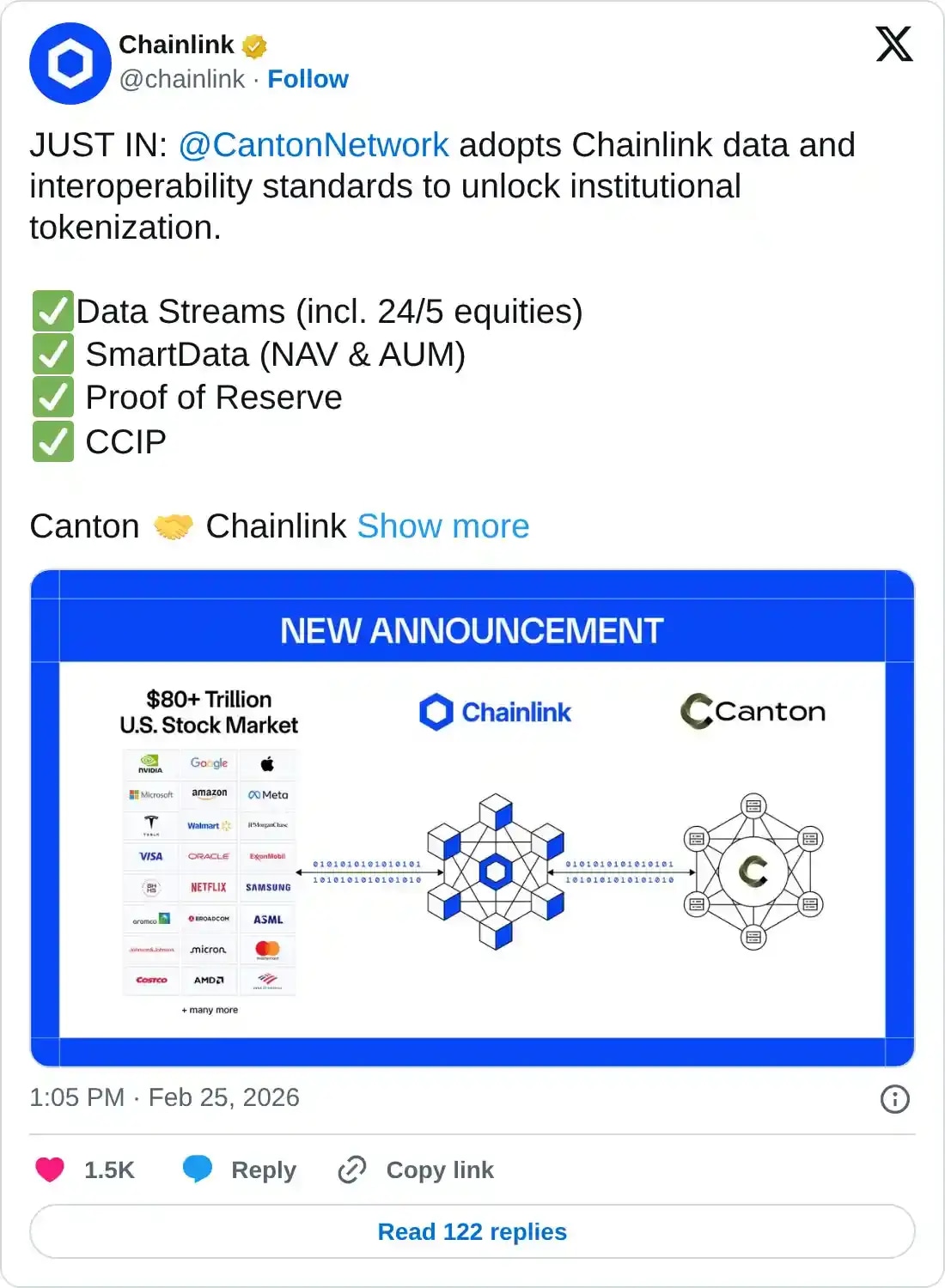
Canton Network works with large financial institutions moving real capital — not with experimental projects in early stages. When a network at that level builds on Chainlink's data infrastructure, it communicates something specific about the position the protocol occupies within the institutional architecture taking shape around digital assets.
The regulatory dimension adds another layer that institutional investors weigh carefully. In February alone, Taylor Lindman, former executive lawyer at Chainlink, joined the SEC's crypto task force, while founder and CEO Sergey Nazarov joined the CFTC's Innovation Advisory Committee.

Direct presence inside the bodies writing the rules of the sector isn't a cosmetic detail for funds that evaluate regulatory risk before building meaningful positions. It reduces a specific category of uncertainty that keeps large allocators on the sidelines.
Institutional capital flows and technical signals point in the same direction
Grayscale's Chainlink Trust (GLNK) now holds over $70 million in assets under management. Bitwise's CLNK manages more than $11 million. Both figures grow in a month when Bitcoin exposure products lose capital. When institutional flows move against the general market direction, the explanation is rarely emotional — it tends to be structural.
Chainlink's strategic reserves surpassed 2.17 million tokens, currently valued above $20 million. The protocol funds those purchases using revenue generated off-chain, directing service fees back into open market token purchases.
That mechanic continuously reduces available supply without depending on speculative narratives or newly minted token distributions. A project that buys its own token with real operating revenue operates under a fundamentally different logic than protocols that manufacture demand through inflation.

The Relative Strength Index moved from 34 to 50 within hours, exiting oversold territory and entering a neutral zone with upward momentum.
Open interest in perpetual contracts approaches $422 million, signaling that leveraged traders return to the market rather than reduce exposure. When both on-chain accumulation and derivatives positioning move in the same direction simultaneously, the probability of a momentum continuation rises above what either signal would suggest in isolation.
The key technical levels for the coming weeks carry practical significance
A LINK breakout above $10.00 would open the path toward resistance zones at $17.50 and then $25.00. A drop back below the 30-day moving average strips the current rally of its structural foundation. A close under $8.20 invalidates the bullish structure built this week and exposes local support around $7.50.

The most honest caveat surrounding the entire narrative is also the most important one. In the short to medium term, Chainlink doesn't operate in isolation. If Bitcoin suffers a meaningful decline, LINK will fall alongside it regardless of the quality of its integrations, the depth of its institutional flows, or the strength of its regulatory positioning.
The crypto market still punishes alternative assets indiscriminately when the reference asset loses ground. That correlation doesn't disappear because the fundamental case for an individual protocol improves.
Author
Isai Alexei
Independent Analyst
I am Isai Alexei. I work as a journalist and financial analyst covering cryptocurrency markets and traditional securities. I have spent ten years analyzing digital assets, trading activity, and market structure.