Chainlink 2.0 ambitious vision could propel LINK price to new highs
- Chainlink released a new whitepaper, Chainlink 2.0, dubbed as the ‘next steps in the evolution of decentralized finance.’
- The whitepaper details its ambitious vision for Chainlink 2.0 and introduces a new architecture for building hybrid smart contracts.
- LINK price establishes swing points and begins to range higher, aiming to retest current all-time highs.
-637336005550289133.jpg)
Chainlink recently announced its plans for Chainlink 2.0 via a whitepaper that elaborates on the team’s plans on what the future holds for the most widely used oracle in the cryptocurrency ecosystem. On the other hand, the LINK price seems to be gearing up for a move higher.
Redefining decentralized oracles
Chainlink, the pioneer of decentralized oracles, has without a doubt been the most used oracle network in the cryptocurrency space. While Chainlink focuses on securely feeding external data into the blockchain in a reliable manner, the latest whitepaper anticipates creating multiple Decentralized Oracle Networks (DON) that can bi-directionally transfer data and perform off-chain computing.
Put simply, Chainlink 2.0, to an extent, is similar to popular Layer-2 solutions.
The blog states,
Chainlink DONs are anchored to existing blockchains in order to periodically sync the data outputs and state changes computed off-chain, as well as establish guardrails that enforce correct oracle reports and arbitrate off-chain oracle disputes.
Additionally, the DONs will facilitate the creation of hybrid smart contracts that rely on already available on-chain code and merge with the off-chain computations.
All in all, the new proposed system will allow DONs to use a universal, blockchain-agnostic gateway for smart contracts to access off-chain resources and the impacts of this are wide-ranging.
Two significant impacts of Chainlink 2.0
Scaling is perhaps the most crucial byproduct of the proposed system. Due to hybrid smart contracts and off-chain computing, blockchains that are usually constrained due to cost and privacy will achieve scalability due to reduced on-chain loads.
Hence, with Chainlink 2.0, DONs will have low latency and high throughput.
Security will vastly improve due to the introduction of the super-linear staking concept that makes it harder for bad actors to manipulate the data.
LINK price embarks on journey to swing highs
Chainlink price set up a new all-time high at $44.37 and a swing low around the $33.27 level, which marked the start of a potential range-bound move. After tapping the swing lows on April 20, LINK has established a new demand zone that extends from $34.02 to $36.65.
A bounce from this zone could propel the oracle by 20%. Supporting this bullish move would be a potential spike in buying pressure, leading to a decisive close above the 50% Fibonacci retracement level at $38.82.
In this scenario, LINK could surge toward the all-time high at $44.37. However, investors should note that the upward trajectory could stop and slow down around the supply zone that stretches from $42.64 to $43.73.
If the buying pressure persists at the retest of the swing high, the 161.8% and the 200% Fibonacci extension levels at $51.23 and $55.47, respectively, will be the bulls’ next target.
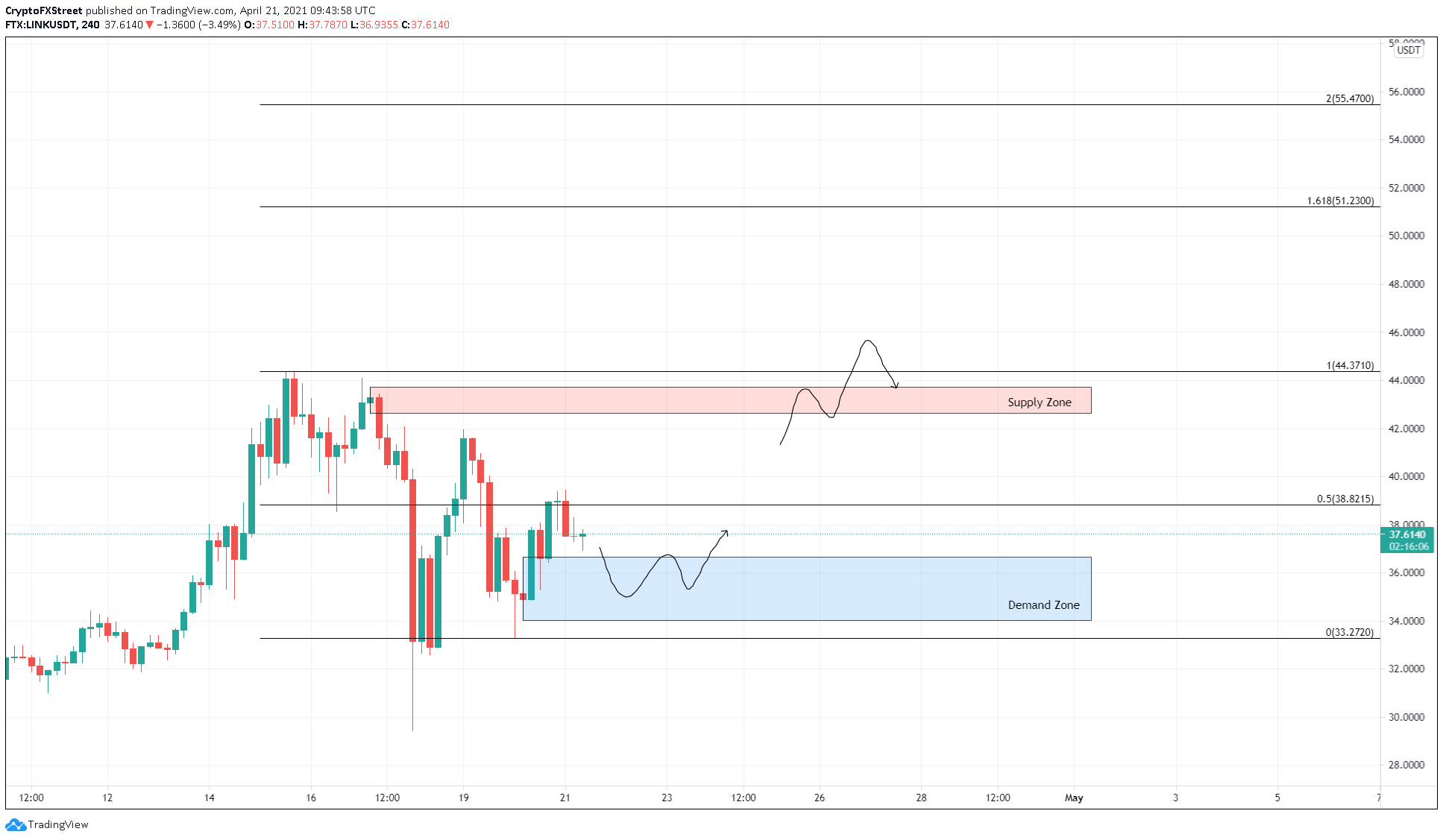
LINK/USDT 12-hour chart
On the flip side, if the sellers push the oracle token to break the demand zone’s lower layer at $34.06, this could signal a weakening buying pressure.
A decisive close below the swing low at $33.27 will invalidate the bullish thesis and start a new downtrend to $30.18.
Author

Akash Girimath
FXStreet
Akash Girimath is a Mechanical Engineer interested in the chaos of the financial markets. Trying to make sense of this convoluted yet fascinating space, he switched his engineering job to become a crypto reporter and analyst.