Bitcoin Price Forecast: Fed rate decision in focus as BTC attempts recovery
- Bitcoin price rebounds slightly on Wednesday after correcting by nearly 3% over the previous two days.
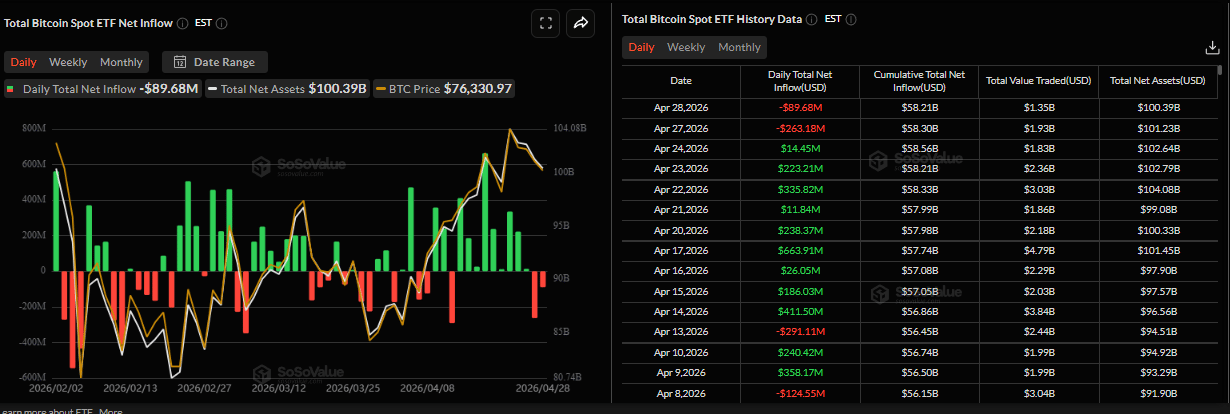
- US-listed spot Bitcoin ETF recorded a mild outflow of $89.68 million on Tuesday, marking the second consecutive day of withdrawals.
- Market participants now await the Fed’s rate decision on Wednesday, which could bring fresh impetus for risky assets such as BTC.

Bitcoin (BTC) price rebounds slightly, trading above $77,000 on Wednesday after declining by nearly 3% over the previous two days. Institutional demand recorded a mild outflow in spot BTC Exchange Traded Funds (ETFs) on Tuesday, marking the second consecutive day of withdrawals. Traders now remain focused on the US Federal Reserve (Fed) interest rate decision and its policy stance on Wednesday, which could play a key role in shaping the next directional move for Crypto King.
Fed interest rate decision could bring fresh impetus for Bitcoin
Bitcoin recovers slightly on Wednesday, trading above $77,000 during the European session, as traders remain hesitant and opt to wait for the crucial Fed monetary policy decision, due later this Wednesday.
The key focus will be on the post-meeting press conference, where comments from the outgoing US Federal Reserve (Fed) Chair Jerome Powell will be scrutinized for cues about the future policy path. The outlook, in turn, will play a key role in shaping near-term US Dollar (USD) price dynamics and provide fresh impetus to risky assets such as BTC.
Bitfinex analysts told FXStreet, “For Bitcoin, the transmission channel is clear: rates feed into yields and the DXY, which feeds into exchange-traded fund (ETF) flows and the Aggregate Exchange Reserve (AER), which feeds into price.”
The analyst noted, “A hawkish hold likely keeps ETF demand macro reactive and the price could fall and remain capped near the $72,100 squeeze zone unless flows improve. A dovish hold, where Powell acknowledges slower growth or avoids pushing back against future cuts, would be risk-positive and could allow ETF inflows and the AER to re-accelerate, opening the path toward the $80,000 to $84,000 region, where multiple confluence resistance levels have been identified over recent weeks.”
Traders should also note that, heading into the key central bank event, uncertainty over the second round of US-Iran peace talks has emerged as a short-term factor capping Bitcoin’s upside momentum, as geopolitical risks continue to dampen risk appetite across markets.
Hopes for diplomatic efforts to end the Iran war receded after US President Donald Trump canceled a planned visit to Pakistan of his special envoy Steve Witkoff and son-in-law Jared Kushner. Furthermore, media reports suggest that Trump is dissatisfied with Iran’s new proposal for ending the conflict and reopening the Strait of Hormuz, while setting aside discussions on the nuclear program.
Institutional demand shows early cautionary signs
Institutional demand started the week on a cautious note. SoSoValue data shows that Bitcoin spot ETFs recorded an outflow of $89.68 million on Tuesday, after $263.18 million in withdrawals on Monday, breaking a nine-day streak of positive flows since mid-April. Traders should be cautious, as if this outflow trend continues and intensifies this week, BTC could see further price corrections.
Bitcoin Price Forecast: BTC finds support around a key level
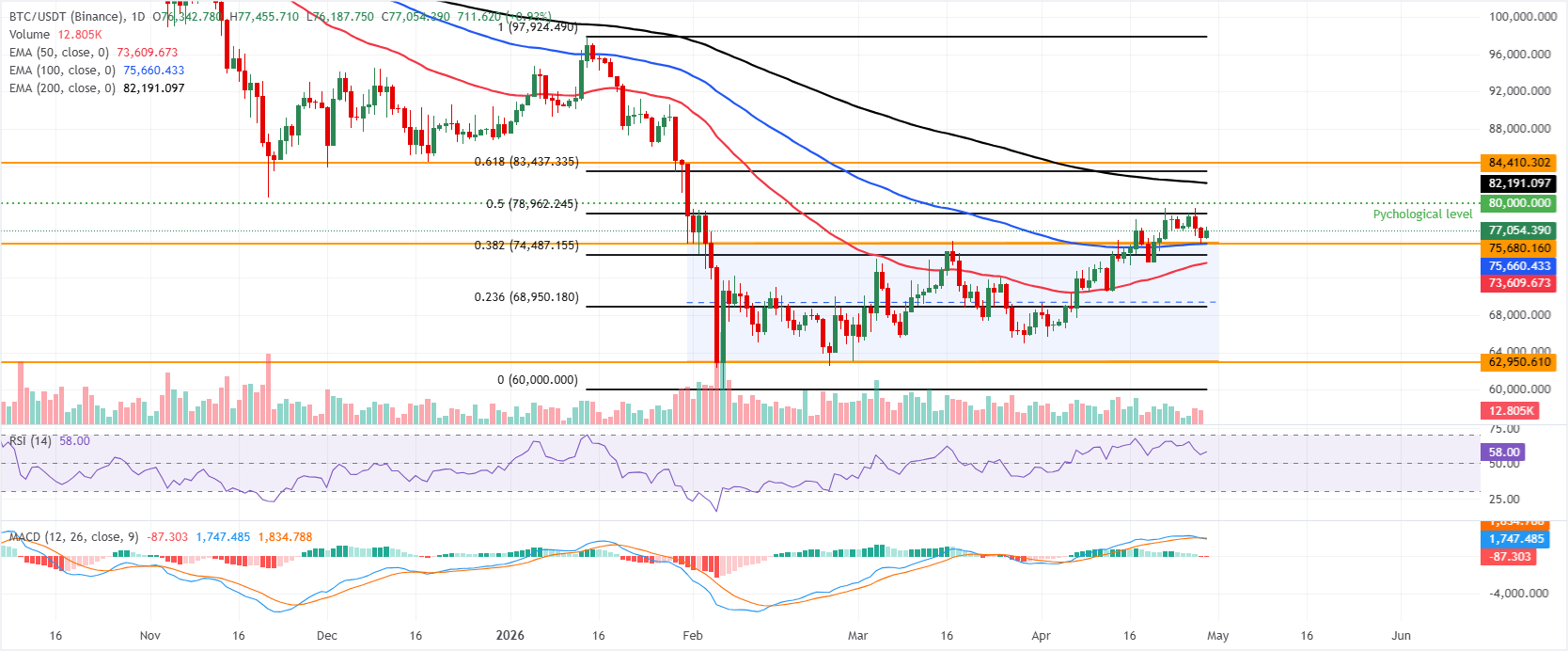
Bitcoin price recovers slightly above $77,000 on Wednesday, holding a constructive bullish bias as it sits above the 50-day and 100-day Exponential Moving Averages (EMAs) at roughly $73,609 and $75,660, respectively, and has also found support around the upper boundary of the parallel channel near $75,680 on Tuesday.
The Relative Strength Index (RSI) around 58 on the daily chart suggests moderate positive momentum, though the Moving Average Convergence Divergence (MACD) line has slipped below the signal line and shows a slightly negative histogram, hinting that upside may be slowing as price approaches a dense band of overhead resistance.
On the downside, immediate support is seen at the former channel top near $75,680, reinforced by the 100-day EMA at $75,660, with the 38.2% Fibonacci retracement (drawn from January high to the February low) at $74,487 and the 50-day EMA near $73,609 providing a deeper cushion before the 23.6% Fibonacci retracement at $68,950 and the channel floor around $62,950.
On the topside, initial resistance emerges at the 50% retracement near $78,962, followed by the psychological $80,000 barrier, while further north, the 200-day EMA around $82,191 aligns roughly with the 61.8% retracement at $83,437 and the horizontal cap near $84,410 to define a major supply zone that bulls would need to clear to extend the broader uptrend.
(The technical analysis of this story was written with the help of an AI tool.)
Bitcoin, altcoins, stablecoins FAQs
Bitcoin is the largest cryptocurrency by market capitalization, a virtual currency designed to serve as money. This form of payment cannot be controlled by any one person, group, or entity, which eliminates the need for third-party participation during financial transactions.
Altcoins are any cryptocurrency apart from Bitcoin, but some also regard Ethereum as a non-altcoin because it is from these two cryptocurrencies that forking happens. If this is true, then Litecoin is the first altcoin, forked from the Bitcoin protocol and, therefore, an “improved” version of it.
Stablecoins are cryptocurrencies designed to have a stable price, with their value backed by a reserve of the asset it represents. To achieve this, the value of any one stablecoin is pegged to a commodity or financial instrument, such as the US Dollar (USD), with its supply regulated by an algorithm or demand. The main goal of stablecoins is to provide an on/off-ramp for investors willing to trade and invest in cryptocurrencies. Stablecoins also allow investors to store value since cryptocurrencies, in general, are subject to volatility.
Bitcoin dominance is the ratio of Bitcoin's market capitalization to the total market capitalization of all cryptocurrencies combined. It provides a clear picture of Bitcoin’s interest among investors. A high BTC dominance typically happens before and during a bull run, in which investors resort to investing in relatively stable and high market capitalization cryptocurrency like Bitcoin. A drop in BTC dominance usually means that investors are moving their capital and/or profits to altcoins in a quest for higher returns, which usually triggers an explosion of altcoin rallies.
Author

Manish Chhetri
FXStreet
Manish Chhetri is a crypto specialist with over four years of experience in the cryptocurrency industry.