XRP edges up as Flare simplifies staking process
- XRP edges closer to the $1.10 hurdle as the broader crypto market advances ahead of the Fed interest rate decision.
- Flare Smart Accounts v1.3 collapses the XRP staking process into a single XRPL signature, without the need for a new EVM.
- XRP institutional demand remains subdued amid muted ETF activity and prevailing risk-off sentiment.

Ripple (XRP) holds modest gains, trading around $1.08 at the time of writing on Wednesday. The remittance token mirrors the general neutral-to-bullish outlook in the crypto market, as focus shifts to the Federal Reserve (Fed) rate decision.
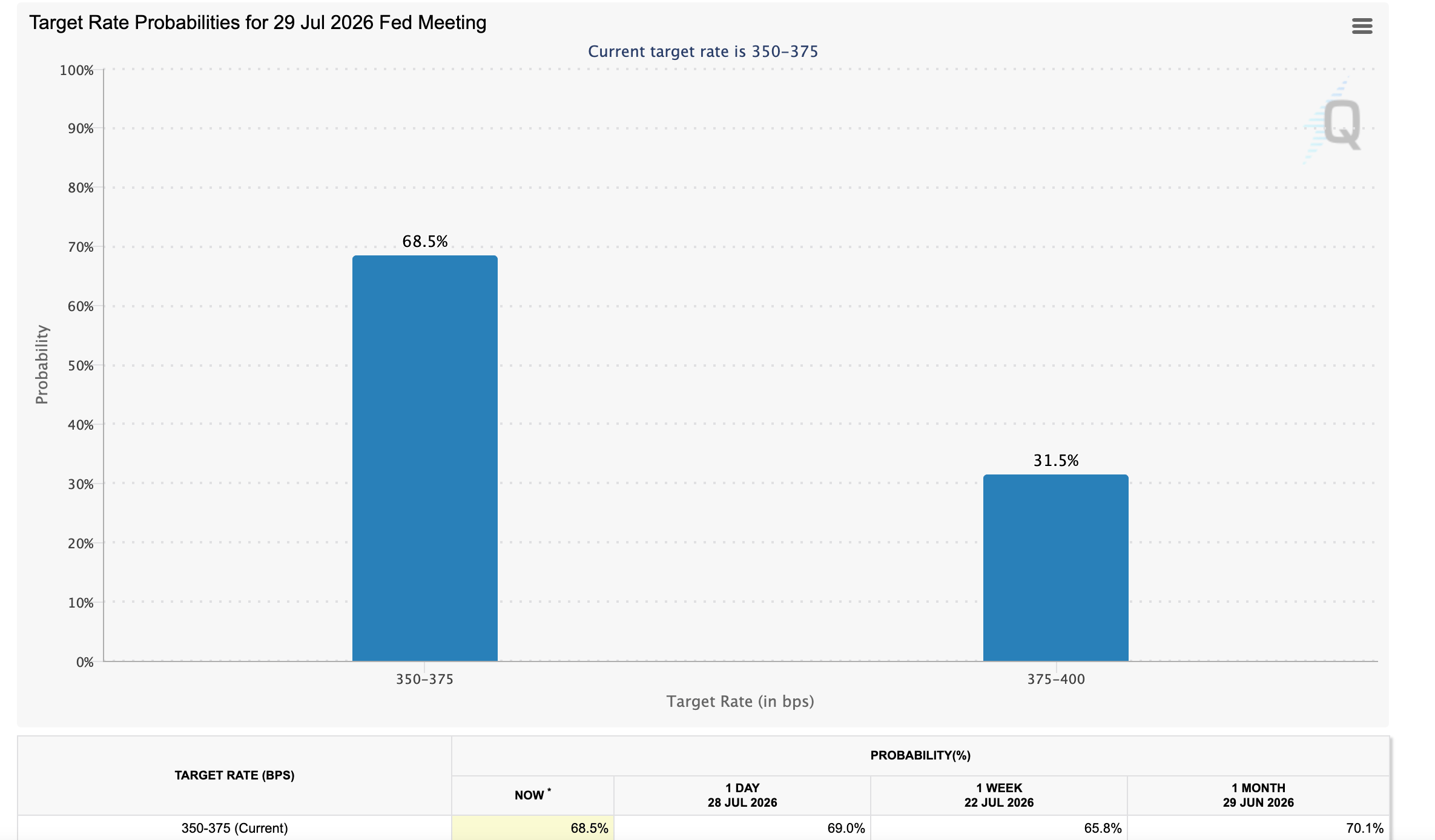
Market participants widely expect the Fed to leave interest rates unchanged in the 3.50%-3.75% range. Still, CME’s FedWatch tool shows a 35% probability that the central bank will hike interest rates by 25 basis points (bps), underscoring prevailing market uncertainty.
Flare enhances XRP DeFi utility
Flare Network’s Flare Smart Accounts (FSA) v1.3 has announced improvements to the process of staking XRP to earn yield in the decentralized finance (DeFi) space. Billions of XRP, which have been sitting in wallets, can now easily be connected to smart contracts through a collapsed single XRP Ledger (XRPL) signature process.
Flare stated in the press release that “previously, the flow required two separate XRPL signatures. v1.3 merges them into one. Pick a vault, sign once from the XRPL wallet you already use, and FSA handles the rest on Flare automatically.”
The one-signature process also operates on key principles, including a non-custodial service, without requiring a new Ethereum Virtual Machine (EVM), gas token or manual bridging. The collateralized XRP remains on the XRPL, backed at a 1:1 ratio, under the holders' control. Moreover, the platform automatically mints FXRP, which is deposited into the chosen vault to start earning.
“Authorization is proof-based, not signature-verification-based. Custody is non-custodial. No separate EVM key, no session-key delegation, no third party holding funds,” Flare expounded.
Technical outlook: XRP poised to extend rebound
XRP edges higher, albeit gradually, with the immediate upside capped below $1.10. Despite the short-term neutral-to-bullish outlook, demand for related digital investment products remains sluggish.
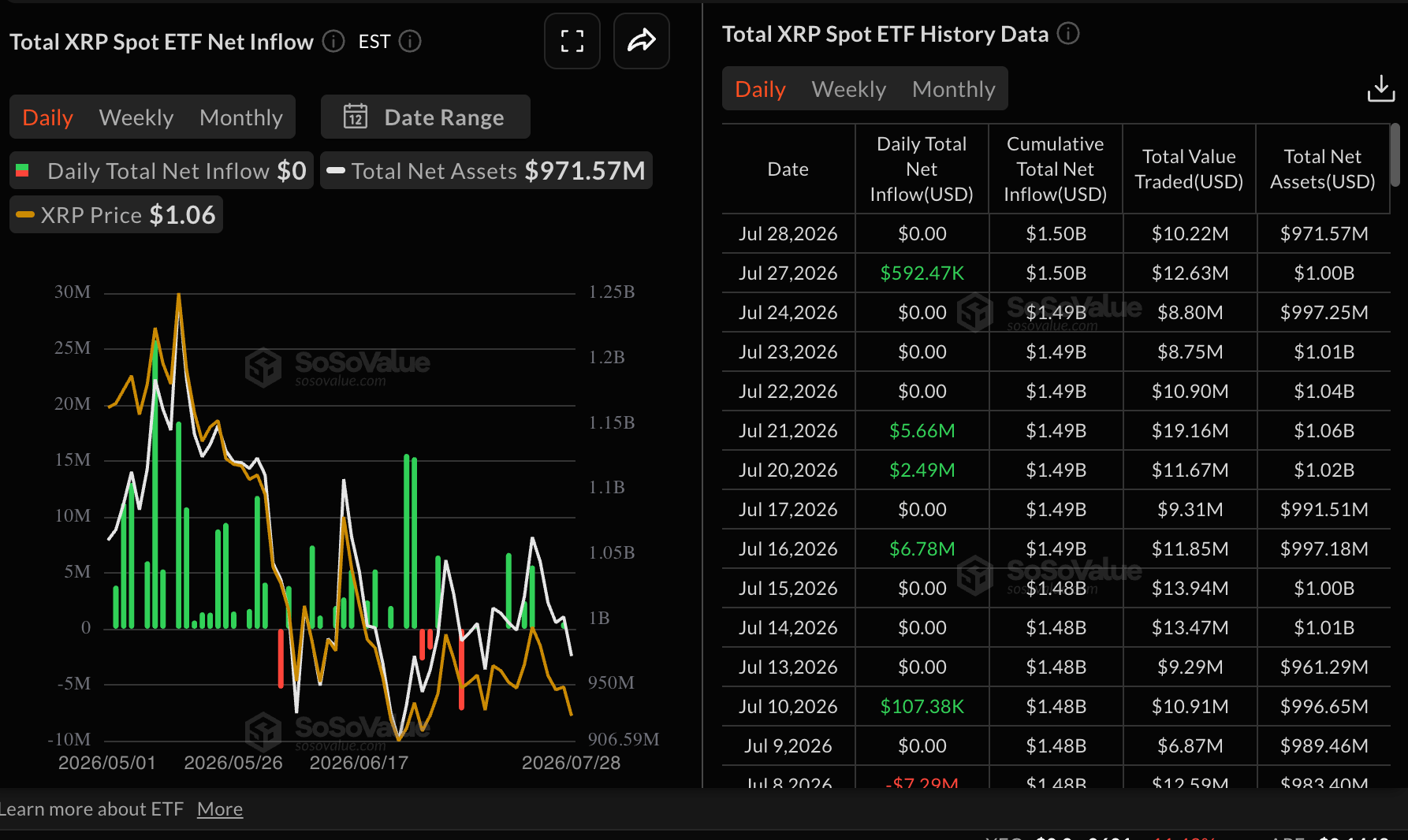
SoSoValue data shows that interest in XRP spot Exchange-Traded Funds (ETFs) dried up amid muted activity on Tuesday. This comes after very mild inflows of $592,000 on Monday, undermining risk appetite. Nevertheless, cumulative inflows hold steady at $1.5 billion, with net assets at $972 million, suggesting that investors remain committed to XRP in the long term.
The remittance token remains under clear downside pressure as price holds below the 50-day Exponential Moving Average (EMA) at $1.13, with the 100-day EMA at $1.22 and the 200-day EMA at $1.42 reinforcing a dominant bearish structure overhead.
The SuperTrend indicator at $1.16 also sits above spot, suggesting rallies are still being treated as corrective. Momentum signals are soft rather than washed out, with the Relative Strength Index (RSI) hovering near 46 on the daily chart and the Moving Average Convergence Divergence (MACD) histogram marginally negative, hinting that sellers retain the upper hand but without capitulation.
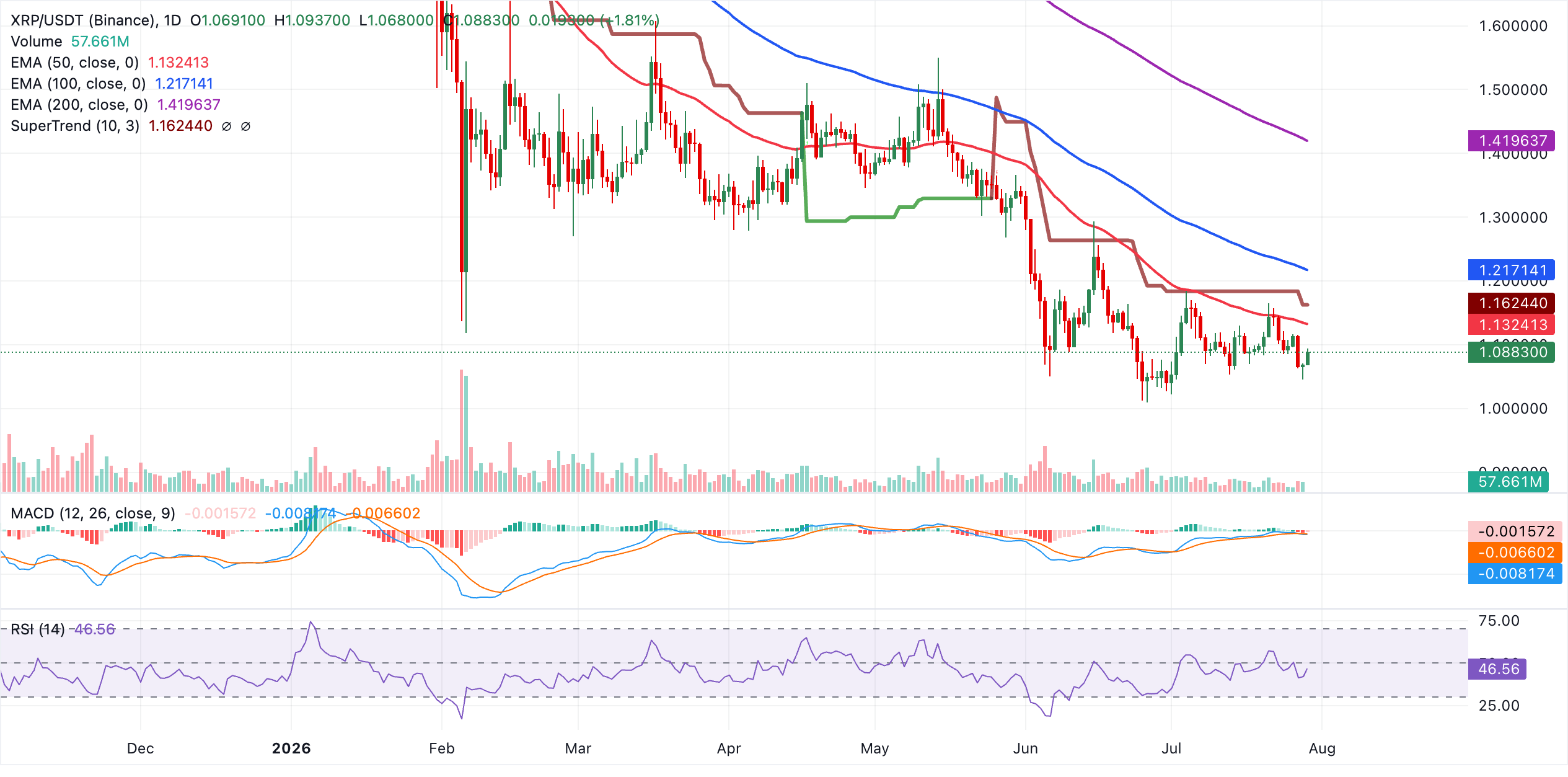
On the topside, immediate resistance is seen at the 50-day EMA around $1.13, where any rebound would first be challenged, followed by the SuperTrend zone near $1.16, which forms a secondary cap. Further up, the 100-day EMA at roughly $1.22 and the 200-day EMA near $1.42 outline broader recovery hurdles that would need to be reclaimed to ease the prevailing bearish bias. On the downside, investors may need to rely on former horizontal support levels such as $1.05 and $1.00 to gauge whether to reengage.
(The technical analysis of this story was written with the help of an AI tool. Know more.)
Crypto ETF FAQs
An Exchange-Traded Fund (ETF) is an investment vehicle or an index that tracks the price of an underlying asset. ETFs can not only track a single asset, but a group of assets and sectors. For example, a Bitcoin ETF tracks Bitcoin’s price. ETF is a tool used by investors to gain exposure to a certain asset.
Yes. The first Bitcoin futures ETF in the US was approved by the US Securities & Exchange Commission in October 2021. A total of seven Bitcoin futures ETFs have been approved, with more than 20 still waiting for the regulator’s permission. The SEC says that the cryptocurrency industry is new and subject to manipulation, which is why it has been delaying crypto-related futures ETFs for the last few years.
Yes. The SEC approved in January 2024 the listing and trading of several Bitcoin spot Exchange-Traded Funds, opening the door to institutional capital and mainstream investors to trade the main crypto currency. The decision was hailed by the industry as a game changer.
The main advantage of crypto ETFs is the possibility of gaining exposure to a cryptocurrency without ownership, reducing the risk and cost of holding the asset. Other pros are a lower learning curve and higher security for investors since ETFs take charge of securing the underlying asset holdings. As for the main drawbacks, the main one is that as an investor you can’t have direct ownership of the asset, or, as they say in crypto, “not your keys, not your coins.” Other disadvantages are higher costs associated with holding crypto since ETFs charge fees for active management. Finally, even though investing in ETFs reduces the risk of holding an asset, price swings in the underlying cryptocurrency are likely to be reflected in the investment vehicle too.
Author

John Isige
FXStreet
John Isige is a seasoned cryptocurrency journalist and markets analyst committed to delivering high-quality, actionable insights tailored to traders, investors, and crypto enthusiasts. He enjoys deep dives into emerging Web3 tren