You don’t get stagflation without stagnation

Outlook: A 180-degee shift in sentiment from gloom-and-doom to “we’re all right, Jack” arises from payrolls at a hefty 467,000 gain instead of a 301,000 loss as ADP had forecast for the private sector (and the 150,000 forecasted gain at Bloomberg just before the release).
Before the NFP release on Friday, some had tried to say the data would not mean anything, anyway, because of so many short-term factors, led by Omicron. A few tried to say the Friday numbers shows only that the jobs data, all the jobs data, has been wrong all along. We agree that the labor market data is always wrong and usually misleading, but mostly because it fails to count the gigantic gray market and because of silly data-gathering methodology (businesses and households). Nobody has an incentive to report accurately.
But to get the direction wrong this time and blame all the numbers all the time fails to clinch the argument if we believe error and miscounting is systematic. In other words, the Friday number may be as erroneous as the preceding data but in the same manner and to the same extent. The new data is “right” in the sense that there is robustness in the labor market and therefore the economy at large, and let’s disregard the new seasonal adjustments. You don’t get stagflation without stagnation.
Let’s add to the condition of the labor market two key factors: the pandemic is fading and even if it’s fading unevenly, people are fed up to the eyeballs with stringency and staying home. Rightly or wrongly from a public health point of view, people want to go back to work.
Secondly, a year-end survey found that 8.8 million persons (The Economist) were not working because they had Covid or were caring for someone with Covid (many of them women with the child-care problem in the midst of controversy over schools). Bloomberg has a number of 3.5 million. Either way, the pool of soon-to-be-available labor is vast. If, indeed, Covid goes away and schools stay open, payrolls may well deliver half a million jobs per month for the 6-12 months. This never happens, but it could.
About that inflation data due on Thursday: just about everything thinks it will be at least 7% or maybe a little more. This should keep yields high and vindicate the Fed’s hike plan. But what about contracting the balance sheet?
We hesitate to enter the fray because like just about every other economist on the planet, we don’t understand the dynamics, but the timing and extent of QT (contracting central bank balance sheets) has an unknown effect on yields. The BoE said it would halt reinvestment when the bank rate reaches 0.50%, achieved last week. Earlier, Japan had stopped adding to the BoJ hoard and cut its holdings in September and December. The ECB claims it’s allowing purchases to fade away on the same schedule as before.
The US, of course, has the biggest amount to dump. Logically, the central bank hoovering up all the assets should depress yields. But a report cited in The Economist by TS Lombard finds that yields are far more highly correlated with inflation expectations than with QE. If QE fails to move the bond premium, QT shouldn’t have much effect, either.
This runs directly contrary to the general belief that QT will lift rates on its own, a view that the Fed itself shares. The Lombard story says the one effect that QT does have is to signal future interest rate decisions. But note that the Fed keeps trying to shove QT into the background and is ambiguous about what it thinks the effect of QT is or should be on interest rates. One thing we can expect–QT is not a substitute for raising rates. More QT should not mean fewer rate hikes, causing bond yields to fall, making QT “bizarrely, a source of stimulus–the last thing a central banker with an inflation problem should want.”
Got that? We had to read it three times. And we don’t buy it, at least not in full. The equity market sees QE as a source of free/cheap money with which to speculate. QT removes cash from banks and together with raising the Fed funds rate, raises the cost of margin. As we showed last week, the US stock market has always been fueled by margin and today’s bubble, if we want to call it that, is not something new. The rise in margin cost should affect only those traders on the margin (economists can make jokes, too). A marginal margin trader is one whose balance sheet really doesn’t stand up to scrutiny.
So, do banks and brokers cut them off, as they should? Not when there is an extra penny or two to be made. We once called brokers “pond scum” and the charge hung around the internet for years, now surpassed by others using the same words. When you make your living a penny (or fraction of a penny) at a time, you are incentivized to offer margin. Period. This idea casts a pall over the crashing stock market idea. And yet there is that P/E, double the historic norm, not to mention a propensity to wild herd behavior inequities, including panic.
As for the QT debate, the implication of the Lombard study is that it can come in March alongside the first hike or in June as suggested by some (“mid-year”), but neither date needs to be watched. It’s the inflation forecasts, embedded in swaps prices and the like, that need to be watched. Here’s a scenario: we get 7% inflation in Feb or a little more, and the Fed hikes in March. By May, it has fallen to (say) 5-6%, in part on improving supply chains, and the Fed does another 25 bp plus some hefty QT.
Yields then reflect only the improving inflation prospects. Nobody really thinks that by year-end, inflation will be back to the old 2%, but numbers like 2.6% (Fed) and 3.6% (Conference Board) can be found. That’s the PCE version, not CPI (which will be higher). The regular CPI version in the Atlanta Fed Business Inflation Expectation for a year ahead (Jan 2923) is 3.4%.
If by the June FOMC meeting we have inflation headed for half the Jan/Feb number, the implication is that yields stop rising and perhaps retreat. We could get stuck with the real yield still short of a positive number. We think this is a problem. The real return should be positive. But to get a real return, the current 2-year yield needs to be more than 3.5% and two hikes don’t get it there (1.316 today + 50 bp = 1.816%). The 2-year is considered the most rate sensitive. Yield seekers will still be eyeing the stock market.
And that’s the happy, wishful scenario. What if inflation persists at high levels like 7% for months on end? Somewhat weirdly, this could allow the Fed to accelerate QT even as those goofy 6 or 7 hikes really do materialize. We see jokes from economists about wishing they had become a firefighter and gotten an inflation-adjusted pension, or seeking commodities/gold/land as an inflation hedge. Either way, we are not getting substantial real rates anytime soon, leaving the stock market as the only liquid asset class.
There is no shortage of economists who agree with former TreasSec Summers that inflation is worse than we think and will be more persistent, meaning the Fed will have to raise rates by a bigger amount than the bond market is now contemplating. Former NY Fed Gov Dudley, the kind of liquidity, concurs and Richmond Fed Barkin sees an ending range of 1.5-1.75% for Fed funds, or 6-8 hikes.
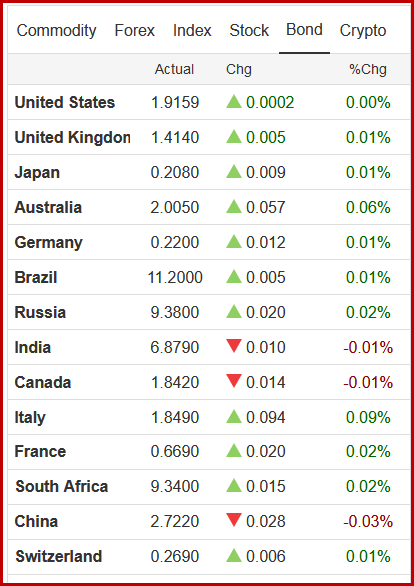
Gird your loins for Thursday’s CPI. Each of these ideas is going to get an airing and some will throw rocks. What it means for the dollar is not clear. We find it very peculiar that Lagarde not ruling out rate hikes is interpreted as a “pivot to hawkishness.” Granted, several European central bankers are throwing out hike bait to see who bites, but an ECB hike is just not in the cards anytime soon, while it’s a dead cert in the US. So why is the euro hanging on to gains? It’s a mystery and suggests the Fed hike scenario is fully priced in. Which one, three or six? We will need more data and more Fed talk to find out, but even then, the change in the Schatz and Bund is equal to or more than the change in the US counterparts, and that perhaps is the ruling factor. And yet yields are rising everywhere, even Japan. See the table from TradingEconomics.com. (We might also imagine that general distaste for things American might have something to do with it, although traders swear up and down it doesn’t.)
This is an excerpt from “The Rockefeller Morning Briefing,” which is far larger (about 10 pages). The Briefing has been published every day for over 25 years and represents experienced analysis and insight. The report offers deep background and is not intended to guide FX trading. Rockefeller produces other reports (in spot and futures) for trading purposes.
To get a two-week trial of the full reports plus traders advice for only $3.95. Click here!
This is an excerpt from “The Rockefeller Morning Briefing,” which is far larger (about 10 pages). The Briefing has been published every day for over 25 years and represents experienced analysis and insight. The report offers deep background and is not intended to guide FX trading. Rockefeller produces other reports (in spot and futures) for trading purposes.
To get a two-week trial of the full reports plus traders advice for only $3.95. Click here!
Author

Barbara Rockefeller
Rockefeller Treasury Services, Inc.
Experience Before founding Rockefeller Treasury, Barbara worked at Citibank and other banks as a risk manager, new product developer (Cititrend), FX trader, advisor and loan officer. Miss Rockefeller is engaged to perform FX-relat

















