WTI turns strategic as Hormuz risk moves into shipping flows
Key takeaways
- Shipping disruption in Hormuz is driving price formation before physical supply shifts.
- Insurance and freight costs are embedding a structural premium into oil flows.
- Market pricing is shifting from supply availability to access conditions.
Shipping stress is becoming the first signal of disruption
WTI is increasingly reacting to the mechanics of movement rather than the headline volume of supply. The current phase is being shaped by what happens before crude even reaches the market. Shipping flows, insurance availability and route viability are now the first layer of price discovery. Reuters reporting shows that maritime traffic through the Strait of Hormuz has been heavily disrupted, with vessels stranded, rerouted or selectively allowed to pass depending on risk exposure and political alignment. Around one fifth of global oil flows through this corridor, which means any friction immediately feeds into market expectations.
Insurance is now a pricing mechanism
The clearest shift is happening in insurance markets. War risk coverage has been withdrawn, repriced or replaced by emergency backstops. Reuters highlights that insurers have cancelled coverage for vessels in the Gulf, leaving ships exposed and discouraging transit. Premiums have surged from roughly 0.25% of vessel value to levels near 3%, turning each voyage into a materially different economic decision. At the same time, new facilities backed by governments and institutions are being introduced to restore minimal functionality.
This matters because access cost is becoming embedded in every barrel before it is even loaded. Oil is being valued not only on availability, but on the conditions required to move it.
Selective transit is fragmenting the market
Flows through Hormuz have not disappeared. They have become uneven. Reuters reports that only a fraction of pre conflict tanker traffic is moving, with some vessels able to transit under specific conditions while others remain blocked. In some cases, Iran has indicated that only “non hostile” ships may pass, effectively introducing a political filter into energy logistics.
This creates a fragmented system. Oil is still moving, though not freely. The result is a market where supply exists but accessibility varies.
That distinction drives repeated adjustments rather than a single shock event.
Shipping costs are transmitting the shock into the system
Freight, insurance and rerouting costs are already rising sharply. Reuters notes that shipping costs have surged as insurers withdraw and traffic slows, with knock on effects spreading into global trade, including food and fertilizer flows. In some routes, freight rates have doubled within days as vessels avoid high risk corridors.
This is the transmission mechanism the market is now absorbing.
The oil market is not waiting for confirmed supply loss. It is adjusting to the rising cost of moving energy through an increasingly constrained system.
Cross asset signals confirm the shift
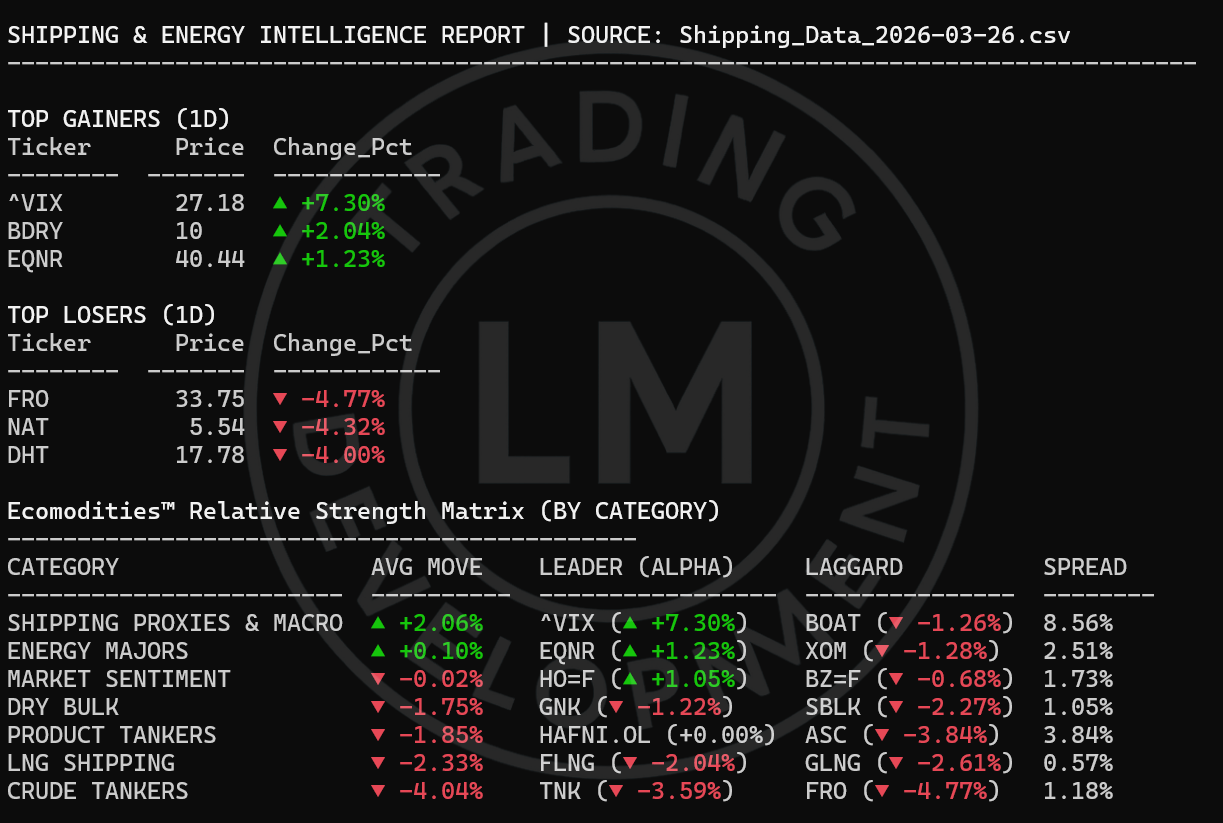
Your shipping and energy report reinforces this dynamic. Crude tanker equities are under pressure, down more than 4%, while broader stress indicators such as VIX are rising. At the same time, freight proxies are diverging, with some segments holding up better than others. This is not a uniform risk move. It is a targeted repricing of logistics exposure.
That divergence matters. It shows that the market is distinguishing between crude exposure and system level stress. Shipping is absorbing the first impact before it fully translates into energy pricing.
Asia positioning reflects early stage repricing
The Asia session shows a similar pattern. Equities are mixed, FX is relatively stable and commodity linked positioning is starting to adjust. This reflects a market that is still processing the shock rather than fully committing to a directional view.
The Asia Morning Brief highlights this cross asset balance, with regional divergence and a focus on FX volatility and commodity exposure into the European open.
This is consistent with an early stage regime shift where the signal is present but not fully priced.
Technical structure supports a release phase
From a technical perspective, WTI is in a clear expansion phase. The Renko structure shows a strong directional move supported by an ECRO reading near 84.9, with the system in a RELEASE state. This reflects a market that has transitioned from compression into directional momentum.
Price is testing resistance around 94.17, with a higher zone near 95.00 to 95.15 acting as the next key barrier. On the downside, 93.67 marks the first level where momentum would begin to soften, followed by 91.29 as a stronger structural support.
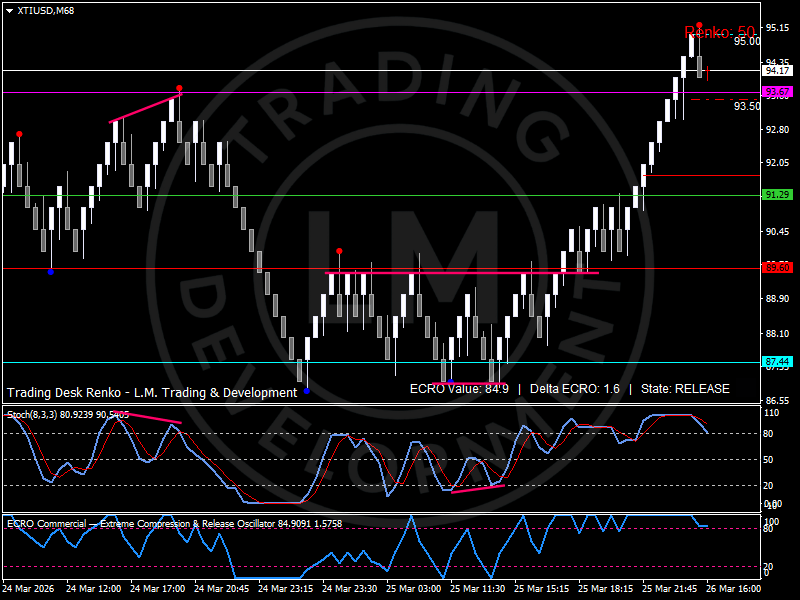
Momentum remains elevated, with Stochastic readings in the upper range. This suggests strength, while also increasing the probability of short term consolidation near resistance before continuation.
The market is repricing access rather than supply
The key takeaway is that WTI is no longer reacting only to physical supply expectations. It is responding to the structure of the system that delivers that supply. Shipping disruptions, insurance constraints and selective transit are redefining how oil is valued.
Reuters reporting makes it clear that the Strait of Hormuz is operating under stress conditions that go beyond traditional geopolitical risk. It is a live logistical constraint with direct implications for energy markets.
Outlook
The next phase depends on whether shipping conditions stabilize or deteriorate further. If insurance markets normalize and transit becomes more consistent, the current premium could ease. If fragmentation persists, the market will continue to adjust access risk in successive waves.
WTI remains supported by this structural shift. As long as shipping stress remains elevated, dips are likely to be interpreted as part of an ongoing adjustment process rather than a reversal.
Author

Luca Mattei
LM Trading & Development
Luca Mattei is a market analyst focusing on FX, metals, and macroeconomic trends. He develops trading tools for retail and professional traders, coding indicators and EAs for MT4/MT5 and strategies in Pine Script for TradingView.