|

Will Exxon Mobil Corporation (XOM Stock) continue to slide?

The Exxon Mobil Corporation stock traded slightly lower on Wednesday, after hitting resistance near 34.50 on Tuesday. Overall, the stock has been trading below a downside resistance line since June 8th and thus, we would consider the medium-term outlook to be negative.

Another round of selling may result in a test of the 31.10 level, which is marked as a support by the low of October 29th, or even the round figure of 30.00, which stopped the price from moving lower on March 23rd. If that psychological zone fails to hold this time around, we may see the price testing territories last seen back in 1997, with a potential upcoming support being the low of September of that year, at around 27.65.

Shifting attention to our short-term oscillators, we see that the RSI turned down again and fell back below its 50 line, while the MACD, although slightly above both its zero and trigger lines, shows signs of topping. Both indicators suggest that Exxon Mobil may start gathering negative momentum again soon, which enhances the case for further declines in the short run.

In order to abandon the bearish case, we would like to see a strong recovery above the key resistance zone of 36.00, which prevented the share from moving higher on September 28th and October 9th. The price would already be above the aforementioned downside line and investors may initially target the high of September 16th, at 38.20. Another break, above 38.20, may extend the recovery towards the 41.00 zone, marked by the high of August 28th. That zone also acted as a good support area on July 10th and 31st.
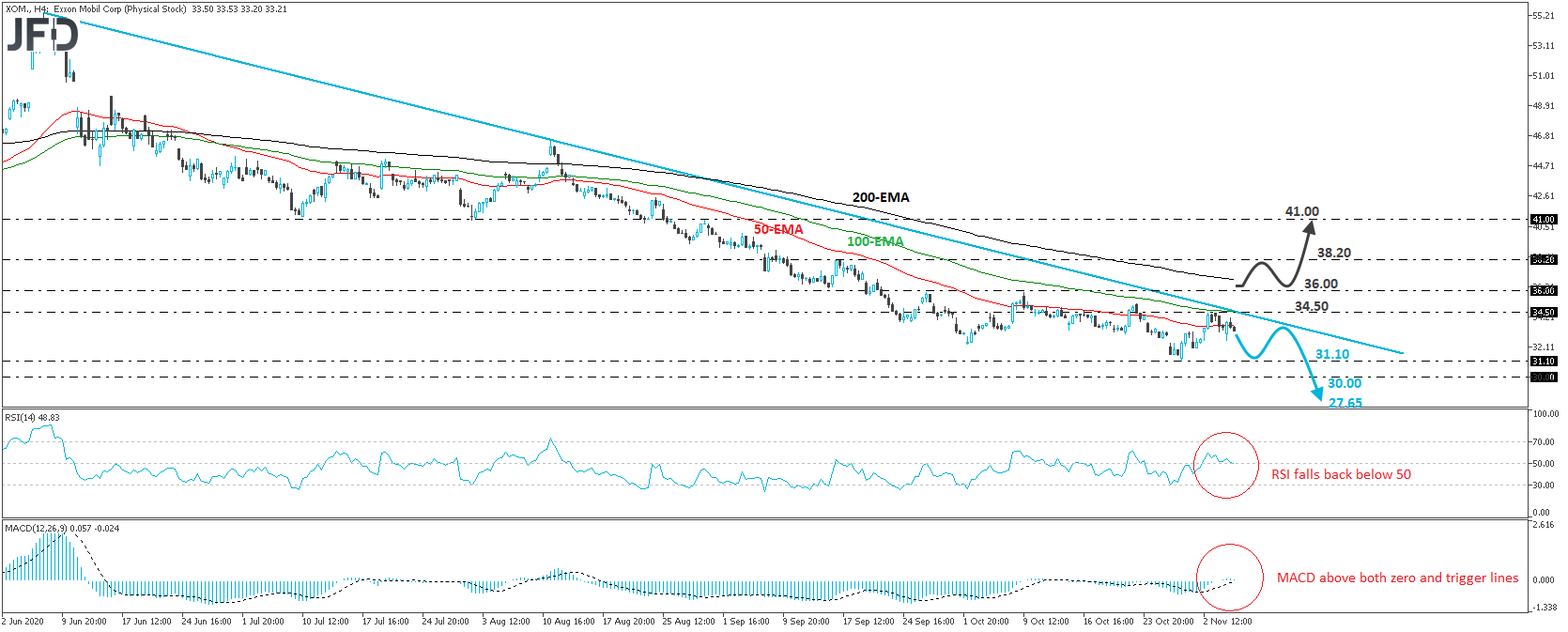
Exxon Mobil 4-hour chart technical analysis

JFDBANK.com - One-stop Multi-asset Experience for Trading and Investment Services


Author

More from JFD Team
Share:

Markets move fast. We move first.

Orange Juice Newsletter brings you expert driven insights - not headlines. Every day on your inbox.

By subscribing you agree to our Terms and conditions.

Editor's Picks

EUR/USD could test 1.1750 amid strengthening bullish bias

EUR/USD remains flat after two days of small losses, trading around 1.1740 during the Asian hours on Thursday. On the daily chart, technical analysis indicates a strengthening of a bullish bias, as the pair continues to trade within an ascending channel pattern.

GBP/USD consolidates above mid-1.3300s as traders await BoE and US CPI report

The GBP/USD pair struggles to capitalize on the overnight bounce from the 1.3310 area, or a one-week low, and oscillates in a narrow band during the Asian session on Thursday. Spot prices currently trade around the 1.3370 region, down less than 0.10% for the day, as traders opt to wait on the sidelines ahead of the key central bank event risk and US consumer inflation data.

Gold awaits weekly trading range breakout ahead of US CPI report

Gold struggles to capitalize on the previous day's move higher back closer to the $4,350 level and trades with a mild negative bias during the Asian session on Thursday. The downtick could be attributed to some profit-taking amid a US Dollar uptick, though it is likely to remain cushioned on the back of a supportive fundamental backdrop. 

Dogecoin breaks key support amid declining investor confidence

Dogecoin trades in the red on Thursday, following a 4% decline on the previous day. The DOGE supply in profit declines as large wallet investors trim their portfolios. Derivatives data shows a surge in bearish positions amid declining retail interest.

Monetary policy: Three central banks, three decisions, the same caution

While the Fed eased its monetary policy on 10 December for the third consecutive FOMC meeting, without making any guarantees about future action, the BoE, the ECB and the BoJ are holding their respective meetings this week. 

Dogecoin Price Forecast: DOGE breaks key support amid declining investor confidence

Dogecoin (DOGE) trades in the red on Thursday, following a 4% decline on the previous day. The DOGE supply in profit declines as large wallet investors trim their portfolios. Derivatives data shows a surge in bearish positions amid declining retail interest.















