Will elevated Oil prices prompt the ECB to sound more hawkish?
- ECB adopts a hawkish tone amid Middle East conflict.
- CPI inflation accelerates but business activity contracts.
- Officials to stand pat, rate hike odds higher for June.
- Hawkish signals may lift the euro; prolonged patience hints could weigh.
ECB keeps rates steady but signals rising inflation risks
At its March policy decision, the ECB kept interest rates unchanged, but the message accompanying the decision had a more-hawkish-than-expected flavor. Officials said that inflation remained near their target, but the war in the Middle East added a strong element of uncertainty, shifting the inflation risks to the upside, and the growth risks to the downside.
They chose to wait for more information before they react, with President Lagarde saying at the press conference that headline inflation could run higher later this year due to rising oil prices, and if this spreads into wages, services inflation and broader price-setting behavior, they may decide to press the rate-hike button.
In contrast to prior meetings, she did not repeat her “good place” mantra. On the contrary, she said “I’m not saying that we are in a good place,” adding that they are positioned and equipped to deal with the consequences of the major shock that is unfolding.
Ceasefire eases pressure but June hike bets build
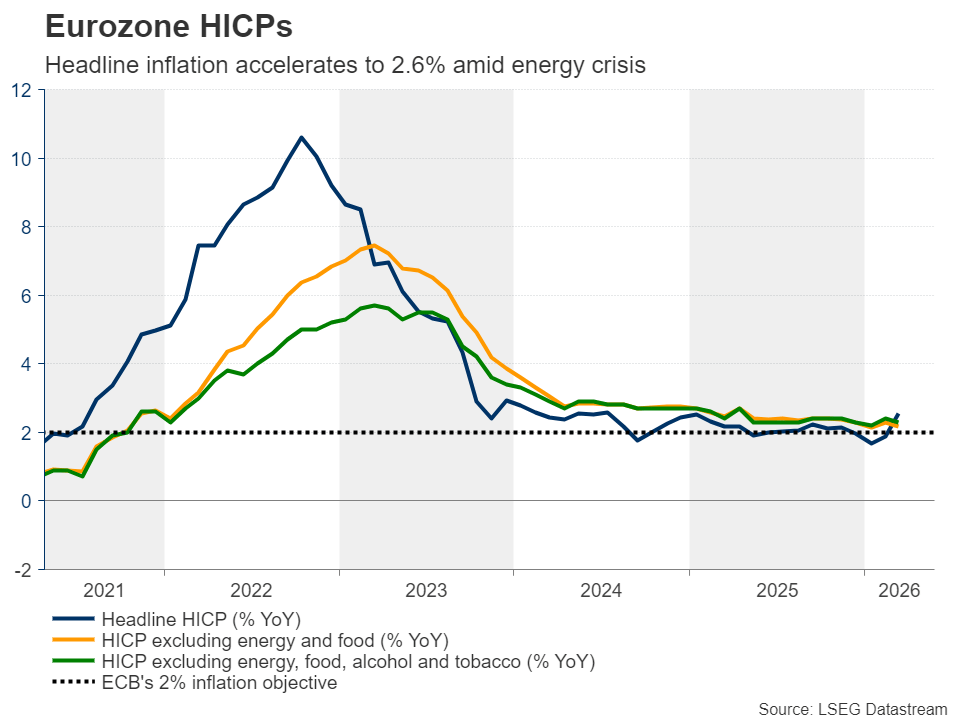
Since then, headline inflation in the euro area rallied to 2.6% y/y in March from 1.9% in February, while the preliminary composite PMI for April revealed that business activity entered contractionary territory for the first time since December 2024. That said, the ECB’s survey on the Access to Finance of Enterprises showed that wage growth is seen moderating, although firms still expect inflation to surge due to the war in Iran. This means that the ECB may not rush into raising interest rates.
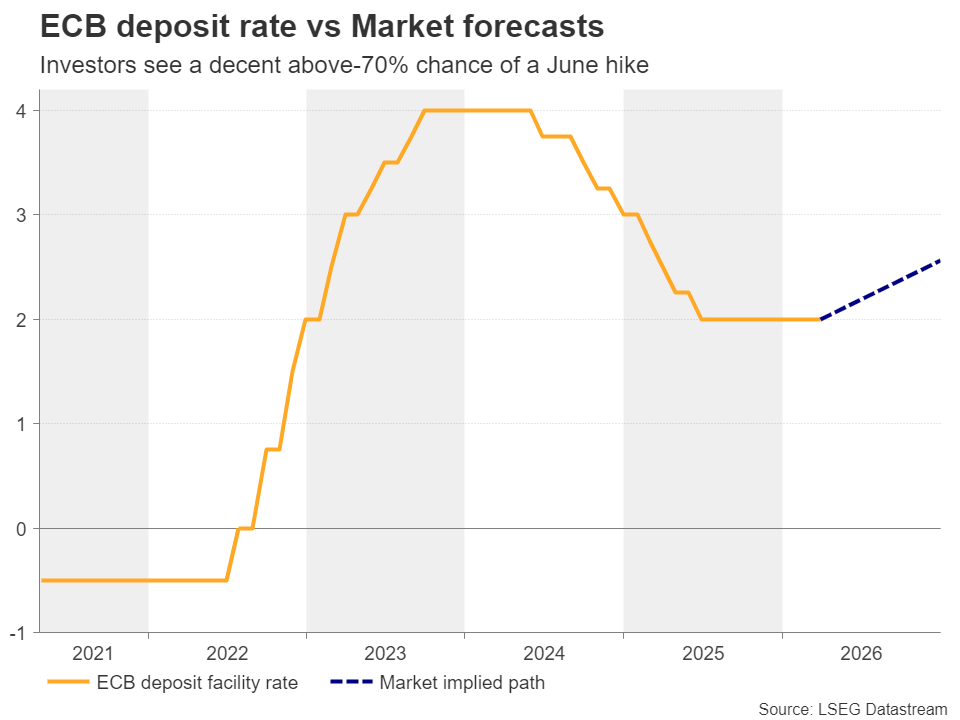
Indeed, there is only a 17% chance of a 25bps rate increase at Thursday’s gathering, but that probability rises to 72% in June. The indefinite ceasefire US President Trump announced last week and the progress revealed in the latest headlines – especially Iran’s proposal towards a permanent truce – are also supportive of a patient stance.
Uncertainty may prevent the ECB from sounding relaxed
However, there are still risks policymakers need to consider. Trump has already said he is not happy with Iran’s proposal and thus, if things fall out of orbit again and the Strait of Hormuz stays closed, already-elevated prices could rise further, intensifying anxiety about stickier inflation down the road. Thus, the ECB cannot appear relaxed. They may reiterate their hawkish message amid concerns about uncertainty surrounding the Middle East.
The key question is how urgent ECB officials will appear this time around to hike soon? Anything suggesting that they are very willing to press the hike button in June could benefit the euro, but whether euro/dollar will stay in upside trajectory may be also impacted by the Fed’s decision the day before. On the other hand, if Lagarde and Co. suggest more patience as they see light at the end of the tunnel and a permanent resolution of the conflict, the euro could correct lower.
Stronger June hike signals could push Euro/Dollar higher
From a technical perspective, euro/dollar rose on Monday, but hit resistance at the key territory of 1.1740 and pulled back on Tuesday. The pair remains capped by that barrier and the support zone of 1.1670, which coincides with the crossroads of the 50- and 100-day exponential moving averages (EMAs).
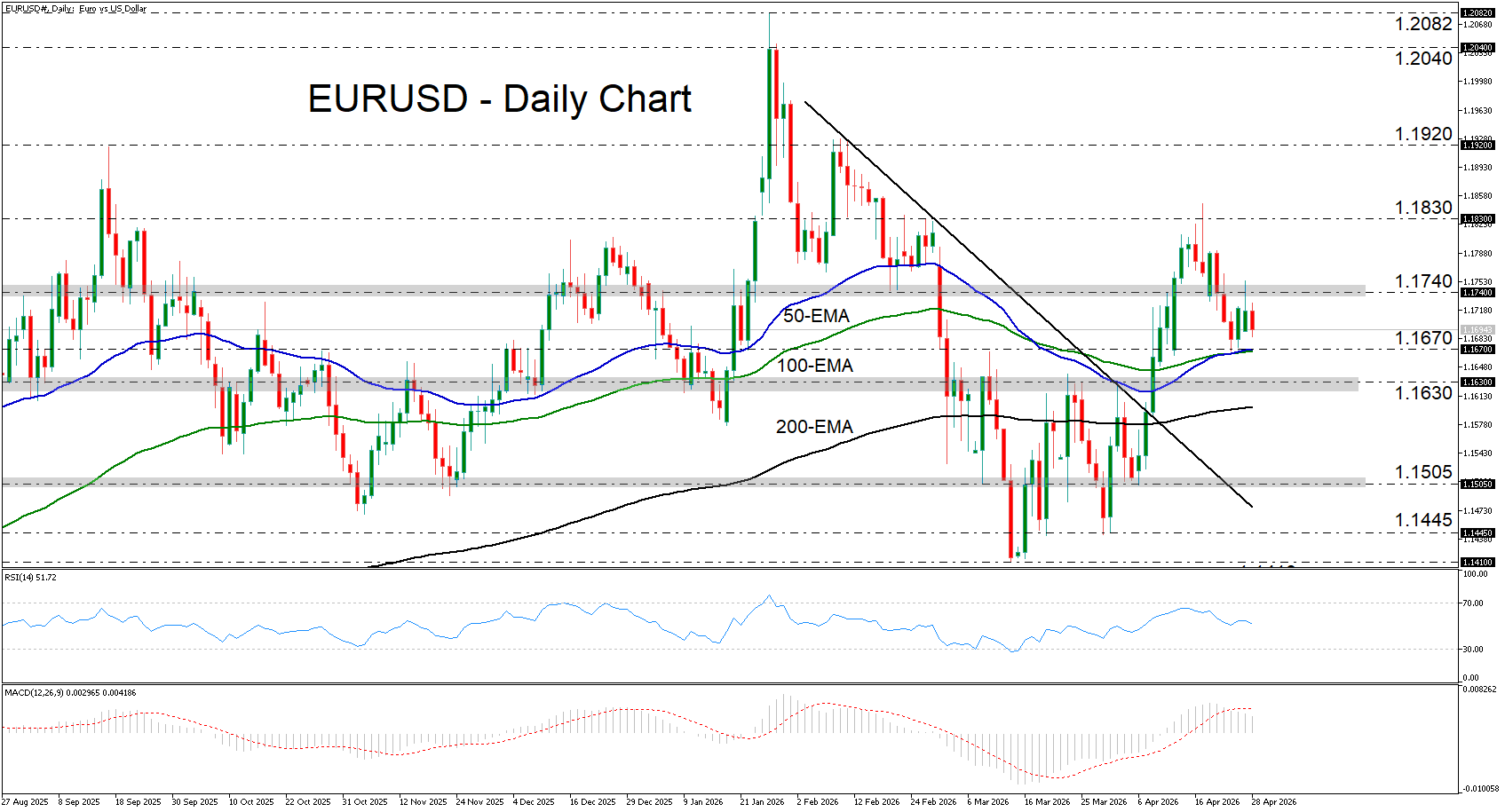
A break above 1.1740 could solidify the low formed late last week near that level and may see scope for advances towards 1.1830. A break higher could pave the way towards the 1.1920 territory. On the downside, a decisive dip below 1.1630 could invite more bears into the action, who could initially target the 200-day EMA and if they don’t stop there, they could dive all the way down to the 1.1505 zone.
Author

Charalampos joined Trading Point in August 2022 as a senior market analyst. He has extensive experience in analyzing financial markets, gained through a decade-long career, with his primary focus being on the currency market.