Wells Fargo: Debasement trade could drive Gold to $8,000

If you had told most people a few years ago that we’d be seriously talking about $8,000 gold today, they would have thought you were crazy.
Well, we’re crazy.
Wells Fargo analysts just set $8,000 as their bullish target for gold next year.
According to Wells Fargo chief equity strategist Ohsung Kwon, the “debasement trade” has the potential to drive gold to that mind-spinning number.
The “debasement trade” is the fancy term Wall Street came up with to describe de-dollarization. As the dollar (along with other fiat currencies) depreciates, central banks and other institutions are dumping them for a “more neutral” safe haven.
That neutral safe haven is gold. It is money without counterparty risk.
“We’re in the 4th debasement cycle that started in 2022. Following the recent pullback, gold is now closer to our model’s fair value of $4,500, and all three drivers are likely to suggest further debasement from here.”
We can see the debasement trade in action when we look at central bank gold buying. It spiked in 2022 and has run hot ever since.
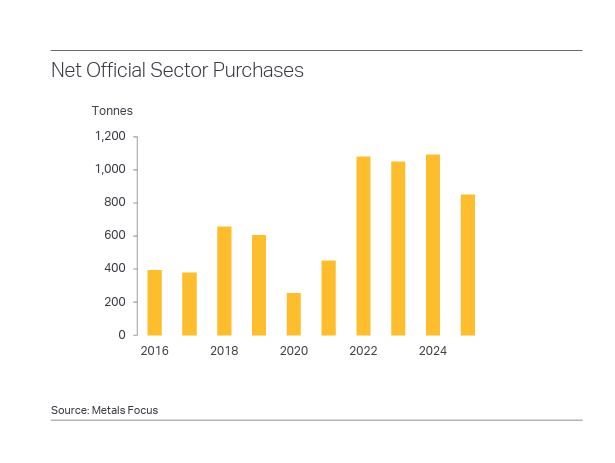
There were already concerns about the dollar before 2022 due to the U.S. government's fiscal irresponsibility. Those worries have not abated, as the federal government spends hand over fist, adding trillions to its pile of debt every year.
Dollar worries were exacerbated around the world after the U.S. and its Western allies effectively locked Russia out of the dollar-driven global financial system and froze billions in Russian assets. This weaponization of the dollar has made many countries wary of holding the greenback.
In an article published by the Atlantic Council, Kimberly Donovan and Maia Nikoladze point out that “central banks that are worried about getting sanctioned, want to protect themselves from a potential global financial crisis, or both have been stacking up gold at record levels.”
Since then, gold has overtaken the euro as the second-largest reserve asset behind the dollar, and the yellow metal now makes up a larger share of foreign reserves than U.S. Treasuries.
Kwon identifies debasement cycles by dividing the M2 money supply by the price of gold. He said that previous debasement cycles have lasted around 8.5 years, meaning the current cycle is still young -- not even at the halfway point.
Debasement trades tend to coincide with major economic crises. Prior cycles were during the Great Depression, after President Richard Nixon shut the gold window and the subsequent stagflation, and the 2000s War on Terror and Great Financial Crisis. This time seems different.
While there have been a series of events created high levels of geopolitical uncertainty, there doesn't seem to be an identifiable crisis in play (at least not yet).
Looking back, the pandemic may be key to understanding what's happening.
When the world locked down, the Federal Reserve cranked up the dollar printing press to an unprecedented level. The central bank created nearly $5 trillion and pumped it into the economy in just two years. That is the very definition of "debasement."
The world was watching.
Think about it. Why would anybody want to hold a rapidly devaluing currency that can be used against you as a foreign policy weapon?
As a result, we might be in the early stages of a significant shift in the global financial system. The world seems to be moving toward a "multipolar" system with the dollar playing a smaller role. That's bad news for a U.S. economy that depends on demand for dollars to support its relentless borrowing, spending, and money creation.
Kwon and his fellow Wells Fargo strategists said four out of five potential economic scenarios point to further debasement with the gold price continuing its bull run. The Wells Fargo bear case is for gold to drop to $4,000 in 2027.
Wells Fargo’s base case gold forecast for 2026 is currently between $6,000 and $6,300 per ounce.
To receive free commentary and analysis on the gold and silver markets, click here to be added to the Money Metals news service.
Author

Mike Maharrey
Money Metals Exchange
Mike Maharrey is a journalist and market analyst for MoneyMetals.com with over a decade of experience in precious metals. He holds a BS in accounting from the University of Kentucky and a BA in journalism from the University of South Florida.
















