Week Ahead on Wall Street (SPY) (QQQ): Bear market bites back as Nordstream shuts down any rally hopes
- The equity market finishes lower on Friday in the US as employment data lean hawkish.
- An early rally in stocks and bonds was quickly reversed.
- Weekend news regarding Nordstream to set tone for more losses.

The equity market finished out last week in a pretty calm but lower fashion. The US employment report pretty much kept the guessing game intact with perhaps a slightly hawkish tone. Revisions were small, and the number itself was more or less in line, meaning the odds of a 75 basis point hike at the Fed's September meeting remain the favorite outcome.
Regardless of whether it is 50 basis points or 75, equities look to be in a bit of a bind. 75 basis points could see something of a relief rally that the end may be in sight, but 50 would likely see a quick rally before the realization that this means more to come. Next week's CPI will be the final piece of data to solidify the outcome. The week ended with VIX volatility remaining stable at around 26. This points to the lack of any panic, meaning more sharp falls could yet be in order. Markets do not bottom with VIX at 26.
Overall, last week continued the negative tone that began with Jackson Hole. The S&P 500 lost 3.3%, but as ever the Nasdaq led the pack in dropping 4.2% for the week. It is back to early summer in terms of rotations with higher bond yields pushing the value-over-growth narrative. Also notable has been the switch back into energy and commodity stocks, while tech and consumer stocks once again come under selling pressure. This is likely to accelerate this week. Bond yields continued to rise and have marked five straight-up weeks in a row for yields. At the beginning of August, the US 10-year was yielding 2.6%, and now it is up to 3.2%.
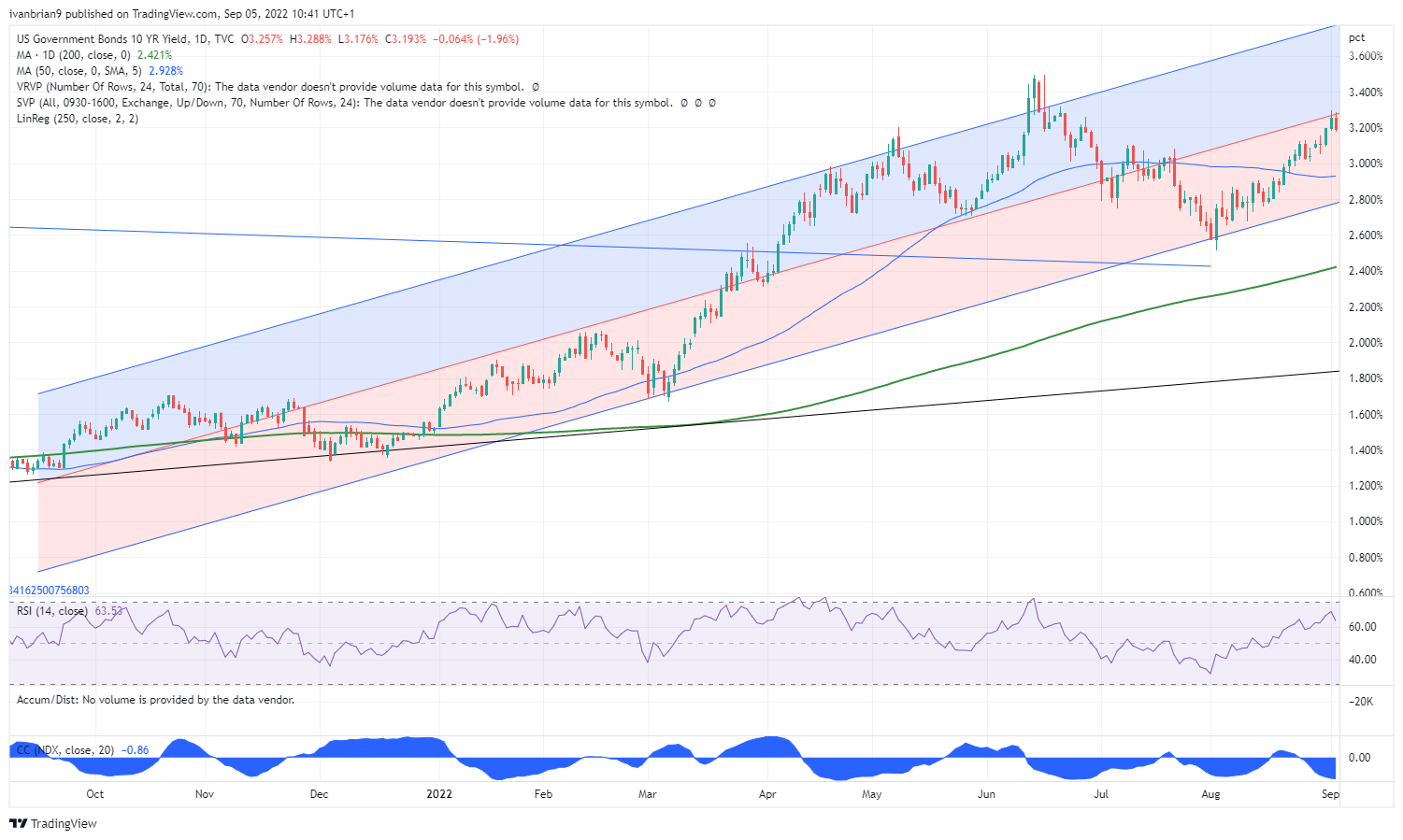
US 10-year yield
Also worth noting is the move higher further out the yield curve we go. That gives us a bearish steepening in the curve, which is never a good look for equities. The ECB joined the hawkish club with a suggestion for a 75 basis point hike now seeming odds on, but that failed to lift the euro as the dollar charged to record highs, mostly on risk-off themes. With European markets looking at steep losses on Monday with the Nordstream shutdown, it seems the dollar has more room to the upside.
Politically, plenty is also happening with a potential new UK Prime Minister, an Italian government to form, and a key meeting of EU energy ministers this Friday.
There is a lot of negativity out there geopolitically and macroeconomically, and that usually feeds down to corporate earnings. On that front, Morgan Stanley has their latest modeling out, and it looks bad for earnings going forward.
MS MIKE WILSON pic.twitter.com/BZKjeH3VHf
— JE$US (@WallStJesus) September 4, 2022
— JE$US (@WallStJesus) September 4, 2022
The problem is everyone is still long. We are way way too long to get anywhere near the capitulation we need to call a bottom.
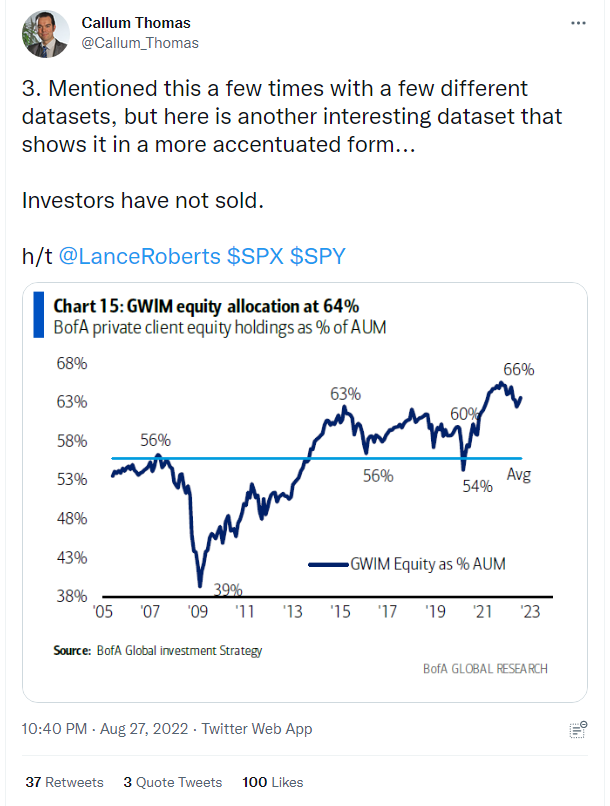
For all the narratives that say short interest is very high and the market has to squeeze higher, the truth is it isn't. At least not for single stocks. Short interest remains near historic lows within that category of hedging/directional betting.
— Markets & Mayhem (@Mayhem4Markets) August 29, 2022
Surprised? pic.twitter.com/fr77FSQCNn
Remember that stock prices are moved by earnings, which largely are determined by macro factors, well for large, mature, globalized firms anyway. We have declining macro and declining earnings. If the E in P/E declines, then the only way to keep it constant is for P to also decline. P/E ratios decline in bear markets and recessions anyway as people are prepared to pay less for risk.
#SPX | Larger Cuts Than Average to EPS Estimates for S&P 500 Cos. in July & August for Q3 - Factset
— Christophe Barraud (@C_Barraud) September 3, 2022
*Link: https://t.co/qOh1huwNXd pic.twitter.com/UPY4Cafz9e
Amazon Closes, Abandons Plans for Dozens of US Warehouses - Bloomberghttps://t.co/jQXSz8QmCm
— Christophe Barraud (@C_Barraud) September 3, 2022
If Amazon is seeing slowing sales growth, then it is likely everyone else is!
Anyway, that was uplifting. Any good news?
SPY forecast
$QQQ $SPY $IWM
— Mauro (@MauroBianchi24) August 2, 2022
Only 3 times on the monthly we saw a death cross between the 10 and 20 MAs
2001, 2008 and Now pic.twitter.com/7AztG5R6ye
Uh oh, that is not a great start.
An ugly red engulfing candle on Friday and now Europe in free fall means that gap at $380 to $378 is odds on to get filled in my view and sooner than I would have expected. That then becomes the key battleground. Tempting to set a new lower low and keep the bear trend intact. There will likely be a battle to hold the line, but it seems the trend will be too powerful, and so a new low below June at $362 is likely. Expect it to be choppy on the way down though. Any sign of a rally will need to sustain above $401, otherwise bears remain in charge.
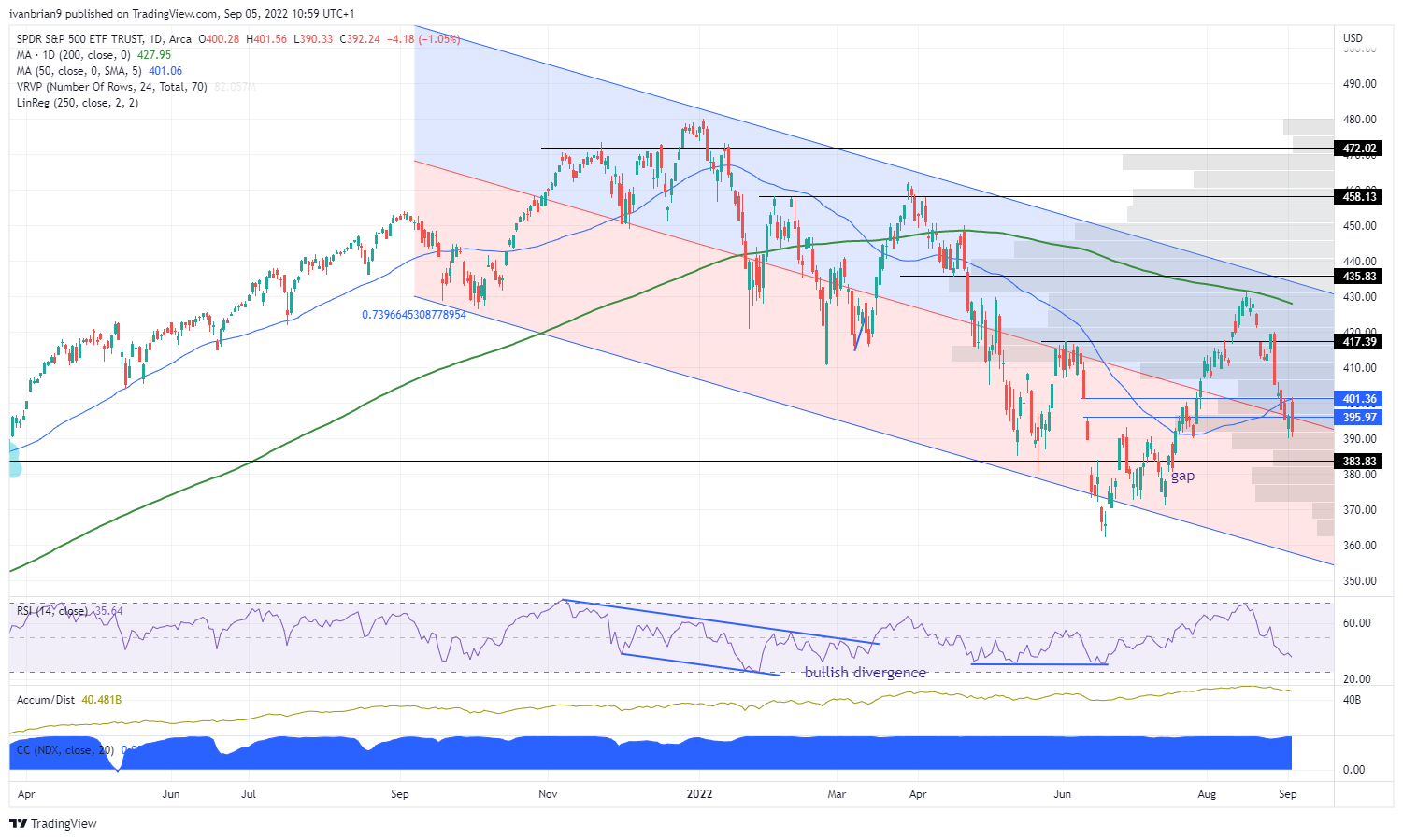
SPY daily chart
Earnings week ahead
#earnings for the week https://t.co/lObOE0dgsr $NIO $DOCU $GME $PATH $ZS $KR $COUP $ASO $GTLB $FCEL $RH $AEO $ASAN $BILI $PLAY $KC $CASY $ABM $MCFT $SWBI $GIII $HQY $BIOX $GWRE $LOVE $REVG $KFY $DSGX $ZUMZ $VRNT $ICMB $AVAV $CDMO $BASE $SOL $PHR $WLY $AVO $CXM $SKIL $IDEX pic.twitter.com/vf2tSQtS4b
— Earnings Whispers (@eWhispers) September 3, 2022
A lot of retail interest stuff for the week ahead but not much to move the dial of the main indices. GameStop (GME) is a highlight – so too Nio (NIO) and Docusign (DOCU).
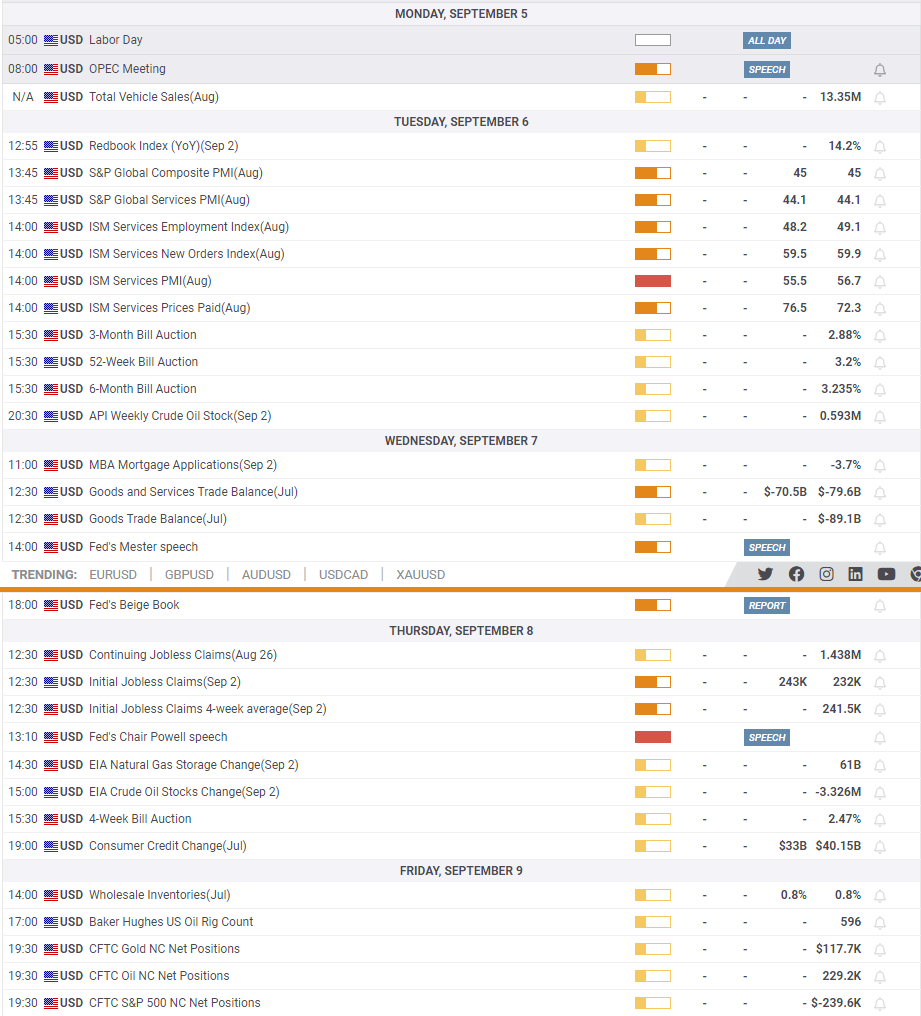
Economic releases
Author

Ivan Brian
FXStreet
Ivan Brian started his career with AIB Bank in corporate finance and then worked for seven years at Baxter. He started as a macro analyst before becoming Head of Research and then CFO.














