CFTC Report: Positioning turns more defensive as Yen longs build

The week in one sentence: Yen positioning surged into a sizeable net long in the week to September 15, while Oil buying accompanied a sharp price increase. CAD shorts also retreated, but Gold exposure remained crowded despite a lower price. Euro and Australian Dollar positioning weakened alongside softer currencies.
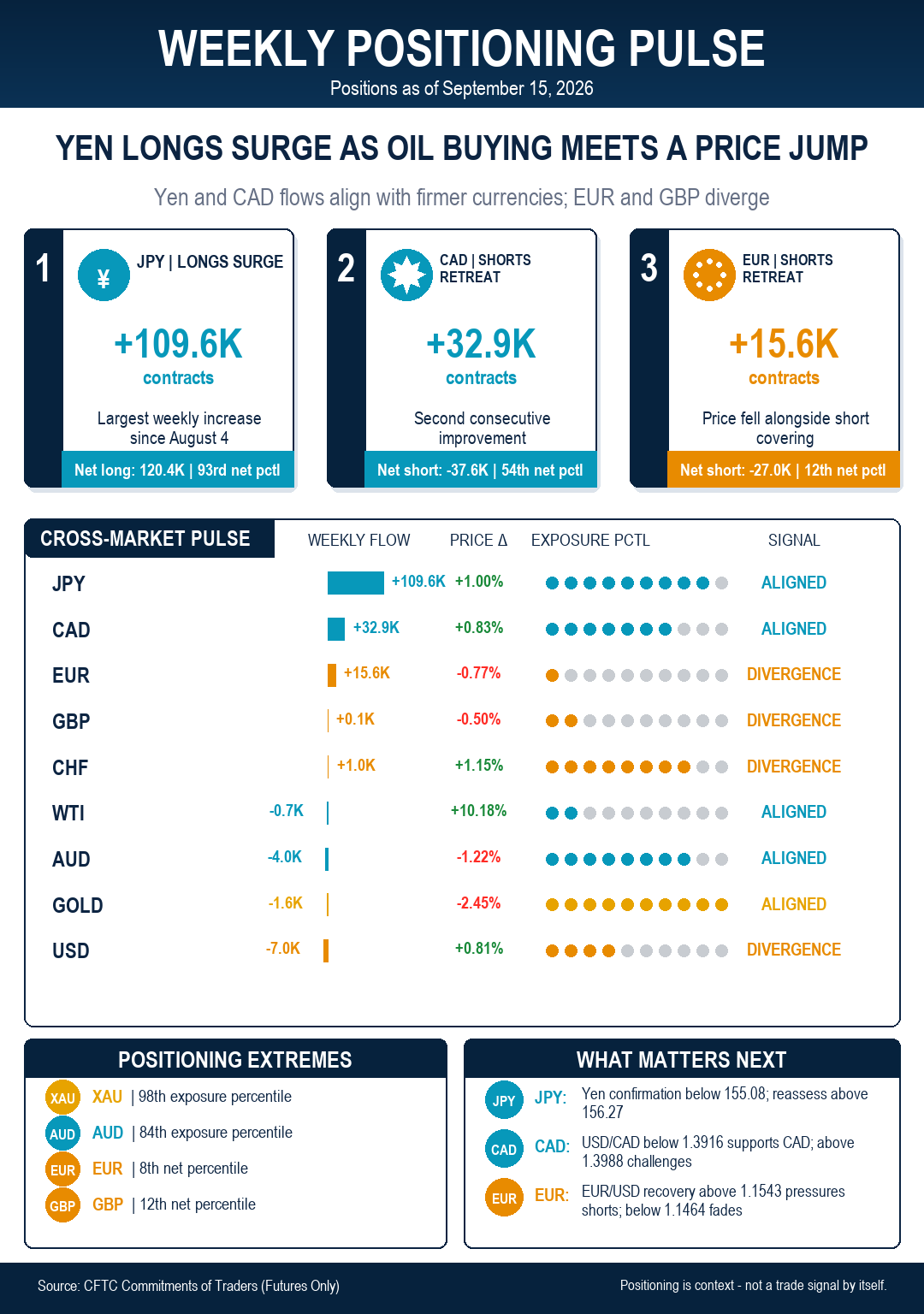
JPY: Longs keep piling up
Non-commercial net longs in the Japanese Yen (JPY) improved markedly to around 120.4K contracts, the largest weekly increase since early August. However, USD/JPY traded with strong gains during the period, diverging from the stronger speculative flow, while the net exposure reached the 88th percentile. A renewed fall in USD/JPY would confirm the positioning; a convincing move above 156.00 would weaken the signal.
CAD: Net longs extend the recovery
Speculative net shorts in the Canadian Dollar (CAD) narrowed considerably to 37.6K contracts, the second consecutive weekly improvement. During that time, USD/CAD rose strongly, surpassing the 1.3900 barrier and leaving price and positioning at odds, while net positioning rose to the 54th percentile. A move back below 1.3900 would improve confirmation.
Price and positioning are still at odds
The clearest mismatches were in JPY, CAD and the Swiss Franc (CHF). Indeed, price and speculative flow are pointing in opposite directions, so the signal is not ready to be treated as a clean trend call. For traders, the next move matters more than the snapshot: continuation would validate the flow, while a reversal would expose the mismatch.
Where the flow has confirmation
Price and positioning moved in the same direction for Euro (EUR), the British Pound (GBP) and Gold. That gives the move a better tactical footing, but it still needs follow-through next week; a quick reversal would turn the apparent confirmation into a false start.
Positioning Map: Gold remains crowded
XAU is the clearest crowded long by exposure at the 97th percentile, while JPY has the strongest net-positioning reading at the 93rd. At the other end, EUR sits near the 12th net percentile. The map therefore points to crowded exposure in XAU and the greatest room for rebuilding in EUR.
Author

Pablo Piovano
FXStreet
Born and bred in Argentina, Pablo has been carrying on with his passion for FX markets and trading since his first college years.














