Warning sign: The US Dollar may not be ready for an AI bubble burst


The US Dollar (USD) is not ready for an AI bubble burst, and its recent strength may be hiding a major vulnerability. China's AI stocks have already suffered a major selloff, while Wall Street faces growing financing concerns. Looking at the connection between US AI spending, Asian chip exports, and foreign investment shows why the US Dollar may not be as strong as it looks.

Why investors are becoming nervous about AI
For the past few years, AI has been one of the biggest investment themes in global financial markets. Technology companies have poured enormous amounts of money into data centers, advanced semiconductors, computing infrastructure, and AI development. The expectation is that these investments will generate enormous future profits.
But an important question remains: Will the revenues and profits eventually justify the money being spent today? That question is becoming increasingly important. A Bloomberg report recently highlighted growing concerns that credit markets were approaching their capacity to absorb more AI-related debt. Financing costs for some AI infrastructure borrowers have surged, while banks are finding it more difficult to distribute loans to other investors. The European Central Bank (ECB) has also warned about the risks associated with rapidly expanding AI-related debt, opaque financing structures and circular financial commitments.
In other words, the concern isn't that AI will disappear. The concern is that companies may have invested too aggressively, borrowed too much, and built infrastructure faster than profitable demand can develop. And if that happens, the consequences could extend far beyond technology stocks.
What China's AI selloff reveals
We don't have to look far for an example of what happens when AI expectations collide with market reality. China's STAR50 index, which includes major AI and semiconductor companies, plunged approximately 40% in less than four months, wiping out around $480 billion in market value. The selloff came amid concerns about stretched valuations, uncertain AI demand, and restrictions on Chinese technology exports.
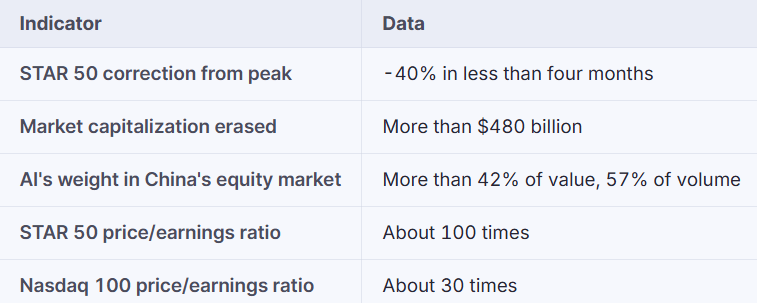
AI-related stocks had become so important that they accounted for approximately 42% of China's market capitalization and 57% of trading turnover, according to Goldman Sachs data. That concentration made the market particularly vulnerable when investor confidence weakened.
This doesn't prove the US AI market will follow the same path. American technology companies have different balance sheets, earnings profiles, and access to capital. But China's experience demonstrates something important: a technology revolution can be real while the stock-market valuations built around it become excessive. And that distinction could become critical for the US Dollar.
The circular link between AI spending and the US Dollar
The US Dollar has developed a new source of foreign support through the AI investment cycle. Traditionally, one important source of global USD recycling came from Oil. Oil exporters earned Dollars from energy sales and often reinvested a portion of those earnings into US government bonds and other USD assets. But the global trade landscape is changing.
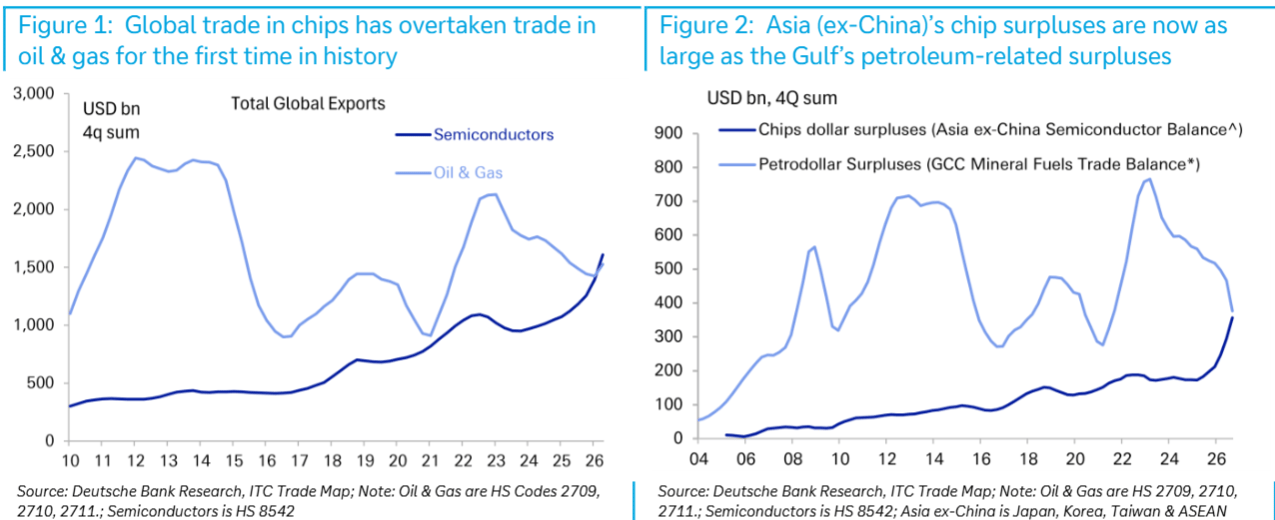
Semiconductor exports are becoming an increasingly important source of foreign earnings. Countries such as South Korea, Taiwan, and Japan supply the chips and components needed to power America's AI infrastructure. And the money doesn't simply stop there.
First, American technology companies spend billions building AI data centers and purchasing advanced semiconductors. Then, Asian semiconductor manufacturers receive those payments as export earnings. Investors and institutions in those Asian economies use some of their accumulated savings to purchase US financial assets, including American technology stocks.
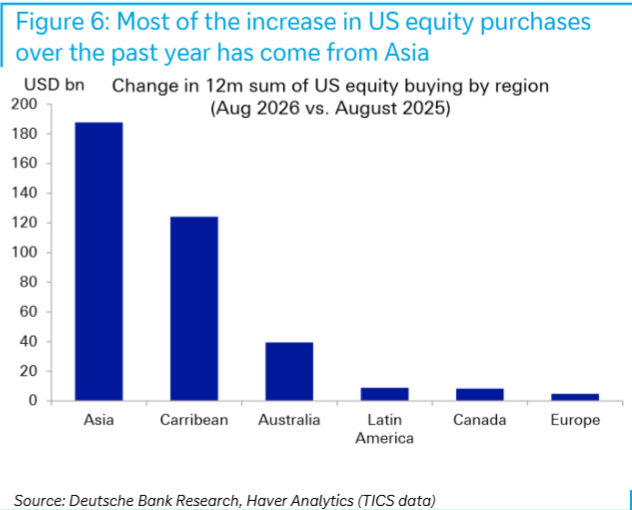
That foreign investment helps support US equity valuations and provides another source of capital for the American technology sector. And the cycle starts again. This is what makes the US Dollar's new strength particularly interesting.
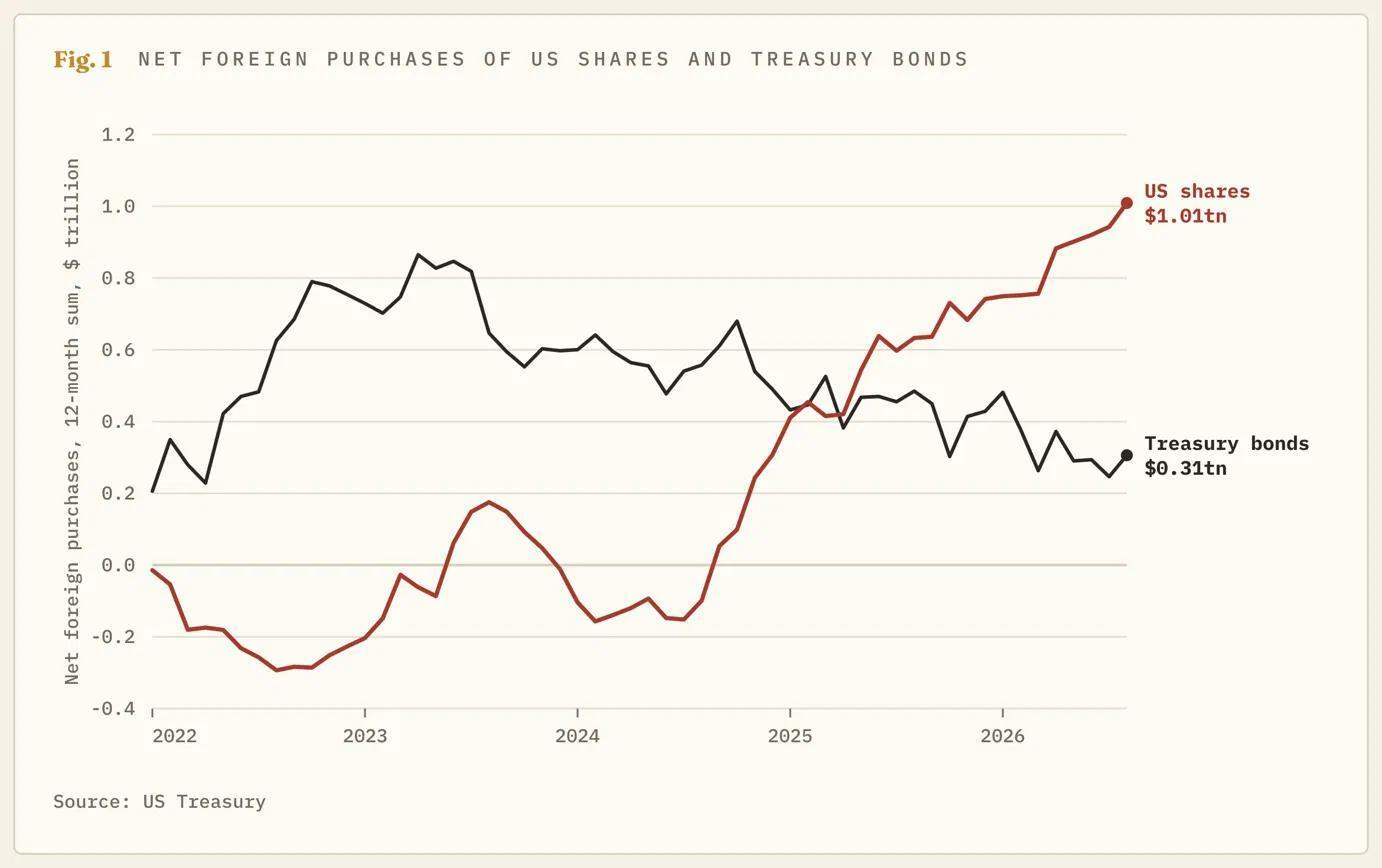
The AI boom is generating demand for semiconductors, supporting Asian export earnings and helping channel foreign capital back into US markets. According to Deutsche Bank, foreign investors purchased more than $1 trillion of US equities over the previous year, more than twice their purchases of US government bonds. But there is a weakness.
The same AI investment cycle supports both sides of the relationship. If American technology companies suddenly reduce their AI spending, Asian chip exports could weaken. And if those export earnings decline, some Asian investors' capacity and willingness to allocate capital to US stocks could also be affected.
At the same time, falling technology valuations could reduce the incentive to invest in those stocks and eventually weaken demand for US assets. That means the US Dollar could lose two sources of support simultaneously. And that's the circular flaw.
Why an AI crash might not sink the Greenback immediately
Don't assume an AI crash would immediately send the US Dollar lower. In fact, the initial reaction could be exactly the opposite. During a major market selloff, investors often seek liquidity and safety. The US Dollar still benefits from its role as the world's dominant reserve currency and a major funding currency.
If technology stocks collapse, global investors could sell riskier assets and move into US Dollars. Another important factor is interest rates. Higher US interest-rate expectations have been supporting the US Dollar, even as concerns about AI valuations have increased. So, even if the AI market weakens, the US Dollar could remain resilient initially. But here's the important distinction: a temporary safe-haven rally is not the same as a sustainable long-term bullish trend.
If AI spending slows significantly, foreign investment into US equities declines, and the Federal Reserve (Fed) eventually becomes more concerned about weakening growth, the US Dollar's underlying support could begin to deteriorate. That is when the market may start questioning whether the recent US Dollar rally is built on a sustainable foundation.
Three scenarios for the US Dollar
There are three possible scenarios traders should prepare for:
1. AI spending remains strong
If hyperscalers continue investing heavily in AI infrastructure, semiconductor exports remain robust, and foreign investors continue buying US equities, the US Dollar could retain key support. If US interest rates also remain relatively attractive, the Greenback could extend its strength. In this scenario, the AI bubble concerns may create volatility without triggering a structural reversal in the US Dollar.
2. AI valuations correct, but the economy remains resilient
This is a more complicated outcome. Technology stocks could correct significantly, but American economic growth may remain relatively strong. Investors could initially move into the US Dollar as a safe haven. However, if Asian chip exports and foreign purchases of US equities begin slowing, the US Dollar's longer-term outlook could become less convincing. This scenario could produce a period of US Dollar volatility rather than an immediate collapse.
3. The AI bubble bursts and credit stress spreads
This scenario could fundamentally challenge the US Dollar's new source of strength. Imagine AI companies canceling data-center projects, cutting semiconductor orders, and reducing capital expenditure. Asian export earnings could weaken, while investors become less willing to purchase expensive US technology shares. If the resulting financial stress also damages business investment and economic growth, markets could begin pricing in a more dovish Federal Reserve. Lower US yields, weaker foreign investment, and deteriorating growth expectations could then put the US Dollar under sustained pressure.
However, remember that a severe financial crisis could still trigger an initial safe-haven Dollar rally. The key signal is whether the Greenback can maintain its strength after the first wave of risk aversion fades.
Four signals USD traders must watch
- AI capital expenditure. Are major US cloud companies increasing or cutting their infrastructure budgets?
- Asian semiconductor exports. Watch South Korean and Taiwanese chip-export growth for signs that global AI demand is slowing.
- Foreign investment flows. Monitor US Treasury International Capital data for changes in overseas purchases of American equities.
- Federal Reserve expectations. If weaker AI investment starts affecting growth and employment, markets may begin pricing in lower US interest rates.
If these indicators deteriorate together, the US Dollar's AI-related support could weaken.
The AI boom may be creating a hidden vulnerability in the US Dollar. A slowdown could weaken semiconductor exports, reduce foreign investment into US equities, and eventually challenge the Greenback's recent strength. But the first reaction could still be a safe-haven rally. For traders, the crucial question isn’t simply whether the AI bubble bursts. It’s whether the shock remains confined to technology stocks or spreads into credit markets, economic growth, and Federal Reserve policy.
(This article was created with the help of an Artificial Intelligence tool and reviewed by an editor. Know more.)
Author
Dhwani Mehta
FXStreet
Residing in Mumbai (India), Dhwani is a Senior Analyst and Manager of the Asian session at FXStreet. She has over 10 years of experience in analyzing and covering the global financial markets, with specialization in Forex and commodities markets.