|

War drums and risk-off
S&P 500 couldn‘t keep the upswing to 4,365 during Powell‘s decent speech, and broke through 4,330 thereafter – not as a function of a stunning hawkish surprise (rising rates can be understood as reflection of still strong economy, sticky inflation and not tanking Q3 earnings), but of rising Mideast tensions – precisely said, of broadening the conflict.

While Israel needed more time to secure its northern border and West Bank, US Navy in Red sea intercepting missiles or US bases in Syria and Iraq under attack, that‘s a different cup of tea beyond Lebanon. Lack of a dead cat bounce coupled with poor DAX and strong gold and oil showing speaks clearly to rips being sold – and to be sold as part of weekend positioning.

Nasdaq is acting as a safe haven, but can‘t rally either, Russell 2000 saw sharp rejection of Tuesday‘s upswing, and yields (10y at 5%) are highlighting the deteriorating financial conditions. Stock market bottom (on these geopoliticals overpowering technicals with macro) before the advance to close the year on a bright note, hasn‘t yet been formed.

Let‘s move right into the charts – today‘s full scale article contains 5 of them.

Stocks and sectors

Chart

NFLX and XLC are now candidates into whose strength to sell, rather than chase higher. The short-term downside has way more potential than the upside.
Chart

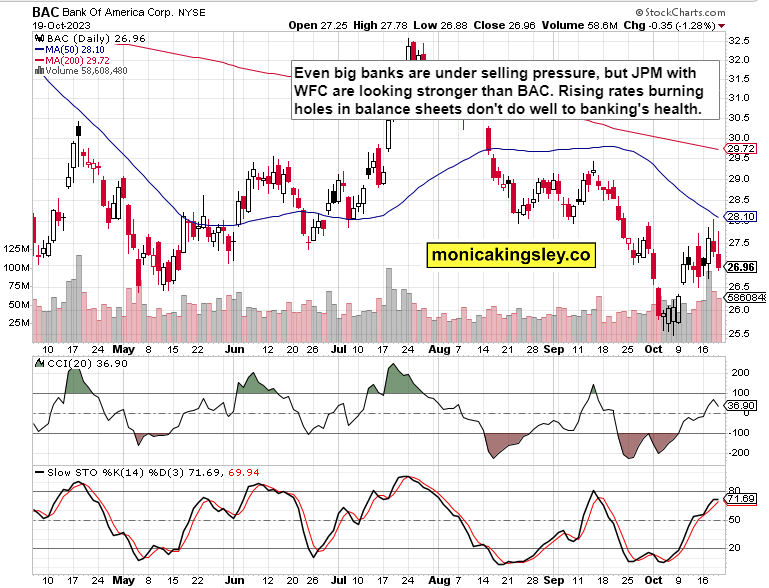
Financials aren‘t yet a buy, and yesterday‘s upswing failure confirms this prospect as regards both big and regional banks. Financials are also to underperform.

Gold, Silver and Miners
Gold

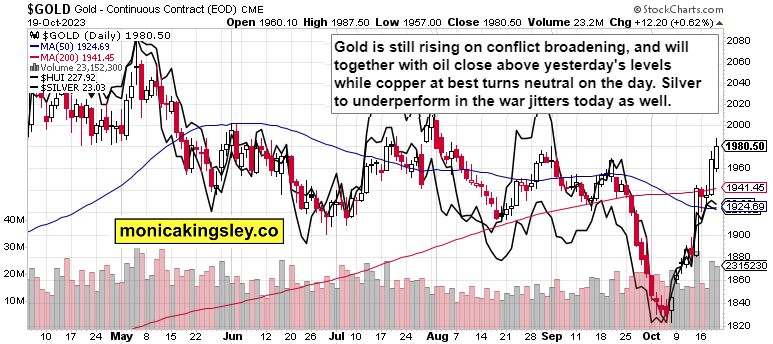
Gold and silver are to consolidate the high ground, with still bullish undertones. I take the last two daily candles‘ volume as one of accumulation – the time for a (significant) pullback isn‘t yet here. Unlike the days before, oil is today better positioned for gains than gold.

Crude Oil
Oil

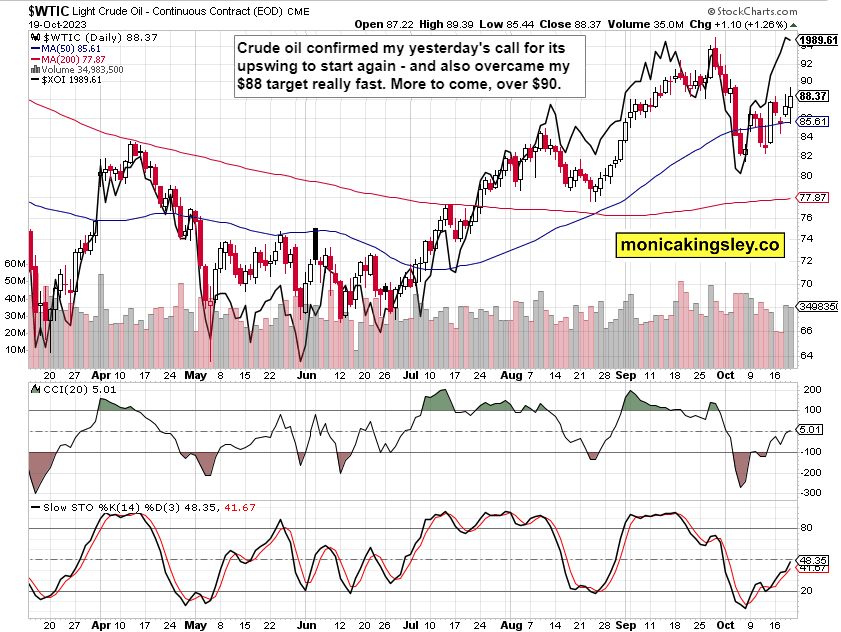
Crude oil is now ready for a bounce, with $86 - $87 serving as support. The flight into energy as safe haven (instead of TLT, charts are clear), is obvious, and about to lift the commodity somewhat more while copper is to remaim barely above the $3.55 support.

Author

Monica Kingsley

Monica Kingsley

Monicakingsley

Monica Kingsley is a trader and financial analyst serving countless investors and traders since Feb 2020.


More from Monica Kingsley
Share:

Editor's Picks

AUD/USD rejected at 0.70 as hot US CPI revived Fed hike threat

The Aussie Dollar ends Wednesday’s session with a 0.17% loss against the US Dollar, as high US inflation sent US yields higher amid expectations that the Federal Reserve may hike rates late this month. The AUD/USD trades at 0.6971 after hitting a high above 0.7000.

USD/JPY consolidates near 158.50; looks to US CPI for fresh impetus

USD/JPY stays range-bound near 158.50 in the Asian session on Wednesday, with looming intervention risks supporting the Japanese Yen and capping upside amid a softer US Dollar. However, geopolitical uncertainties act as a tailwind for the safe-haven USD and the pair. Traders also seem hesitant ahead of the release of the latest US inflation figures.

Gold remains offered below $4,100

Gold adds to the weekly bearish tone and slips back below the $4,100 mark per troy ounce on Wednesday. Indeed, the precious metal continues to suffer the stronger US Dollar and rising US Treasury yields as bets for extra tightening by the Fed remain on the rise following US inflation figures.

Australia Unemployment Rate forecast to remain at 4.6% in September

The Australian Bureau of ​Statistics will publish the September employment report on Thursday at 00:30 GMT. The Australian Dollar could see a big reaction to the jobs data if the numbers significantly alter market expectations for another interest rate hike by the Reserve Bank of Australia later this year.

Ethereum falls below $2,500 as hot CPI raises Fed hike odds

Ethereum extended its decline below $2,500 on Wednesday after a hotter-than-expected US inflation print renewed selling across the crypto market. At the time of writing, the top altcoin trades near $2,430, down 3.1% in the past 24 hours. The US Consumer Price Index for September rose 0.6% monthly, in line with market forecasts and up from a 0.4% increase in August.

Has Bitcoin really escaped the macro forces it was built to fight?
Over 17 years ago, Satoshi Nakamoto designed Bitcoin (BTC) on the back of a global financial crisis as an alternative to the global monetary system outside the control of central banks, governments and traditional intermediaries. This raises a key question: has Bitcoin really become independent of the macroeconomic forces it was built to challenge?