Walmart and Target unveil diverging outlooks

Walmart and Target released diverging outlooks for the final quarter of 2022 as the companies' respective recent financial results show how rising inflation prompts consumers in the US to be extra mindful and plan their purchases instead of becoming abrupt buyers who will end up buying more than intended.
The change in consumer behavior benefited retail corporation Walmart, which generates much of its sales from groceries, and somehow took away sales from big box department store chain Target, which is a destination more for top-up shopping.
Consumers becoming extra careful of their spending can be attributed to inflation and concerns about the US economy heading into a recession.
The annual inflation rate in October slowed to 7.7%, compared with the 8.2% in September, according to figures released in November. The latest figure is lower than the consensus estimates of 8% and marked the lowest inflation figure since Jan. 22.
However, consumer confidence across the country fell during the month to a three-month low of 102.5 from a 107.8 reading in September despite the slowdown in inflation amid growing concerns regarding the economy.
Opposing outlooks
In the third quarter, Walmart upgraded its financial outlook for the year after reporting an 8.2% growth in comparable sales and a sustained gain in market share of the grocery sector.
On the other hand, Target downgraded its forecast for the fourth quarter following a 2.7% hike in comparable sales, attributable to a 1.4% rise in traffic growth and a 1.3% increase in average ticket.
Since the release of their respective results, Walmart is up ~10% while Target has fallen ~8%.
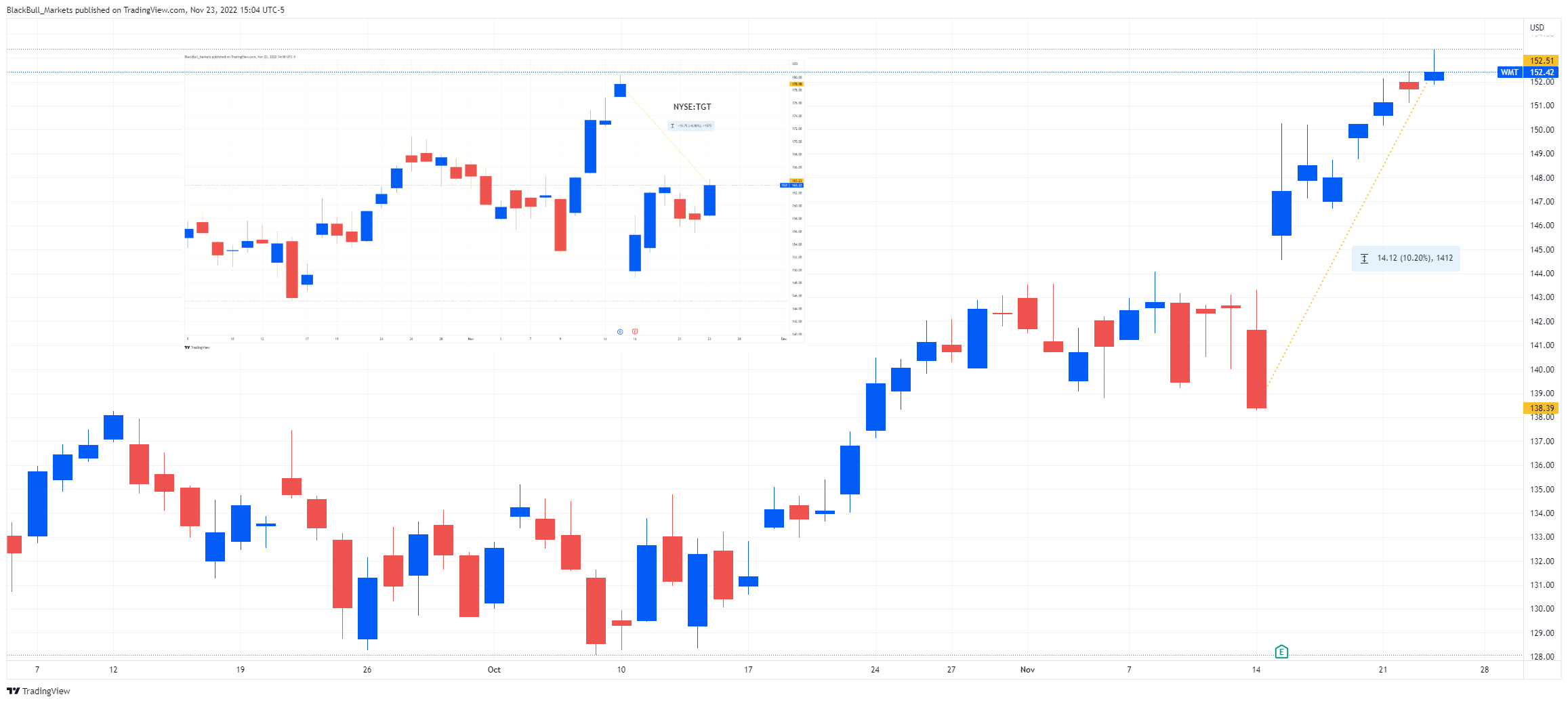
NYSE:WMT 1D
Target's failure to hit its profit and revenue targets for the quarter paints a picture of how consumers are becoming more selective of what they spend on.
Saunders said the company's financial results show that people are now spending more on food and grocery staples and not as much on apparel and home goods, which provide better margins for the company.
This is how the behavioral shift becomes beneficial for Walmart. The company prides itself on offering products at "everyday low prices." As Americans become more careful with their spending, this mantra becomes even more appealing.
In addition, grocery items are always a necessity regardless of the soaring prices of products. With the bulk of its sales coming from groceries, this change could be very lucrative for Walmart.
Possible ray of light for the economy
Retail sales across the US in October saw a 1.3% uptick after being unchanged in September. Year over year, sales grew 8.3%.
The better-than-expected growth in retail sales across the US in October suggests consumer spending has picked up early in the fourth quarter of 2022. According to Reuters, this could be beneficial for the US economy, especially amid fears of an incoming recession.
Along with the slowdown in inflation, the solid retail sales for the month elicited cautious optimism that perhaps, the US economy could avoid the expected recession or at least only experience a mild downturn.
But Target's warning of "dramatic changes" in consumer behavior that dragged its third-quarter sales still hangs in the air, eliciting concerns that it may affect sales over the holidays.
Expectations for retail sales in November is a 0.9% rise. The National Retail Federation is forecasting holiday sales for 2022 will grow between 6% and 8% this year. If realized, the expected figure would be lower than the 13.5% hike recorded in the prior-year period even at top end of the range. Even so, it will still be higher than the 4.9% growth average over the past 10 years.
Author
Mark O’Donnell
Blackbull Markets Limited
Mark O’Donnell is a Research Analyst with BlackBull Markets in Auckland, New Zealand.