Volatility has returned with a vengeance to global markets [Video]
![Volatility has returned with a vengeance to global markets [Video]](https://editorial.fxsstatic.com/images/i/charts-02_XtraLarge.jpg)

Volatility has returned with a vengeance to global markets. While many investors watch daily movements with uncertainty, there's a select group of traders using advanced technical tools to navigate these turbulent waters. In this in-depth analysis, you'll discover the strategies making the difference between protecting capital and suffering significant losses.
The eye of the storm: Tariffs and institutional repositioning
International markets are going through a critical phase driven by escalating trade war tensions between the United States and Europe. The new tariffs aren't just headline news: they represent a structural shift in capital flows that's forcing major institutional players to aggressively reposition their portfolios.
The most revealing data comes from analyzing the positions of so-called "commercials" or large institutions. These players, who have historically demonstrated the ability to anticipate major moves, are systematically increasing their short positions in major U.S. indices. This reading isn't anecdotal: when institutional money moves with conviction in one direction, ignoring these signals can prove costly.
The Million-Dollar question: Where are the opportunities?
For equity indices, the technical answer is clear but uncomfortable: this is not the time to look for optimistic buys in the S&P 500 or Nasdaq. Analysis using Elliott Wave theory, a methodology that identifies fractal patterns in price behavior, shows bearish structures developing. Each technical bounce should be interpreted not as the start of recovery, but as an opportunity to position strategic shorts.
Experienced traders are applying a specific approach: monitoring short timeframes (especially 5-minute charts) to identify optimal entry points for short positions during momentary bounces. Confirmation comes from technical oscillators like MACD, which allow the detection of temporary exhaustion of bullish momentum before new declines.
The exodus to traditional safe havens
While risk assets face selling pressure, a massive capital migration is occurring toward two specific instruments: gold and the Swiss franc. This movement doesn't respond to irrational panic, but to institutional logic backed by decades of market behavior.
Why Gold shines in the darkness
Gold is experiencing a structural bullish cycle for solid fundamental reasons. Unlike assets with excess supply, the precious metal maintains its relative scarcity while demand for protection increases exponentially. Major institutional funds, contrary to what traditional textbooks suggest, are avoiding sovereign bonds and migrating toward tangible commodities.
This trend can extend as long as geopolitical uncertainty persists. For investors and traders, the recommended strategy is gradual accumulation on pullbacks, taking advantage of technical corrections to build positions without chasing prices at highs.
Swiss Franc: Europe's safe haven par excellence
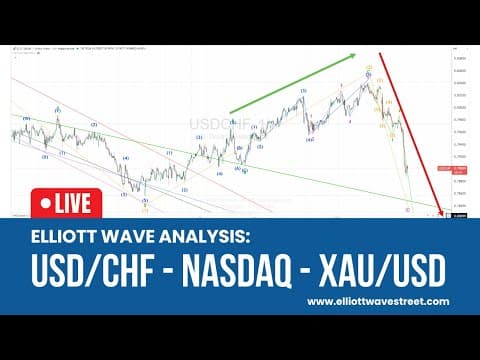
The Swiss franc versus the U.S. dollar (USDCHF) shows bullish behavior for the CHF. Institutional flows are rewarding the strength of the Swiss economy and its traditional stability during crisis periods. Buying on technical pullbacks offers entry points with favorable risk-reward ratios.
Gold vs Silver: A critical distinction
Although both are precious metals, there's a fundamental difference every investor must understand. While gold lacks excess supply and directly benefits from institutional protection demand, silver faces significant bubble risks due to its greater relative abundance.
For capital protection in the current environment, the conservative strategy favors concentration in gold, avoiding overexposure to silver that could reverse sharply when market sentiment changes.
The reality about price prediction
A recurring question among traders: Is it possible to anticipate future movements using technical indicators alone? The honest answer is nuanced and requires a balanced perspective.
Technical analysis, including advanced methodologies like Elliott Waves, harmonic patterns, and institutional volume analysis, offers improved probabilities but not absolute certainties. Without considering the context of monetary policy, liquidity injections by central banks, and macroeconomic flows, no predictive tool is sufficient on its own.
The real competitive advantage emerges from a combination: using technical analysis to identify optimal entry and exit points, while maintaining awareness of the fundamental landscape driving major movements. This hybrid approach allows for minimizing risks and maximizing the probability of successful trades.
Risk management: What separates professionals from amateurs
In volatile markets, the difference between preserving capital and suffering devastating losses comes down to discipline in risk management. The fundamental principles are non-negotiable:
Never trade without a defined Stop Loss. This simple rule eliminates the risk of catastrophic losses from unexpected movements. Each position must have a clearly established point where the investment thesis becomes invalidated.
Adjust position size according to volatility. In high-volatility periods like the current one, reducing the size of each individual trade allows maintaining market exposure without excessively compromising capital in amplified adverse movements.
Intelligent diversification among safe havens. Don't concentrate all your protection in a single asset. Combine physical gold or gold-linked instruments with Swiss franc exposure, allowing different correlations to work in your favor.
Follow institutional money signals. Large operators have access to flow information and superior analytical capacity. When institutional positions show clear conviction in one direction, aligning with that flow improves success probabilities.
The tech revolution: Artificial intelligence in trading
Automated systems based on artificial intelligence are transforming the professional trading landscape. Models combining Elliott Wave analysis with machine learning algorithms are generating trading alerts 24/7 on key assets: gold, oil, Nasdaq, Swiss franc, S&P 500, and euro.
This technology democratizes access to quantitative strategies that were previously exclusive to major funds. Individual traders can now leverage big data analysis applied to financial markets, receiving potential signals at any time of day without the need for constant manual monitoring.
What to monitor this week
Properly positioned traders are focused on specific variables:
On U.S. indices: Each bounce in short timeframes represents a potential opportunity for shorts. Key technical support levels are being tested, and confirmed breakdowns would signal bearish acceleration toward new lows.
On gold: The precious metal maintains a solid bullish structure. Corrections toward previous support levels offer optimal points for gradual accumulation. The underlying trend favors long positions while global risk aversion persists.
On the Swiss franc: The USDCHF pair shows CHF strength. Technical pullbacks toward support levels offer entries with tight stop losses, allowing efficient risk management while capturing the larger directional move.
Validation with oscillators: Tools like MACD on multiple timeframes help confirm temporary exhaustion of impulses, improving entry timing and avoiding premature positions that face adverse volatility before the main move develops.
Final thoughts: Knowledge and discipline in times of crisis
Markets are going through what many analysts describe as a "perfect storm": geopolitical tensions, escalating trade war, massive institutional repositioning, and amplified volatility. In this environment, impulsive speculation and emotional decisions invariably lead to losses.
Your best ally is a combination of deep technical knowledge and unwavering discipline in execution. Follow institutional signals, maintain flexibility to adapt strategies as the landscape evolves, and above all, constantly reinforce your risk management.
The traders who thrive in this cycle won't necessarily be the most aggressive, but the most disciplined. Those who understand that preserving capital in adverse phases is as important as capturing gains in favorable ones.
The opportunity exists, but it requires preparation, rigorous analysis, and flawless execution. The markets are speaking clearly for those who know how to listen.
Author
Juan Maldonado
Elliott Wave Street
Juan Maldonado has a University degree in Finance, and Foreign trade started his trading career in 2008. Since 2010 has been analyzing the markets using Elliott Wave with different strategies to spot high probability trades.