USD/JPY Price Forecast: Ascending channel breakdown in play amid rising trade tensions
- USD/JPY remains confined in the weekly range amid mixed fundamental cues.
- Concerns about Trump’s tariffs weigh on the JPY and lend support to the major.
- The divergent BoJ-Fed expectations cap the pair ahead of the critical US tariffs.


The USD/JPY pair struggles to capitalize on modest intraday gains and remains below the 150.00 psychological mark through the first half of the European session on Wednesday. Investors remain worried that the new US levies would have a far-reaching impact on Japan's key industries. This, in turn, tempers market expectations that the Bank of Japan (BoJ) will raise the policy rate at a faster pace and undermines the Japanese Yen (JPY), which turns out to be a key factor acting as a tailwind for the currency pair.
In fact, US President Donald Trump said on Sunday that reciprocal tariffs would essentially include all nations, dashing hopes that the levies would be limited to a smaller group of countries with the biggest trade imbalances. Adding to this, US Treasury Secretary Scott Bessent said late Tuesday that Trump will impose the highest possible reciprocal tariffs on major trading partners. Moreover, reports suggest that Trump was considering imposing duties on roughly 20% of imports coming into the country.
Meanwhile, the BoJ's Tankan survey released on Tuesday showed that Japanese enterprises raised their inflation forecasts for one year, three years, and five years ahead. This comes on top of strong Tokyo consumer inflation figures on Friday and backs the case for further tightening by the BoJ. Moreover, the market anxiety ahead of the Trump administration's so-called reciprocal tariffs announcement supports the safe-haven JPY, which, along with subdued US Dollar (USD) demand, caps the USD/JPY pair.
The Federal Reserve (Fed) remains in an uncomfortable position amid rising prices and slowing growth, which implies that the economy could be heading toward stagflation. The concerns were further fueled by Tuesday's data showing that the manufacturing sector contracted for the first time in three months and inflation at the factory gate jumped to the highest level in nearly three years. In fact, the US ISM Manufacturing PMI fell to 49 from 50.3 in February and the Prices Paid Index rose to 69.4 from 62.4.
Adding to this, the Employment sub-index highlighted a decrease in the sector's payrolls at an accelerating pace. Separately, the Job Openings and Labor Turnover Survey (JOLTS) revealed that job vacancies on the last business day of February stood at 7.56 million, down from 7.76 million in the previous month. This suggested a slight cooling in the US labor market, which reaffirms market bets that the Federal Reserve (Fed) will resume its rate-cutting cycle soon and keeps the USD bulls on the defensive.
The markets are pricing in the possibility that the Fed would deliver a cumulative rate cuts of 80 basis points by the end of this year, which fails to assist the USD to attract any buyers. Furthermore, this marks a big divergence in comparison to hawkish BoJ expectations and could benefit the lower-yielding JPY, suggesting that the path of least resistance for the USD/JPY pair is to the downside. Moving ahead, the US ADP report on private-sector employment could provide some impetus ahead of the key US tariffs.
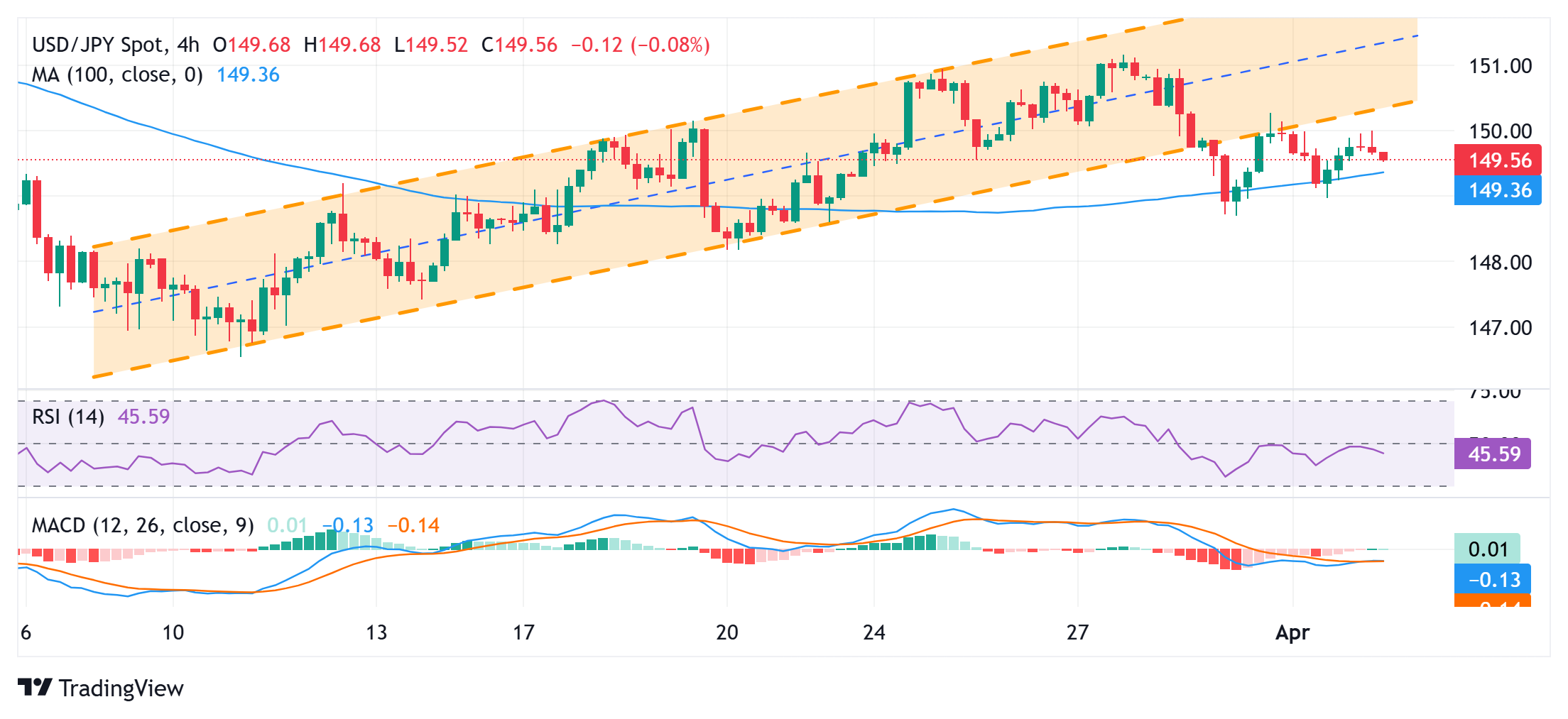
USD/JPY 4-hour chart
Technical Outlook
From a technical perspective, the USD/JPY pair has been showing resilience below the 100-period Simple Moving Average (SMA) since the beginning of this week. The subsequent move up could favor bullish traders, though neutral oscillators warrant some caution. Moreover, the recent breakdown below a multi-week-old ascending channel makes it prudent to wait for strong follow-through buying before positioning for any meaningful gains.
On the flip side, the 149.30-149.25 area, or the 100-period SMA on the 4-hour chart, could protect the immediate downside ahead of the 149.00 mark and the 148.70 region, or the weekly swing low. Some follow-through selling will be seen as a fresh trigger for bearish traders and make the USD/JPY pair vulnerable to resume a well-established downtrend witnessed over the past three months or so.
Premium
You have reached your limit of 3 free articles for this month.
Start your subscription and get access to all our original articles.
Author
Haresh Menghani
FXStreet
Haresh Menghani is a detail-oriented professional with 10+ years of extensive experience in analysing the global financial markets.