USD/JPY at 160.00: What the Yen can expect

USD/JPY remains near 160.00 on Thursday, having tested early September highs yesterday and today. Despite the yen’s attempts to recoup some losses, USD/JPY remains relatively stable above 159.50, so it is too early to speak of a sustained reversal lower.
The yen is being supported by expectations of a Bank of Japan rate hike in December. Preliminary CGPI data showed wholesale inflation rising 0.7% month-on-month in October – the first increase in three months – with the annual rate accelerating to 7.1% from 6.8%. Additional support came from comments by Japan’s chief currency diplomat, Atsushi Mimura, who warned about excessive exchange rate volatility. This has brought the risk of currency intervention back into focus.
The dollar, meanwhile, is holding near highs last seen in April 2025. Markets are increasingly pricing in another Fed rate hike, including the possibility of a 50-basis-point move in December. Expectations of tighter Fed policy and the geopolitical premium surrounding the US-Iran confrontation continue to support the US dollar.
Donald Trump has made clear that further strikes on Iran are unlikely for now, supporting hopes for a negotiated settlement. However, attacks in the region, including strikes on facilities associated with shipping through the Strait of Hormuz, mean a diplomatic resolution cannot be taken for granted.
As a result, the fundamental backdrop for USD/JPY remains mixed, with the yen supported by BoJ tightening expectations and intervention risk, while expectations of tighter Fed policy and geopolitical uncertainty support the dollar.
Technical analysis
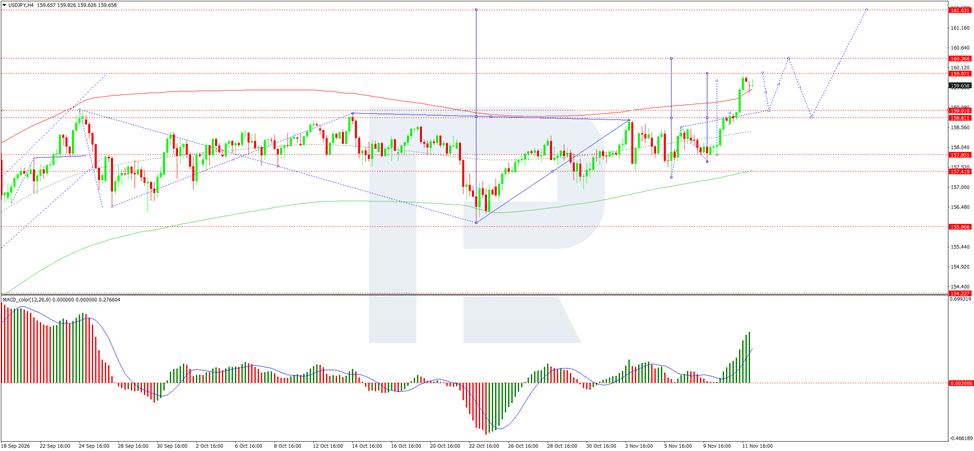
On the H4 USD/JPY chart, the upward structure remains intact: after breaking out of the 158.81 area, the pair gained momentum towards 159.92 and moved into consolidation. The nearest resistance is around 159.96. A break above this level would open the way for further gains towards 160.36, the next local target. At the same time, after reaching a new high, an intermediate correction towards 159.00 is possible, followed by a potential resumption of the upward move.
The MACD indicator supports the positive medium-term outlook. The histogram is above zero, and the signal line is pointing upwards. However, the latest histogram bar is smaller, indicating weakening momentum, so an immediate acceleration in the upward move has not yet been confirmed. Holding above the 159.00 area would support the main scenario.
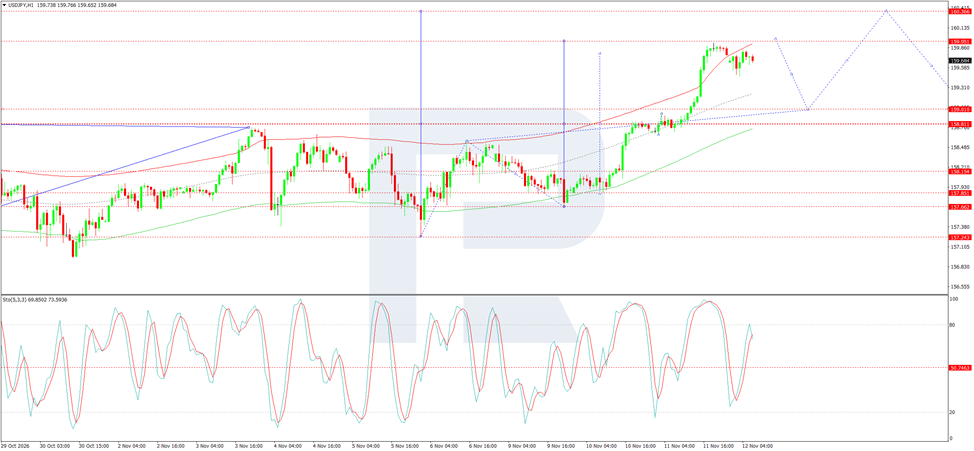
On the H1 USD/JPY chart, the pair has entered consolidation following a sharp rise. The 159.79 level is the nearest upside reference point, although the upper boundary of the recent move lies higher. A move towards 159.96 is viewed as the first stage of a potential advance towards 160.36. The Stochastic is holding above 50 but turning downwards after recovering towards the 80 zone. This allows for a short-term decline before another attempt to move higher.
For the coming day, a test of 159.96 remains the baseline scenario. Sustained consolidation above resistance would increase the likelihood of a move towards 160.36. Failure to break above would maintain the risk of a return to 159.00. A break below this support would shift attention to 158.81 and require a reassessment of the upward scenario. Local advances and corrective pullbacks are likely to alternate until the price breaks decisively out of consolidation.
Conclusion
USD/JPY remains near 160.00, with the yen finding support from expectations of a December BoJ rate hike, accelerating wholesale inflation and intervention warnings from Japan’s chief currency diplomat. The dollar, in turn, is supported by expectations of tighter Fed policy – including the possibility of a 50-basis-point move in December – and lingering geopolitical uncertainty surrounding the US-Iran confrontation. Technically, the pair retains an upward structure, with resistance at 159.96 and a target at 160.36 if the breakout is confirmed. A corrective pullback towards 159.00 is possible before the upward move resumes, while a break below that support would shift attention to 158.81 and call the upward scenario into question. The near-term direction will hinge on whether buyers can break above 159.96 or whether intervention risks and corrective pressure prevail.
Author

RoboForex Analysis Department
RoboForex
RoboForex Analysis Department provides timely market insights, expert technical analysis, and actionable forecasts across forex, commodities, indices, and equities.