USD/JPY after volatility: Multiple events in one day

USD/JPY recovered to 160.60 on Friday following a sharp drop the previous day. Investors believe the Bank of Japan intervened to support the yen, although there has been no official confirmation.
The Bank of Japan also held its policy meeting today, keeping the rate unchanged at 1.0%. Borrowing costs remain at their highest level since September 1995, after a 25-basis-point hike in June.
The decision was in line with market expectations and was passed by a vote of eight to one. Board member Hajime Takata dissented, advocating for a further rate increase and highlighting the risk of accelerating inflation due to heightened demand pressures linked to the Middle East conflict.
In its quarterly outlook, the BOJ lowered its core inflation forecast for fiscal year 2026 to 2.5% from 2.8%, attributing the revision to a gradual weakening of the impact from previously elevated oil prices.
At the same time, the BOJ slightly raised its GDP growth forecast for fiscal year 2026 to 0.6% from 0.5%, supported by robust domestic demand and government measures aimed at reducing household energy spending over the summer.
For fiscal year 2027, the core inflation forecast was raised to 2.4% from 2.3%, while GDP growth expectations were trimmed to 0.8% from 0.9%.
Technical analysis
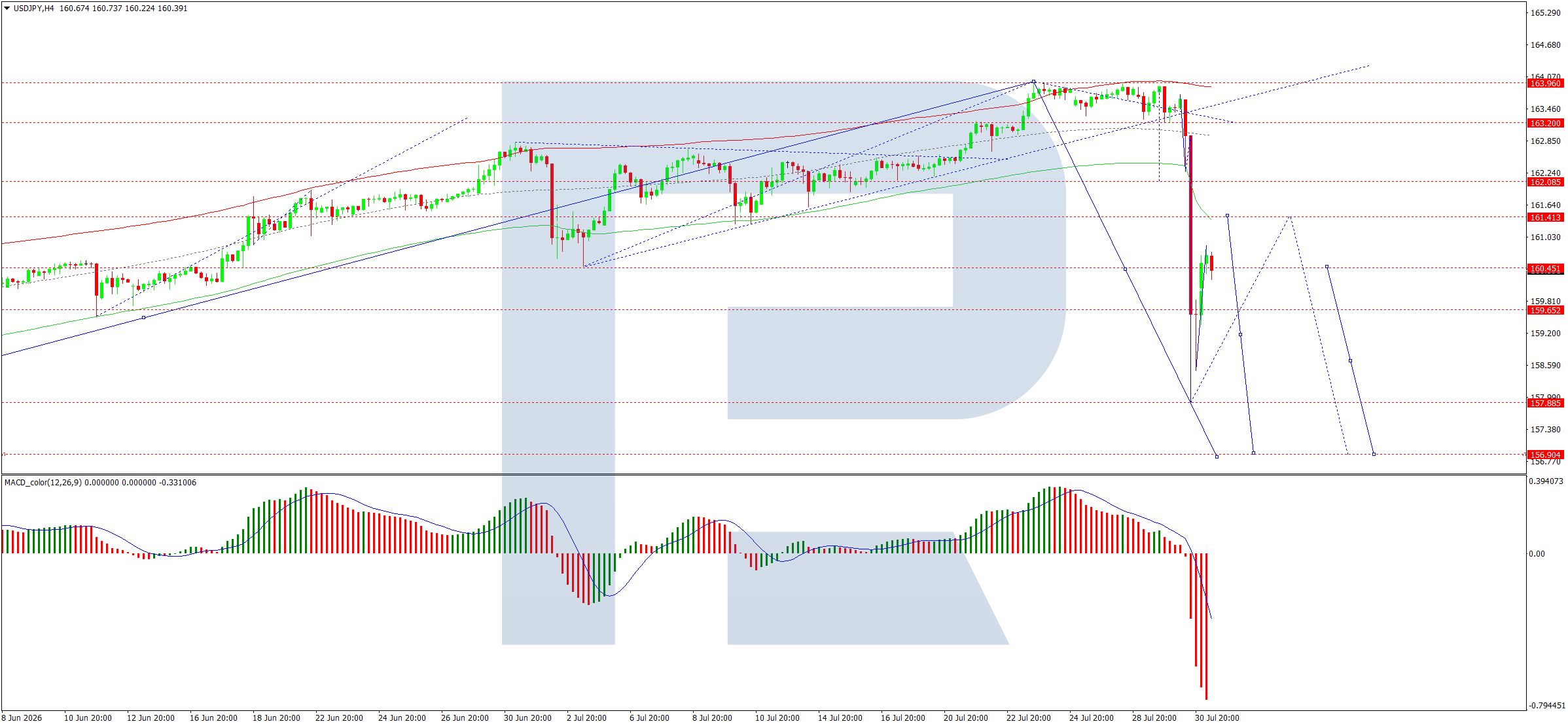
On the H4 USD/JPY chart, the market is forming a consolidation range around the 159.65 level, currently extending between 159.65 and 160.83. A move lower towards 159.66 is expected today, followed by a move higher to 161.44. The MACD indicator supports this scenario, with its signal line below zero and pointing downwards.
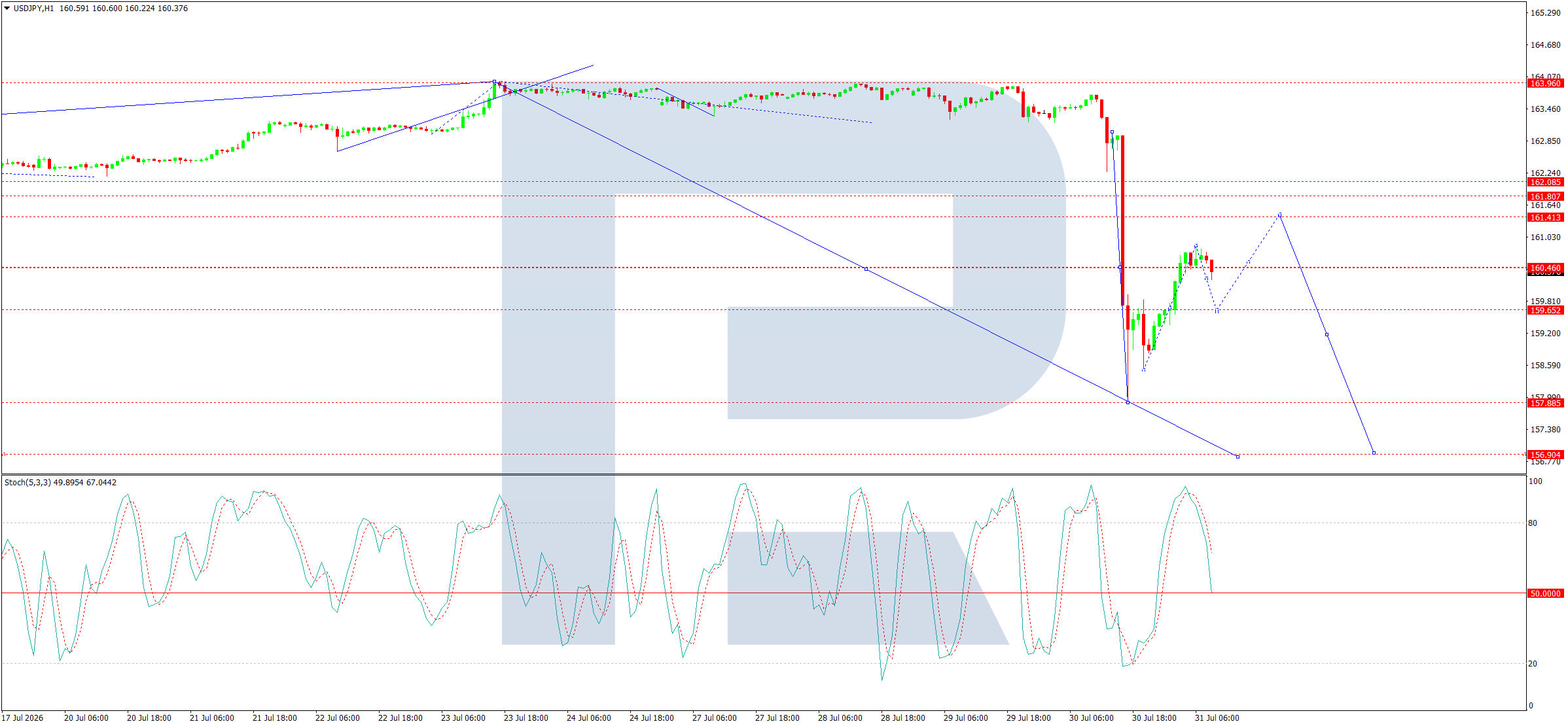
On the H1 chart, USD/JPY has completed a downward move to 158.53, followed by a rise to 160.86. A move lower towards at least 159.66 is expected next, followed by a move higher to 161.44. The Stochastic oscillator confirms this scenario, with its signal line below 80 and pointing downwards towards 20, indicating short-term downside pressure.
Conclusion
USD/JPY saw significant volatility following a suspected intervention by Japanese authorities, although no official confirmation has been provided. The Bank of Japan kept rates unchanged at 1.0%, as widely expected, with one dissenting vote calling for further tightening. The central bank revised its inflation and growth forecasts, lowering its core inflation outlook for 2026 while slightly raising GDP expectations for the same period. The mixed signals from the BOJ, combined with lingering geopolitical risks and speculation over further intervention, have left markets uncertain. Technically, USD/JPY may see a short-term pullback towards 159.66 before resuming its upward trajectory towards 161.44. The pair’s direction will depend on further signals from Japanese authorities and global risk sentiment.
Author

RoboForex Analysis Department
RoboForex
RoboForex Analysis Department provides timely market insights, expert technical analysis, and actionable forecasts across forex, commodities, indices, and equities.