USD/CNH put fly


Data buffet
I mentioned a few weeks ago that I have onboarded the Perscient data system and I have started working with it this week. The system is a new product from Ben Hunt and Rusty Guinn of Epsilon Theory fame. The machine collects millions of news stories, TV broadcasts, social media posts, and other forms of media and measures the density of semantic signatures of various stripes. The dashboard I use is customized for FX and macro. There are tabs for every central bank, currency, and macro theme/narrative of relevance. The page for CNY includes these measures:
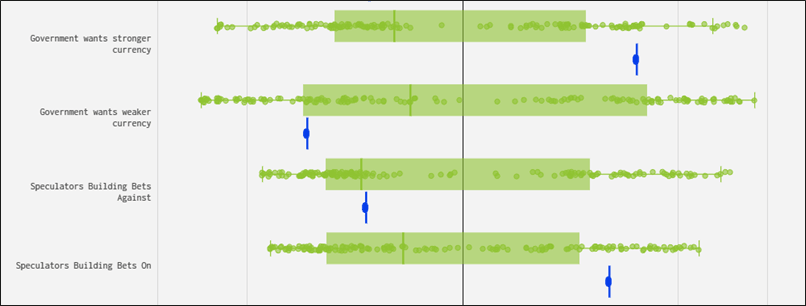
The blue bar shows the current reading; the green dots and bars show the individual readings and median zone. There are hundreds of these data sets, but today I will focus exclusively on the data surrounding the yuan.
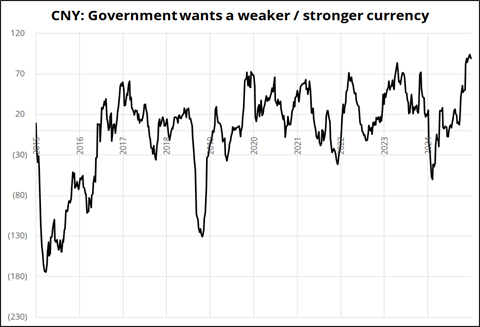
These readings are interesting to me because the CNY (and CNH) are primarily driven by just two factors: The overall direction of the USD, and the PBoC’s policy preference. You can export the data to create a time series, and here is the net of “Government wants stronger currency” and “Government wants weaker currency”
Anyone following China could tell you that the general vibe is towards a stronger currency these days, but I was surprised that the density of media reports is at its highest level ever. To see how the government preference evolves over time with the value of the CNH, we need to look at the CFETS basket because USDCNH has so much USD beta. I use CNH and CNY interchangeably here.
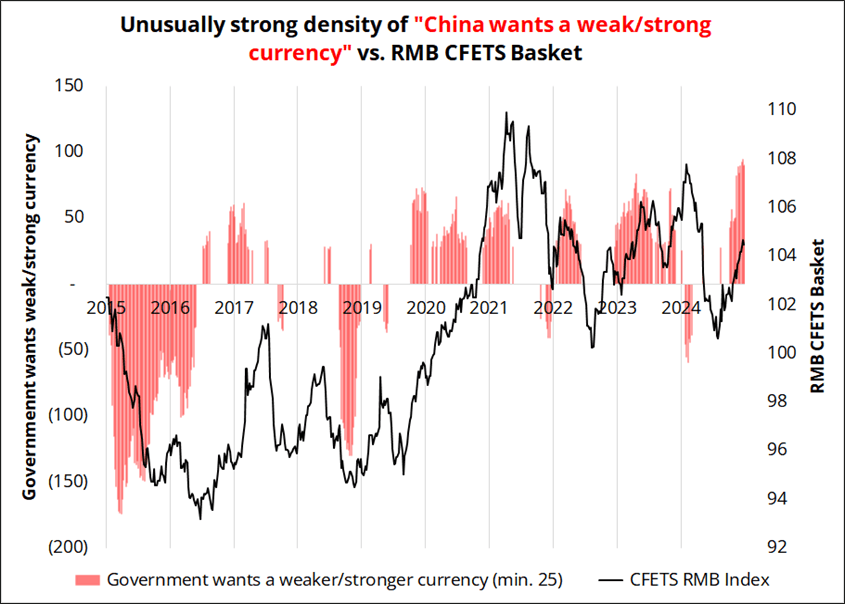
This chart shows a red bar any time the series plotted above gets above +25 or below -25, overlayed with the CFETS RMB Basket (using BIS weights for the currency basket). A higher number is stronger CNY vs. the basket. I used the >25 filter to reduce the noise a bit.
If you spend a bit of time staring at that chart, you can see that the government preference mostly comes true. When they stopped preferring a weak currency in 2016, that was the bottom. Their preference for stronger CNY came true in 2017. Weak in 2019. Strong in 2020/2021. Weak in 2024. It’s not perfect, but it’s pretty solid.
To test it, I ran a simple strategy. Go long if they want it strong / go short if they want it weak. Here’s the result.
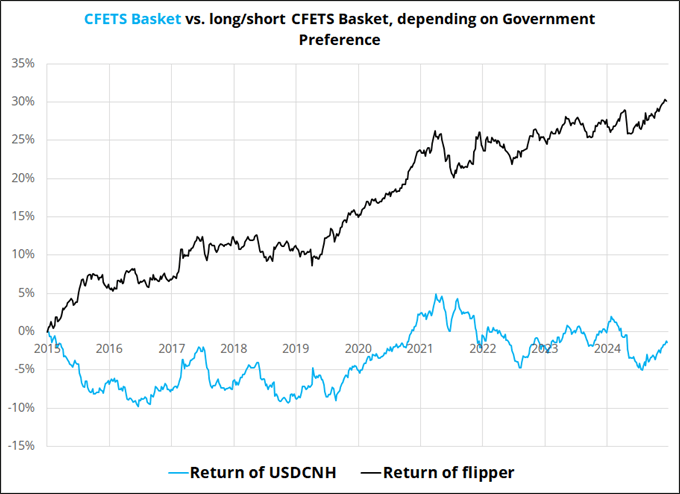
Pretty good! The CFETS is virtually unchanged vs. where it was in 2015, while the strategy caught the major trends in both directions and generated pretty solid returns for something with a 90-day realized volatility around 7%.
Trading the CFETS is a bit complicated as you need to execute a basket of currencies against CNH. It’s a hassle. The good thing is, if you’re bearish USD (I am) and bullish CNH vs. the basket (I am)… Short USDCNH works. This trade idea will only work for institutional clients, but I really, really like this put fly.
Buy 6.98 USDCNH put.
Sell 6.88 USDCNH put (X2).
Buy 6.78 USDCNH put.
1X2X1 this is. The cost is around 15bps off 7.0550 spot and if you get to 6.88 it pays 150bps. So that is 9:1 payout and it’s realistic that it could happen, I think. You spend $250,000 and if you pin the 6.88, you make $2.2 million.
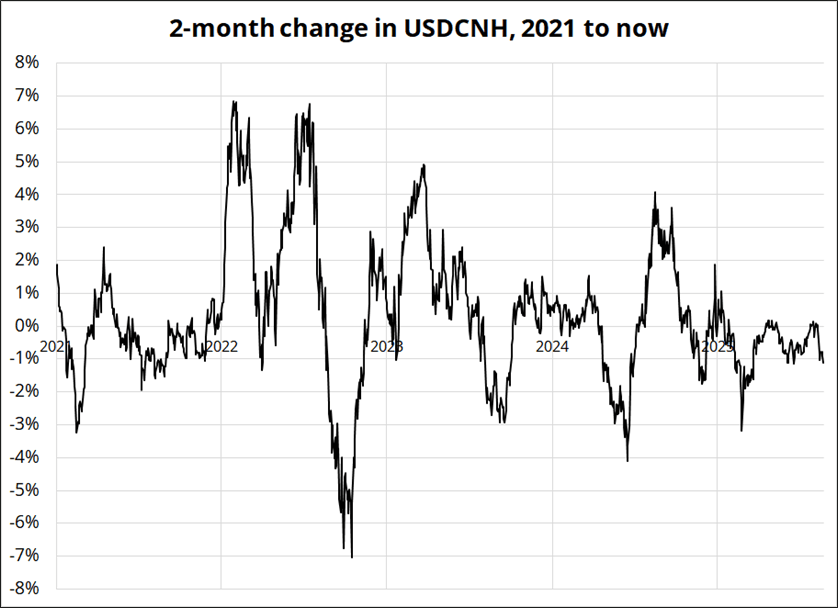
The strikes are chosen because 2.5% in two months is a big move. It’s a fairly realistic move, but it’s near the maximum you might expect. Here is the 2-month change in USDCNH over the years. Current spot 7.0550 X 0.975 = 6.88.
Also: The number 8 is considered lucky in Chinese culture because its pronunciation, bā, sounds similar to the word fā (发), which means "to prosper" or "to get rich". This phonetic similarity links the number 8 to wealth, success, and good fortune, leading people to incorporate it into important events, business practices, and daily life. And this structure has a ton of 8’s in it. So there’s that.
I think this is an excellent structure and I am adding it to the Current Trades. This is effectively doubling down on the short USD trade I put on yesterday. If you have a relationship with Spectra FX, please ping me on Bloomberg and I can price this up for you.
If you are curious about Perscient… Here’s the dashboard I look at. There are tabs for Central Banks, Growth, Geopolitics, Fiscal, Trade, and Currencies. Then you click through and there are a zillion reading for the semantic signatures; they all look like the graphic on page 1.
I was worried it would be overwhelming, but you kind of know what is relevant and what isn’t at any given time, so it’s pretty easy to zoom in on the factors you’re interested in.

My guess is that this enormous trove of data would be pure gold for systematic trading strategies, so if that’s your business, you might be interested too. I realize this is starting to sound like an ad for Perscient, but I am more than happy to vouch for it as Ben Hunt is probably the first person in the world I would trust to build something like this, or to babysit my kids if they were still little.
Author
Brent Donnelly
Spectra Markets
Brent Donnelly is the President of Spectra Markets. He has been trading currencies since 1995 and writing about macro since 2004. Brent is the author of “Alpha Trader” (2021) and “The Art of Currency Trading” (Wiley, 2019).