USD/CHF one to watch amid heightened trade war fears, SNB decision

Both the US dollar and US equity markets attempted to bounce on Wednesday after consecutive down days, but were unable to fully buck the pressures imposed largely by fears of an impending global trade war. These fears stemmed from US President Trump’s protectionist drive to impose hefty tariffs on foreign imports into the US. A report on Tuesday suggested that Trump may soon announce substantial tariffs on a wide range of imports from China. Markets were seriously concerned that such actions may prompt swift and severe retaliation from China that could result in a full-blown trade war. The list of major US companies that could stand to lose on such a retaliation and trade war is long.
As the US dollar continued to struggle under the specter of a potentially disastrous trade war, Wednesday’s US economic data releases were also not dollar-supportive. Though the Producer Price Index inflation reading for February came out slightly higher than expected at +0.2% against a +0.1% consensus expectation, it was significantly lower than January’s +0.4%. And the core PPI (excluding food and energy) was in-line with expectations at +0.2% after January’s +0.4%. Combining these PPI readings with Tuesday’s tepid CPI inflation data and the soft wage growth numbers released with last week’s US jobs report, it appears highly unlikely that the Federal Reserve will be compelled to raise interest rates at a faster pace than expected due to inflation concerns alone. In addition, Wednesday’s US retail sales data for February was significantly worse than expected, with the headline data coming in negative at -0.1% against previous expectations of +0.3%. Core retail sales (excluding automobiles) also disappointed at +0.2% versus a prior consensus of +0.4%.
As pressure on the dollar from weak data and trade war fears continued, USD/CHF traders were additionally anticipating Thursday’s monetary policy and rate decision from the Swiss National Bank. As usual, no changes are expected to be made on the negative Libor rate of -0.75%. However, the degree to which the SNB adheres to or strays from its typically dovish rhetoric will be a key concern for USD/CHF traders, especially since the Swiss franc remains exceptionally strong against the US dollar (a frequently-made observation by the central bank).
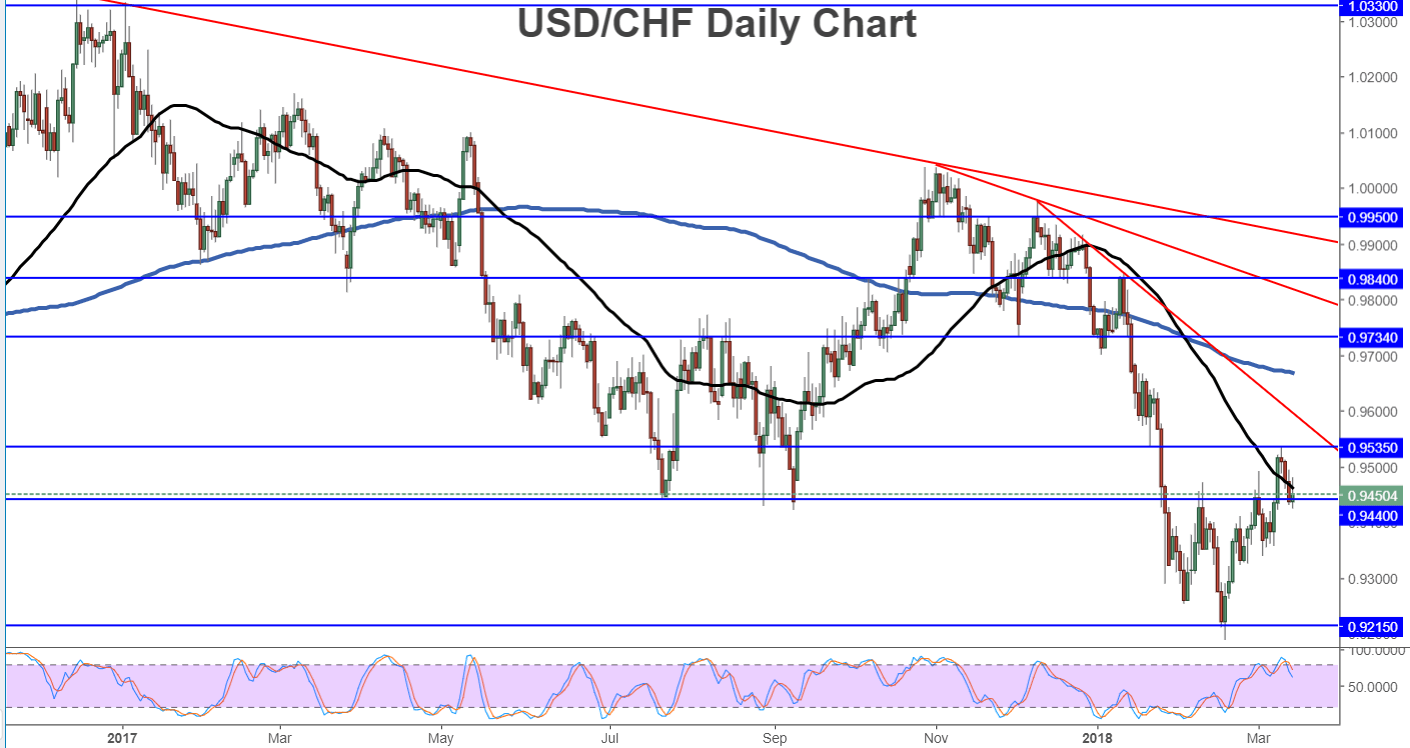
As it currently stands, USD/CHF continues to trade within a long-term and medium-term downtrend. Most recently, the currency pair retreated from key resistance around the 0.9535 level, and has settled just above support around 0.9440 as of this writing. With any further pressure on the dollar from trade war concerns, and/or a boost for the Swiss franc from a less dovish SNB, a breakdown below support could push the pair down towards the 0.9300 level. To the upside, any unexpected breakout above the noted 0.9535 resistance on a more dovish SNB or relief rally for the dollar, could boost USD/CHF towards the 0.9600 area.
Author

James Chen, CMT
Investopedia
James Chen, Chartered Market Technician (CMT), has been a financial market trader and analyst for nearly two decades.

















