|

USD/CAD turns higher for second week, tests 50-SMA

  • USDCAD rises above 1.3700 as gains extend for second consecutive week.
  • Technical bias remains positive, but caution emerges near 50-SMA.
USD/CAD turns higher for second week, tests 50-SMA
Chart

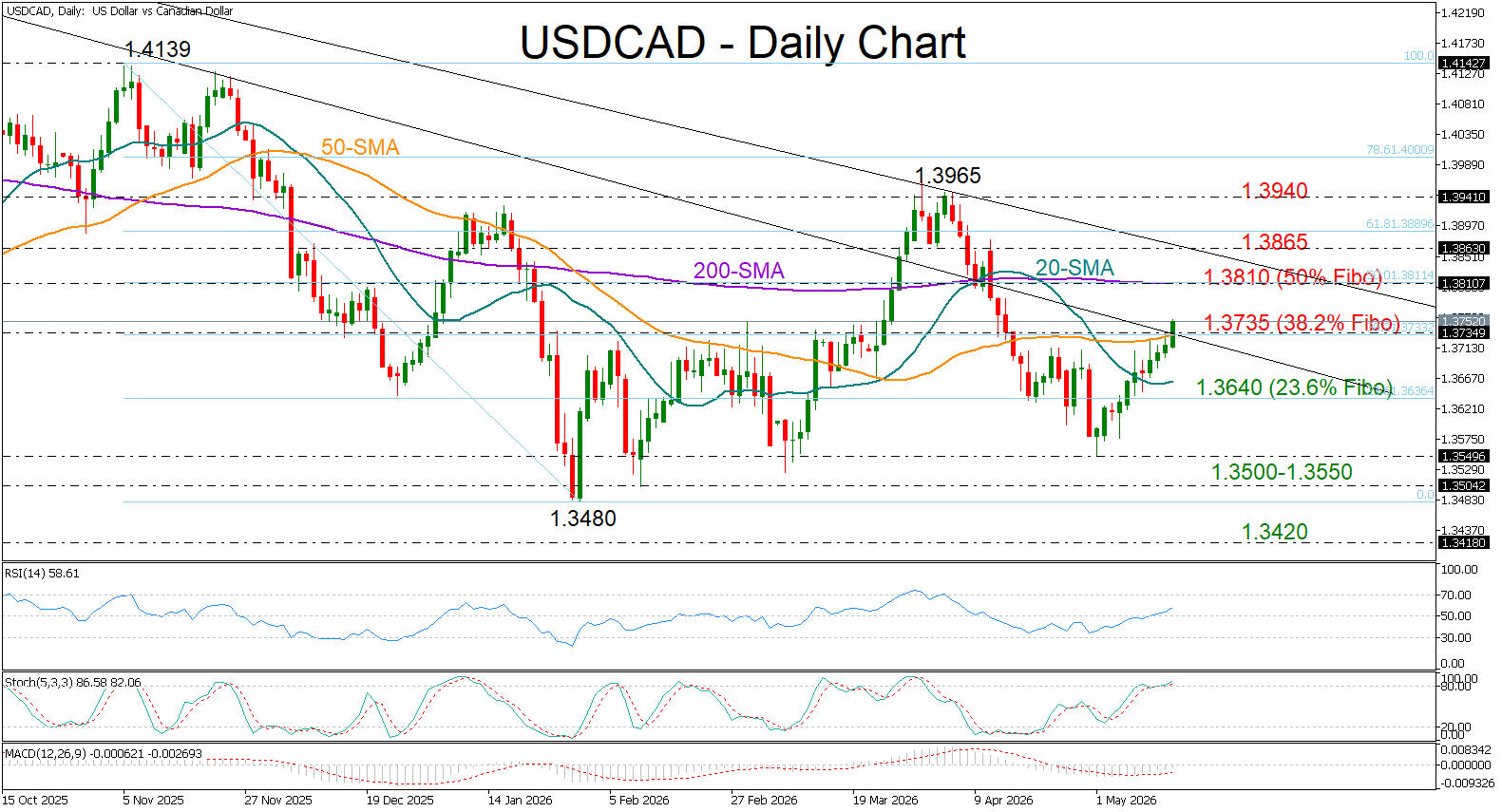
USDCAD has traded mostly in positive territory since the beginning of May. After stabilizing around the 1.3500 region for the third time this year, the pair is now attempting to close above its 50-day simple moving average (SMA) near 1.3735. The move follows President Trump’s comments expressing limited patience over Iran-related tensions, while two-day talks with China conclude.

Both the RSI and the MACD suggest improving buying momentum. However, the stochastic oscillator, which is hovering in overbought territory, signals caution as the pair tests the 38.2% Fibonacci retracement of the November–February decline near 1.3735. A decisive break above this level could pave the way toward the 200-day SMA and the 50.0% Fibonacci retracement at 1.3810. Slightly higher, a critical battle could emerge around the descending trendline connecting the 2025 and 2026 highs near 1.3860.

If the pair fails to maintain momentum above the 50-day SMA, it could retreat toward the 23.6% Fibonacci level at 1.3640. A deeper pullback may then retest the 1.3500-1.3550 zone, a break of which could reinforce the broader bearish outlook and expose the 2024 support level at 1.3420.

Overall, USDCAD remains in a bullish short-term mode, with further gains likely if buyers manage to clear the 1.3735 resistance area decisively. Nevertheless, the broader outlook remains bearish as long as the pair stays below 1.3860.

Author

Christina Parthenidou

Christina joined Trading Point in May 2017. She holds a master degree in Economics and Business from the Erasmus University Rotterdam with a specialization in International economics.


More from Christina Parthenidou
Share:

Editor's Picks

AUD/USD holds recovery above 0.6600 as risk rally meets twin inflation tests

AUD/USD is clinging to recovery gains above 0.6600 in Asia on Tuesday. The pair stopped the bleeding on Monday, recovering against the US Dollar as market mood improved on Jensen Huang's reappointment as NVIDIA’s CEO, while traders await crucial Australian and US inflation data amid ongoing Middle East tensions.


USD/JPY stays defensive near 159.00 amid intervention fears, USD retreat

USD/JPY remains on the back foot near 159.00 during Asian trading hours on Tuesday. The Japanese Yen gains traction as traders remain on high alert for market action amid intervention risks. Additionally, a broad US Dollar retreat on the resurgence of AI trade optimism weighs on the pair. Traders now await Wednesday's US Personal Consumption Expenditures (PCE) Price Index data for fresh impetus.

Gold declines toward $3,600 as mood sours

Gold (XAU/USD) finds it difficult to build on Monday's gains and declines toward $3,600 on Tuesday. The risk-averse market atmosphere, as reflected by the bearish action in US stock index futures, and reports claiming that the US is preparing to raise tariffs on China and other countries weigh on the precious metal.

Crypto Today: Bitcoin and Ethereum edge lower, XRP stabilizes as ETF redemptions continue

Cryptocurrency prices are sending mixed signals on Tuesday, with both Bitcoin (BTC) and Ethereum (ETH) edging lower while Ripple (XRP) trades broadly sideways around $0.94.

Jensen Huang is back – Is it time to buy AI stocks again?

Jensen Huang’s return removes a major source of uncertainty for the AI trade. While it may not justify immediate earnings upgrades, it reduces the risk of earnings downgrades. Investors should distinguish between a tactical recovery and a sustainable investment opportunity, prioritising earnings resilience, financial strength and reasonable valuations.


Gold snaps a five-day losing streak as Bessent warns the Fed against overtightening
Gold (XAU/USD) stages a strong recovery on Monday to trade above the $3,600 level. The precious metal snaps a five-day losing streak after suffering a nearly 9% decline last week, its steepest weekly setback in the recent sell-off, as investors reconsider the prospects for further monetary tightening in the United States (US).