USD/CAD sellers eye a break below 1.3770 on potential CPI miss
USD/CAD has threatened to break below 1.3770 twice, but buyers have defended the level on both occasions. The pair remains under pressure, although the Canadian dollar has offered little support of its own to accelerate the decline.
Recent moves in USD/JPY show the importance of the other side of a currency pair. The yen has gained around 1.7% this week against the dollar, supported by expectations of further Bank of Japan tightening. The Canadian dollar does not have the same level of monetarypolicy support.
The Bank of Canada adopted a more cautious tone at its September meeting, acknowledging that upside inflation risks had increased. However, the latest employment report weakened the case for an immediate change in policy. Canadian employment declined by 42,000 in August, against expectations for an increase of around 15,000, reversing part of July’s 75,000 gain. The unemployment rate remained unchanged at 6.4%.
Canada’s next inflation report will provide another important test of the Bank of Canada’s position. A softer reading would reinforce the argument for keeping interest rates unchanged, despite the Bank’s concerns about energy prices and other upside inflation risks.
Higher oil prices would normally provide some support for the Canadian dollar. WTI crude approached $96 per barrel as the US-Iran conflict escalated, while Brent moved above $100. However, the Loonie has struggled to benefit, partly because of concerns surrounding Canada’s domestic economy and renewed trade tensions with the United States.
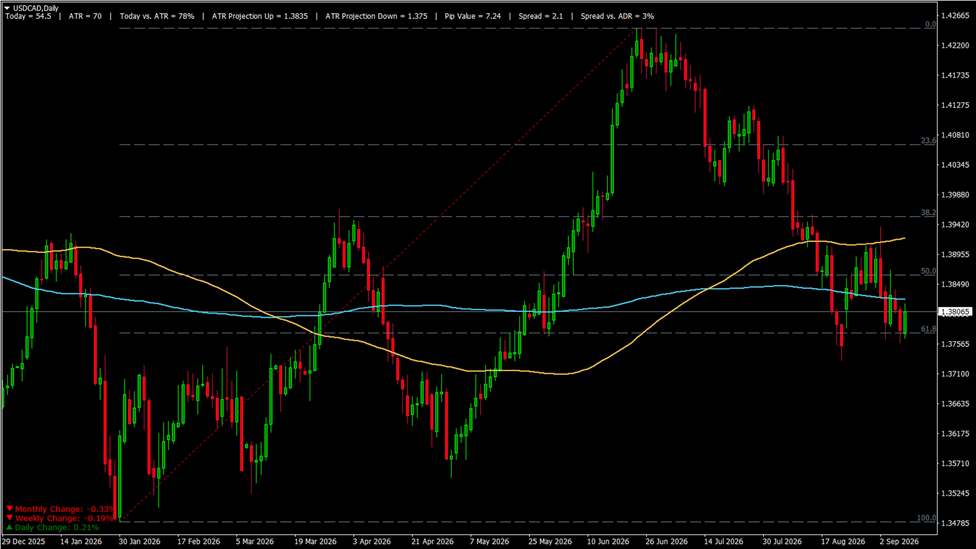
On the daily chart, USD/CAD trades below its 100-day and 200-day moving averages following a firm rejection from the 50% Fibonacci retracement around 1.3865. Buyers have continued to defend the 1.3770 area, but the 200-day moving average could restrict any sustained recovery.
The next major catalyst is Friday’s US Consumer Price Index report. Market’s Expectation is for headline CPI to rise by 0.4% m/m in August, while core CPI is expected to increase by 0.2%.
According to CME FedWatch, markets currently assign a 37.6% probability to the Federal Reserve holding interest rates unchanged in September, while the probability of a 25-basispoint hike stands at 62.4%. A softer-than-expected CPI print could increase the probability of a hold and put further pressure on the US dollar, giving USD/CAD sellers another opportunity to break below 1.3770.
In contrast, a material upside surprise would strengthen the case for higher US interest rates and could push the pair back towards 1.3865 and 1.3890. A result broadly in line with expectations may leave USD/CAD trading between these levels, although the direction of Treasury yields and developments in the US-Iran conflict would remain important.
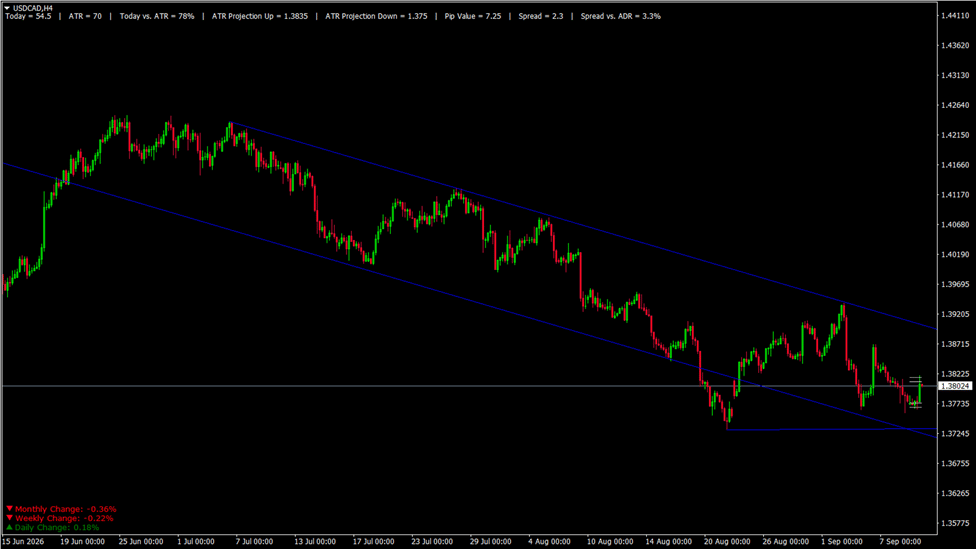
On the four-hour chart, USD/CAD has traded within a descending channel. Price briefly broke below the channel on August 20, but the move was not sustained, with buyers pushing the pair back inside the structure and towards its upper boundary before sellers regained control.
Positioning ahead of the US CPI release could produce another recovery towards the 1.3865–1.3890 resistance area. That would offer sellers a better level from which to target another move below 1.3770 and, eventually, the previous low around 1.3730.
A sustained break and retest below 1.3730 would place sellers firmly in control and expose the 1.3550 region. However, an upside CPI surprise and a corresponding rise in Treasury yields would weaken the bearish setup and increase the risk of a break above 1.3890.
Author

Olalekan Akinola
Independent Analyst
Olalekan Akinola is a financial-markets analyst and writer with five years of experience covering forex, commodities, and global macroeconomic developments.