USD/CAD Forecast: Bears seize control below 100 DMA, could target November 2022 lows
- USD/CAD adds to Friday’s heavy losses and continues losing ground for the second successive day.
- Upbeat Canadian jobs data, an uptick in oil prices underpin the Loonie and exert pressure on the pair.
- A combination of factors weighs on the USD and contributes to the ongoing downward trajectory.

The USD/CAD pair remains under heavy selling pressure for the second successive day and drops to over a one-month low during the Asian session on Monday. This also marks the third day of a negative move in the previous four and is sponsored by a combination of factors. The Canadian Dollar continues to draw support from the upbeat domestic employment details released on Friday. Furthermore, a modest uptick in crude oil prices underpins the commodity-linked Loonie. This, along with sustained US Dollar selling, is seen weighing on the major.
Statistics Canada reported that the economy added a whopping 104K jobs in December, surpassing even the most optimistic estimates. Adding to this, the unemployment rate unexpectedly ticked down from 5.1% in November to 5.0% during the reported month. The US NFP report, meanwhile, showed an addition of 223K jobs in December as compared to the 200K estimated. Moreover, the jobless rate edged down to 3.5% from the previous month's downwardly revised reading of 3.6%, though was overshadowed by softer Average Hourly Earnings growth data.
Separately, the US ISM Services PMI fell in contraction territory and hit the worst level since 2009, fueling expectations for a less aggressive policy tightening by the Fed. This leads to a further decline in the US Treasury bond yields, which, along with the prevalent risk-on environment, contribute to driving flows away from the safe-haven buck. The bad economic data is good news for the markets. Furthermore, the optimism over China's
the biggest pivot away from its strict zero-COVID policy boosts investors' confidence.
In fact, China opened its borders over the weekend for the first time in three years. This, in turn, lifts the outlook for fuel demand growth and acts as a tailwind for the black liquid. That said, worries that the massive flow of Chinese travellers may cause another surge in COVID infections and looming recession risks could cap gains for oil prices. Furthermore, reluctance to place aggressive bets ahead of the release of the US consumer inflation figures on Thursday might help limit any further losses for the USD/CAD pair.
Technical Outlook
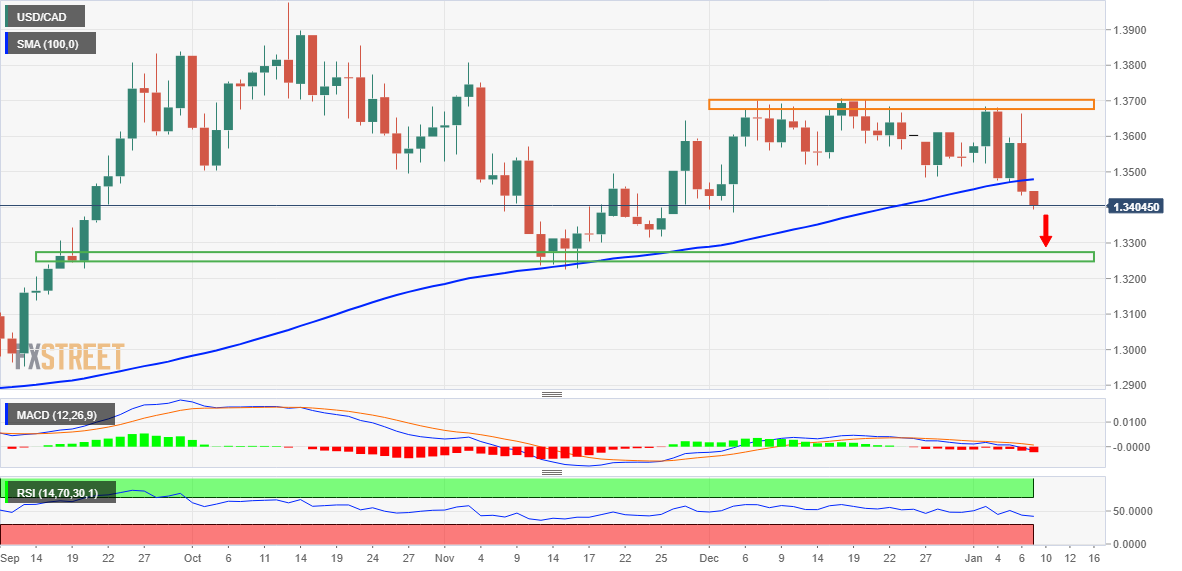
From a technical perspective, the recent repeated failures near the 1.3700 mark and a subsequent breakdown below the 100-day SMA support could be seen as a fresh trigger for bearish traders. Given that oscillators on the daily chart are holding in the negative territory and are still far from being in the oversold zone, the USD/CAD pair seems poised to depreciate further. Hence, some follow-through weakness towards the next relevant support, around the 1.3335-1.3330 horizontal support, looks like a distinct possibility. This is followed by the 1.3300 round figure, below which spot prices could drop to the 1.3250 intermediate support en route to the November 2022 low, around the 1.3230-1.3225 region.
On the flip side, any meaningful recovery attempt might now confront stiff resistance near the 100-day SMA support breakpoint, currently around the 1.3470 region. That said, some follow-through buying, leading to a subsequent strength beyond the 1.3500 psychological mark, could trigger a near-term short-covering rally. The USD/CAD pair might then climb to the 1.3540-1.3545 intermediate hurdle and eventually aim to reclaim the 1.3600 mark. The latter should act as a pivotal point, which if cleared decisively will negate the negative outlook and shift the bias back in favour of bullish traders.
Author

Haresh Menghani
FXStreet
Haresh Menghani is a detail-oriented professional with 10+ years of extensive experience in analysing the global financial markets.