US PCE Inflation Preview: Gold could extend slide toward $1,780 on Fed's rate outlook
- Annual Core PCE Price Index is expected to rise to 4.1% in October.
- Fed rate hike expectations continue to drive US T-bond yields higher.
- Gold eyes $1,780 as the next target on the downside.

The US Bureau of Economic Analysis will release the Personal Consumption Expenditures (PCE) Price Index data on Wednesday, November 24. Investors expect the Core PCE Price Index, the Federal Reserve’s preferred gauge of inflation, to rise to 4.1% on a yearly basis from 3.6%.
Earlier in the month, the US Bureau of Labor Statistics reported that the annual Consumer Price Index (CPI) jumped to 6.2% in October from 5.4% in September. With this print surpassing analysts’ estimate of 5.4% by a wide margin, markets started to reassess the Fed’s policy outlook in the face of the strongest inflation in nearly three decades.
On November 3, the Fed noted that it will start reducing its asset purchases by $15 billion per month to conclude the quantitative easing program by June 2022. Although FOMC Chairman Jerome Powell reiterated that the Fed will not rush to hike its policy rate at the end of tapering, the sharp increase witnessed in the US Treasury bond yields after the CPI report showed that markets don’t think that the Fed could stay patient.
In fact, the CME Group’s FedWatch Tool’s probability of the Fed leaving its policy rate unchanged by June 2022 currently stands at only 20%.
In the meantime, US President Joe Biden announced on Monday that he has nominated Powell for a second four-year term as the Fed chair, giving more confidence to markets that the hawkish policy outlook will remain intact.
In summary, unless the PCE inflation data reveal that price pressures have suddenly started to ease in October, markets are unlikely to change the way they price in rate hike expectations.
Gold outlook
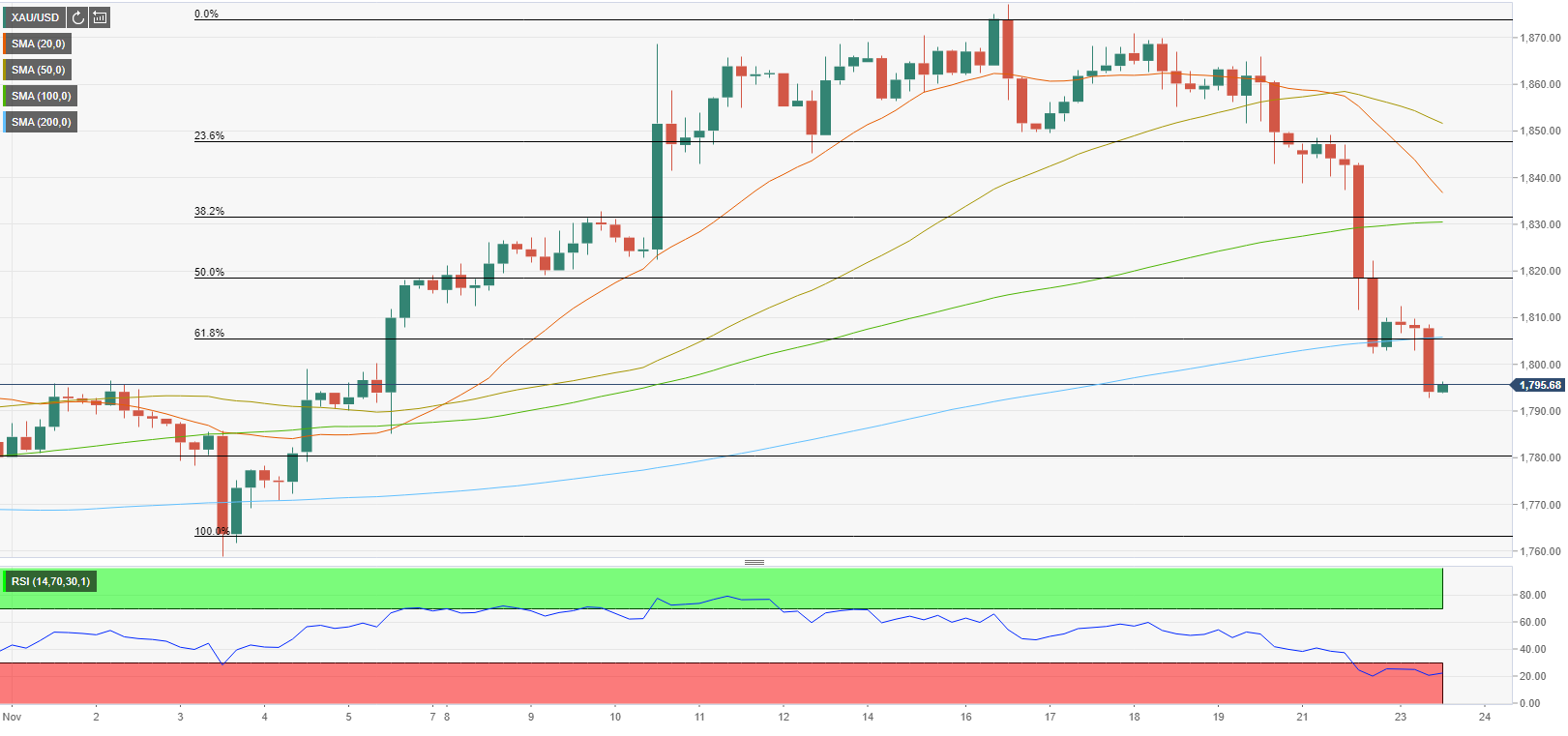
XAU/USD rose sharply with the initial market reaction to the CPI data as the precious metal attracted demand as a traditional inflation hedge. However, the pair struggled to preserve its bullish momentum after climbing to a multi-month high of $1,877 and then reversed its direction. XAU/USD slumped below $1,800, erasing the majority of CPI-inspired gains, as gold’s inverse correlation with US Treasury bond yields once again became the primary driver of valuations, .
The technical picture also reveals an obvious bearish shift in the near-term outlook. Gold is trading below the 200-period SMA on the four-hour chart for the first time since November 3 and buyers have failed to defend the key $1,800 level.
The Relative Strength Index (RSI) indicator is staying below 30, suggesting that gold could stage a technical correction before the next leg down.
As long as the $1,800/$1,805 resistance area, where the Fibonacci 61.8% retracement level of the latest uptrend and the 200-period SMA are located, holds, sellers are likely to continue to dominate XAU/USD in the near term. Above that level, the next hurdles are aligned at $1,820 (Fibonacci 50% retracement) and $1,830 (100-period SMA)
On the downside, $1,780 (static level) could be seen as the first target ahead of $1,760 (the starting point of the latest uptrend).
Author

Eren Sengezer
FXStreet
As an economist at heart, Eren Sengezer specializes in the assessment of the short-term and long-term impacts of macroeconomic data, central bank policies and political developments on financial assets.