US oil – Reduced production and economic recovery

Crude Oil Looks Neutral
USOIL trades have been in the range of $39.20 – $41.90 since the beginning of July. Various factors drive the oil market, all of which eventually affect the market’s supply and demand.
On the supply front, OPEC+ agreed to reduce its output from 9.7 million barrels per day to 7.7 million barrels per day from August, which was decided at its last meeting in mid-July. There were indications that some countries were not living up to their previous commitment, however, which meant more supply.
On the other hand, demand is in the spotlight too. How can we understand that demand is growing? Some of the signals for it can be examined, such as GDP, retail, industrial and factory production data, as well as index data of purchasing managers. The latest PMI data released earlier this week, coupled with a significant increase in retail sales, raised hopes that we can count on the recovery process. However, a second wave of coronavirus has begun in many countries, and could be seen as a negative point for market demand as some countries, or at least some parts of the country or state, are back in quarantine, as we saw earlier this week in Victoria, Australia.
In the end, the market now has some sort of balance between supply and demand, and that is exactly what balances price. The WTI market needs a strong signal to break out of this range, whether bullish or bearish, for good reason.
Technical overview
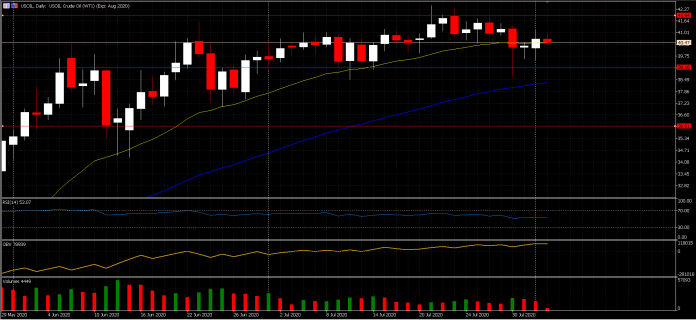
$40.47 is the current level, which is at 20 DMA. The next support of the lower line of the current range is at $39.20, followed by 50 DMA at $38.35, and a break of this level would put the focus on the next support at $36. On the upside, the market should be able to trade steadily above $41.00, with the 200 DMA resistance now at $42.90.