US midterms: Can democrats pull off a clean sweep as Trump sinks in polls?
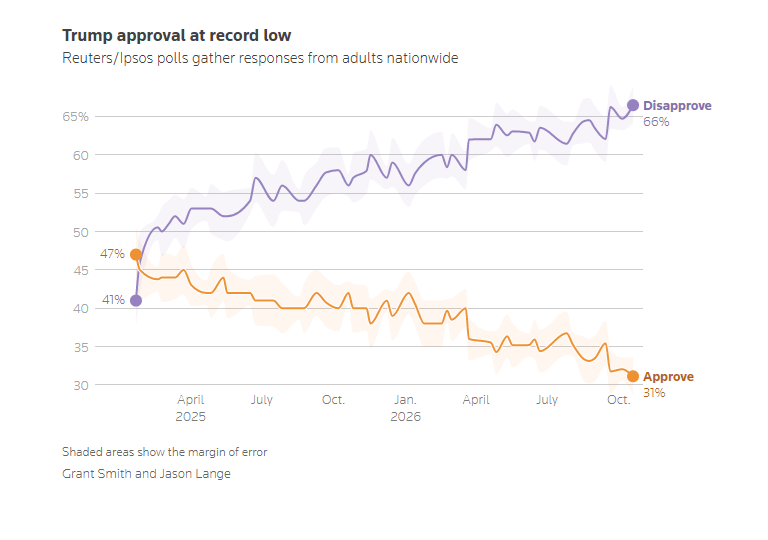
- Most polls show Trump’s popularity is near all-time lows.
- But does this imply a Republican wipeout?
- Democrats are riding high in the polls, but a blue wave is far from certain.
- Dollar and Wall Street stand to lose if Democrats retake Congress.
Democrats riding high in the polls
American voters go to the polls on November 3 to vote for a new Congress. All 435 seats in the House of Representatives are up for election, but in the upper Senate chamber, only 35 of the 100 seats are being contested. This doesn’t mean that the Senate is unlikely to change hands. In fact, most opinion polls indicate there’s a strong prospect of the Democrats regaining control of both the House and Senate.
The race to retake the House of Representatives should be quite straight forward for the Democrats. Aside from having history on their side, as the president’s party struggles to retain control of the House in midterm elections, Democrats only need to pick up four additional seats from the current 214 to win a majority. However, the Senate battle is much tougher than a lot of the polls suggest, as it’s a very tight race in several key states, such as North Carolina, Alaska, Iowa, Ohio, Maine and Texas.
Senate races are tight
Although Democrats also need to win just four seats in the Senate where Republicans hold a 53-47 majority, the number of states that have a realistic chance of flipping is fewer than 10. There are several reasons why these battleground states are proving to be so difficult for the Democrats.
For one, Republicans are pouring more money into the campaign than the Democrats are, particularly in this vital late stage. Moreover, most of the tight races are in states that are structurally Republican, giving the incumbents the edge. Further favouring the GOP is the fact that midterms tend to be more important for older voters, who are more likely to back the Republican party, while younger turnout isn’t as high as in presidential elections.
So even though the polls suggest greater enthusiasm for the Democrats, that support may not materialize if younger voters, who overwhelmingly prefer the blue party, do not turn out to cast their ballot, or if the polls are understating Republican support, as has been the case in recent elections.
Democrats can’t afford surprise losses
This isn’t the only risk for the Democrats, as it’s not just Republican-controlled seats they must fight. The slightest upset could see the Democrats lose their held seats in places such as Michigan, Georgia and New Hampshire.
There are dangers in the House race too for the Democrats, with the biggest being the redrawing of district maps. Several Republican states recently approved changes to congressional district lines in a bid to improve the GOP’s chances of securing those seats. Though, this hasn’t quite led to the boost they were hoping for.
The most important question, however, for the midterms, is whether Republican support will crumble because of the unpopularity of President Donald Trump. More crucially, will Trump’s record low approval ratings translate to votes for the Democrats?
High inflation comes back to haunt Republicans
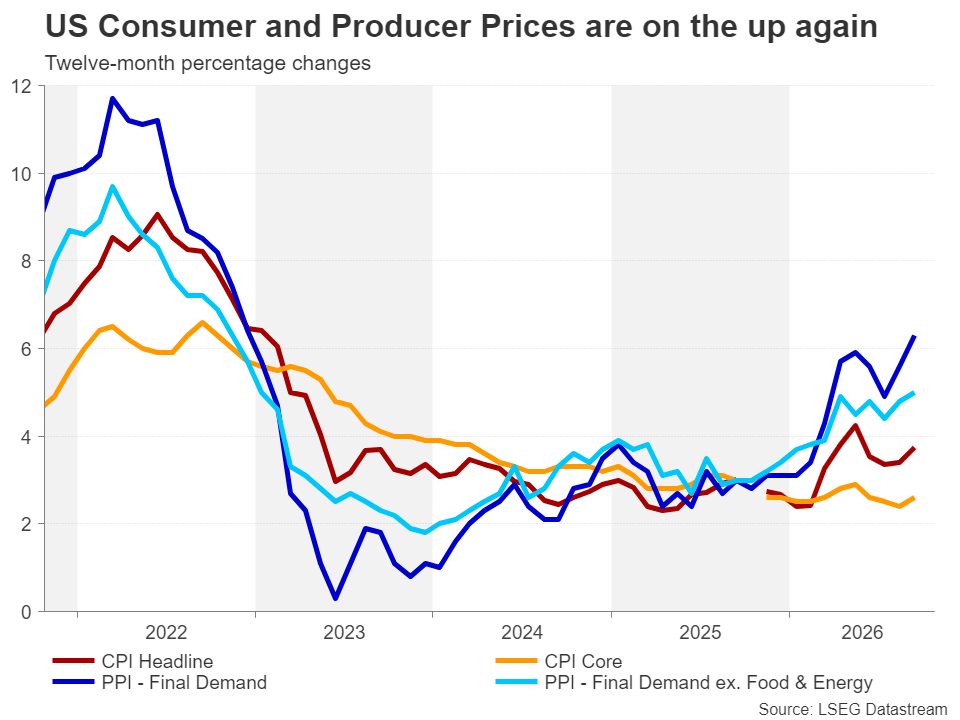
The biggest issue for American voters is the cost of living, which ironically, was a major reason why the Democrats did so badly in the 2024 Presidential Election. Trump’s decision to attack Iran several months before the midterms was a gamble that didn’t pay off, as rather than being the brief conflict he had hoped for, it has turned into a messy war that’s far from being resolved anytime soon.
Subsequently, gasoline prices shot up to the highest since soon after the start of the Russia-Ukraine conflict and diesel prices skyrocketed to record highs.
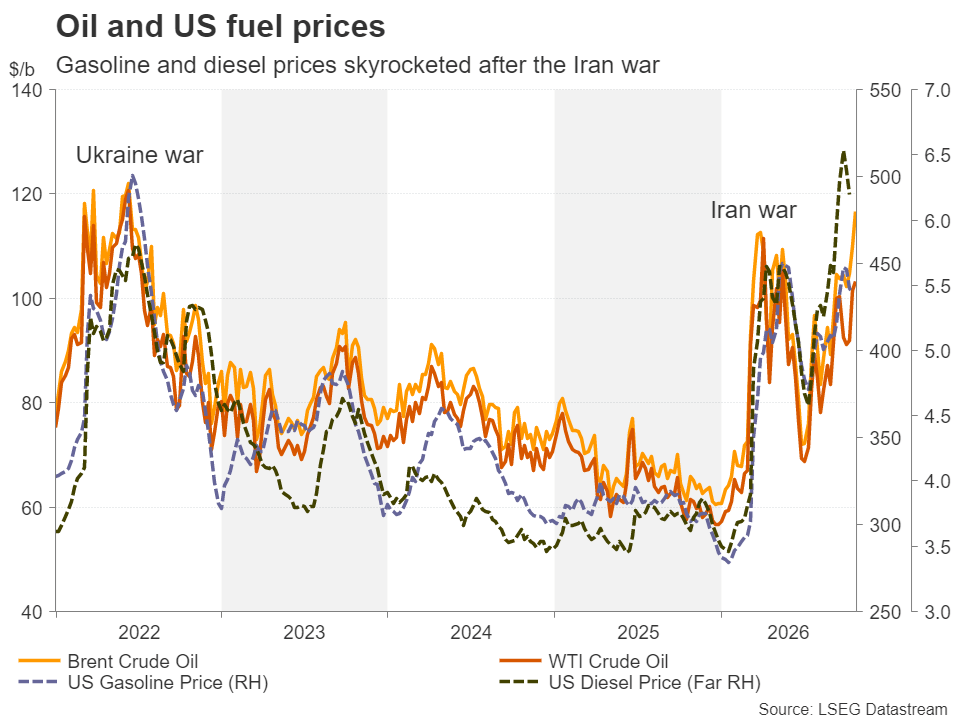
But price pressures were already brewing even before the US-Iran war, as Trump’s tariffs raised the cost for a whole host of imported goods. Add to that the surge in semiconductor prices, or ‘chipflation’, triggered by the boom in artificial intelligence (AI) that’s pushing up costs for manufacturers, Trump has failed to deliver on his pledge to bring down prices.
Amid the affordability crisis, housing and healthcare costs have also become major election issues, while even on immigration, Republicans’ heavy-handed deportation policy may backfire on the party.
A referendum on Trump?
The midterms will be a major test of what voters think of Trump’s Trade War II and his economic record, ‘zero-tolerance’ immigration policy, and his decision to start a needless war with Iran as well as foreign policy in general amid the weakening of traditional alliances.
Democrats are poised to be disappointed if the American electorate doesn’t blame the GOP for Trump’s messes. However, even if voters hold Trump personally responsible for his mistakes rather than the Republican party, it would take a major surprise for the Democrats not to flip the House, as most polls put the odds at more than 80%.
However, the probability of winning a majority in the Senate is much lower at around 65%, with some polls putting the odds closer to 50%.
Either way, markets are preparing for a White House with reduced grip on Congress in the second half of Trump’s second presidential term, which comes at a time when the Federal Reserve has embarked on a new round of monetary tightening and there are growing fears of an AI bubble.
Investors brace for a divided Congress
But a lame duck president isn’t necessarily a bad thing. A split Congress would constrain Republicans’ desire for more expansive fiscal policy, such as the pledge for a ‘Trump Dividend’ of $5,000 cheques for every adult American citizen. Although under most circumstances, a giveaway of this scale would massively stimulate the economy, the humongous price tag of at least $1 trillion is the worst thing Treasury markets need right now amidst all the global angst about the concurrent rise in government deficits and borrowing costs.
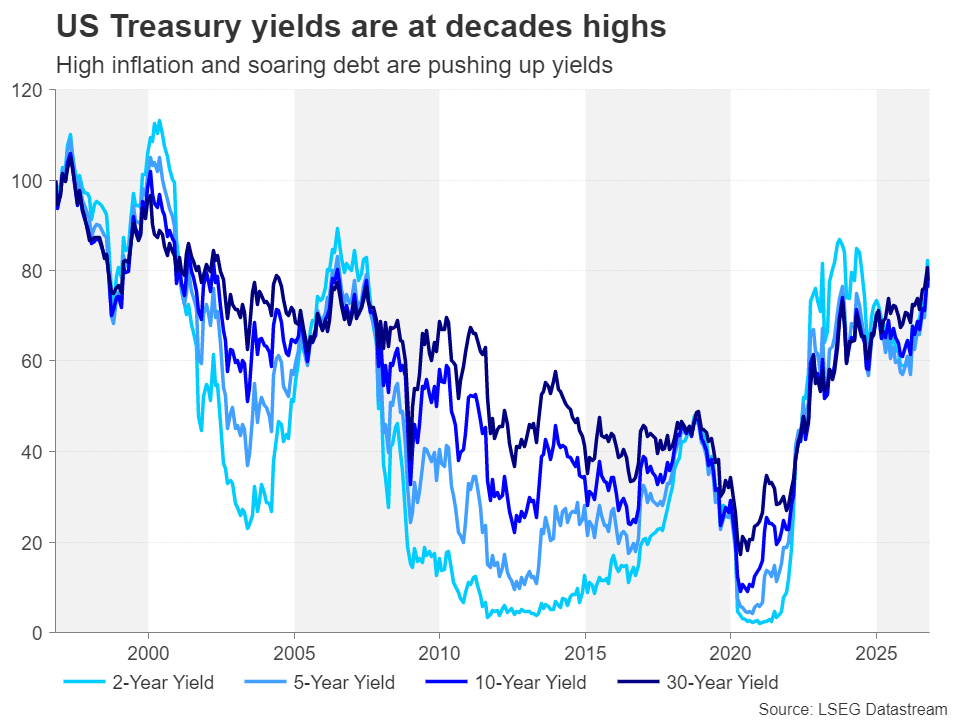
Clipping Democrats’ wings would also be good for the markets, as it would limit their ability to raise taxes or reverse some of the deregulation carried out by the Trump administration. Hence, a legislative gridlock would be seen by investors as reducing uncertainty, something that would underscore the US dollar.
Is another shutdown looming?
However, a split Congress isn’t risk free, as it may complicate negotiations for a new spending bill that would extend government funding beyond the next deadline of December 11. Republicans might prefer to let the government shut down rather than hand the Democrats any concessions right before Congress’ new term begins in January, in the hope of harming them in the polls.
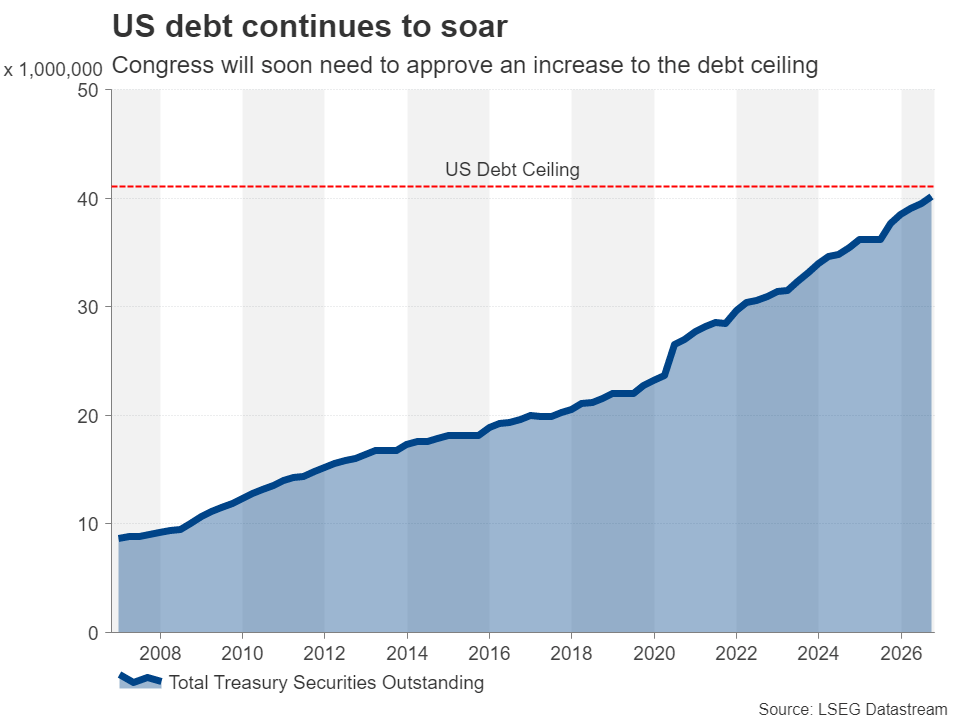
Considering that Congress would also need to reach a deal at raising the debt ceiling at some point in the first half of 2027, another government shutdown would make markets extremely nervous ahead of those separate negotiations.
Hopes for a blue wave
But what if Democrats manage to pull off a clean sweep of Congress? Whilst the risk of a government shutdown or debt default would be greatly reduced if they secure a large enough majority in both the House and Senate, it would be easier for them to push through some of their own agenda.
For example, they could attempt to raise the corporate tax rate to fund some of their spending increases such as reinstating the enhanced premium tax credits of the Affordable Care Act that expired in 2025, and press ahead with regulating the AI sector.
The combination of more prudent fiscal management and less business-friendly policies would be positive for Treasuries but negative for the US dollar as Treasury yields would decline. But it would also be negative for Wall Street.
Would a Democrat-controlled Congress change much?
One positive for Wall Street, though, is if Democrats try to use their majorities to unwind some of Trump’s tariffs. Repealing the levies completely would be difficult as it requires a two-thirds majority in both chambers of Congress – something that they’re highly unlikely to achieve – to override the almost certain Presidential veto. But they may be able to narrow the scope of tariffs, which again is not very dollar supportive if this lowers inflation, but it could please stock investors.
Similarly, any attempt by a Democratic-controlled Congress to tie the President’s hands with the Iran war would boost the stock market vis-à-vis lower energy prices, but not so much the US dollar, which has benefited from safe-haven demand.
However, the main question on many people’s minds is whether the Democrats would be able to successfully impeach Trump. This is only possible with a two-third supermajority vote in the Senate, the chances of which are incredibly slim. Instead, Democrats are more likely to focus on carrying out investigations into Trump’s various affairs, which may have little direct implications for markets.
Volatile times ahead
Yet, Trump’s frustrations may make him even more unpredictable and erratic, potentially generating fresh uncertainty into the markets, particularly when it comes to Iran, Russia, China, and perhaps more importantly, the Fed’s independence. He may even try to contest the results if Republicans suffer a battering at the polls.
One thing that is for certain: whatever the outcome of the midterms, the post-election period looks set to be quite explosive. Trump has signalled that it’s soon going to be “decision time” on whether to make a deal with Iran or order new strikes on the country. Meanwhile, another budget showdown is coming on Capitol Hill, as lawmakers will need to approve new appropriation bills by December 11 to prevent government agencies from running out of money.
Author

Mr Boyadjian graduated from the London School of Economics in 1999 with a BSc in Business Mathematics and Statistics.

















