|

Uneasy Gulf calm keeps USD resilient

The initial announcement by the Qataris that a deal had been struck between Iranian and Omani negotiators was met with a more cautious optimism that the MoU back in mid-June. That deal was well anticipated, with Crude futures falling 14% in the 3 days leading up to the June 17th signing, before going on to soften 10% further in the 10 days following. Crude futures did drop 10% last week but are actually back above $80bbl as of present.
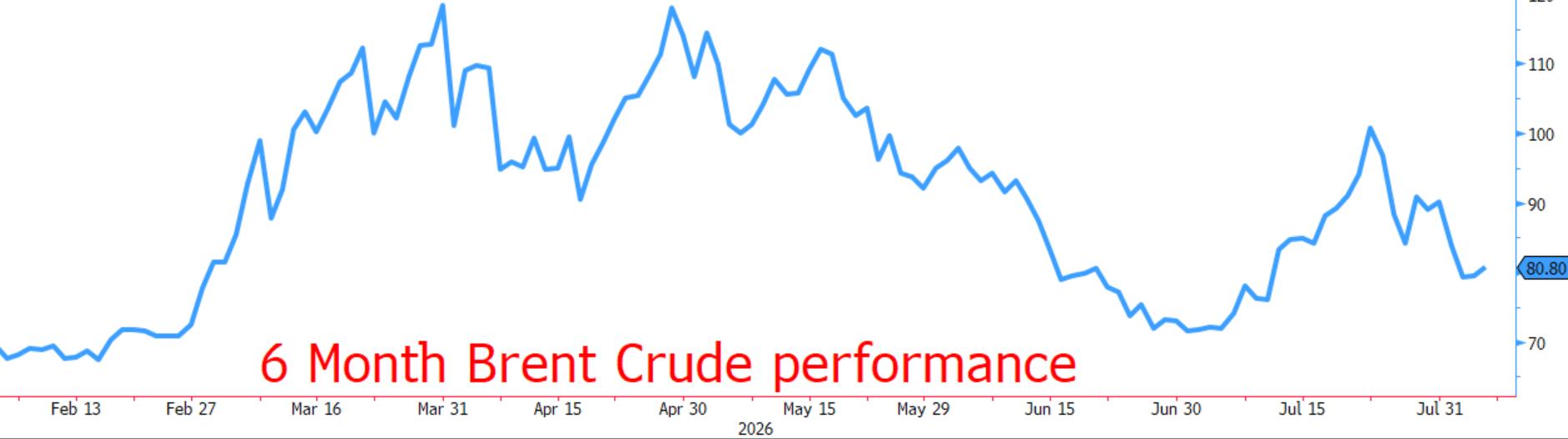
Likely, this owes to the full details of the deal gradually coming to light, such as that this is just an interim deal for “4-6 months” and that it does not “represent a full reopening of the Strait”. Indeed, the deal, which has still only been agreed in principle, only represents an agreement to “manage traffic” through the Strait in a way that allows for a partial resumption of exports.

Moreover, little needs to be said about the credibility of a “4-6 month deal” when the MoU only lasted 3 weeks. Naturally, Iranian strikes on tankers exiting the strait closer to the Omani side of the Gulf, in the face of Iranian demands of not only total control of their side of the strait, but a great authority over the Omani side too are what caused the collapse of the MoU. Whether anything has changed this time around is very difficult to know.

Reducing this complex concoction down to practical FX commentary is difficult, but should this latest deal prove to hold over the next 3 weeks, and Oil again commences to exit the Gulf, we may expect to see USD softer. Mistrust over both sides' willingness to fully commit to peace within the market is keeping USD’s safe haven value alive whilst also keeping the Fed in a hawkish mood. Should we see average US Gas prices drop back below $4 a gallon, USD may go from retreat to rout.

Author

David Stritch

Working as an FX Analyst at London-based payments provider Caxton since 2022, David has deftly guided clients through the immediate post-Liz Truss volatility, the 2020 and 2024 US elections and innumerable other crises and events.


More from David Stritch
Share:

Editor's Picks

AUD/USD holds firm near 0.7000 after Chinese inflation, trade data

AUD/USD stays firm near 0.7000 in Wednesday’s Asian session, picking up some bids after China's mixed inflation and upbeat trade data. CPI rose less than expected in September, while PPI inflation picked up. Meanwhile, the Chinese trade surplus unexpectedly widened in September. The pair remains underpinned by a broadly subdued US Dollar, despite the Middle East escalation, as focus remains on US CPI data.

USD/JPY consolidates near 158.50; looks to US CPI for fresh impetus

USD/JPY stays range-bound near 158.50 in the Asian session on Wednesday, with looming intervention risks supporting the Japanese Yen and capping upside amid a softer US Dollar. However, geopolitical uncertainties act as a tailwind for the safe-haven USD and the pair. Traders also seem hesitant ahead of the release of the latest US inflation figures.

Gold consolidates above $4,150 as softer USD lends support ahead of US CPI report

Gold steadies above $4,150 during the Asian session on Wednesday, awaiting the release of the latest US inflation figures before the next leg of a directional move. The US Consumer Price Index is due for release later today, followed by the Producer Price Index (PPI) on Thursday. Moreover, US Federal Reserve Chair Kevin Warsh's speech at the annual meetings of the IMF and World Bank in Bangkok on Friday will be scrutinized for more cues about the future policy path.

Bitcoin eyes $85,000; ETH holds support, XRP stabilizes
Bitcoin (BTC), Ethereum (ETH), and Ripple (XRP) show signs of recovery on Wednesday as buyers try to regain control after their recent market weakness. BTC extends its rebound toward the $85,000 resistance, while ETH and XRP find support around key levels.
US CPI in focus ahead of October FOMC Meeting
In the US, the most important data release of the week will be the September CPI, released this afternoon. We forecast headline inflation at 0.5% m/m SA, 3.6% y/y (prior: 0.6% m/m, 3.4% y/y) and core inflation at 0.2% m/m SA, 2.5% y/y (prior: 0.3% m/m, 2.4% y/y), with energy prices being the main driver of the expected pickup in headline inflation.
Has Bitcoin really escaped the macro forces it was built to fight?
Over 17 years ago, Satoshi Nakamoto designed Bitcoin (BTC) on the back of a global financial crisis as an alternative to the global monetary system outside the control of central banks, governments and traditional intermediaries. This raises a key question: has Bitcoin really become independent of the macroeconomic forces it was built to challenge?















