UK services activity lead the economy from the adverse weather-related blip

- The UK services PMI rose to 44.0 in May, up from 52.8 in April.
- The UK manufacturing PMI rebounded to 54.4 in May from April’s 17-month low of 53.9.
- The UK construction PMI remained unchanged at 52.5 in May compared to April but rose from the 47.0 representing slump to the territory indicating economic contraction of the industry.
- UK PMIs indicate rebound in the Q2 UK GDP to 0.3%-0.4%.
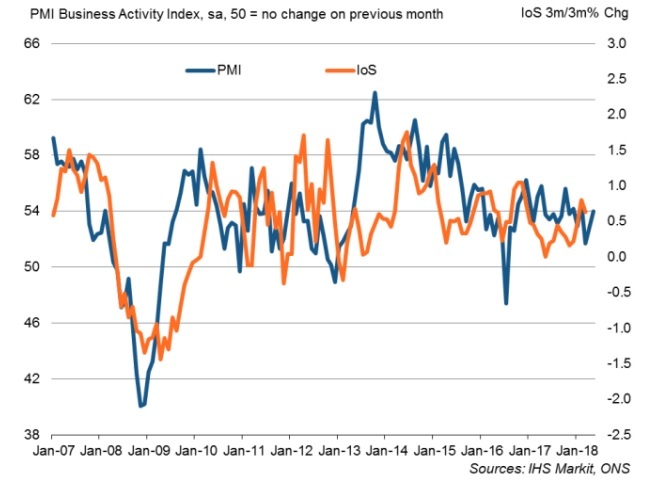
The UK services PMI lead the economic recovery, at least as far as the forward-looking indicators are concerned in May with services purchasing managers’ index (PMI) from IHS/Markit rising to 54.0 in May, up from 52.8 in April and up from 53.0 expected by the market.
The surveyed service providers cited a catch-up from the snow-related disruption seen in the first quarter of 2018, alongside the sustained growth of incoming new work.
“The improvement in service sector activity adds to evidence that the economy is on course to rebound in the second quarter but, like the earlier manufacturing and construction surveys, raises questions about the outlook. So far, the three PMI surveys indicate that GDP looks set to rise by 0.3%- 0.4% in the second quarter,” Chris Williamson, the author of the report and the chief business economist at IHS/Markit wrote in the report.
The upturn in the economic activity has also been forecast by policymakers at the Bank of England that wrote in its May Inflation Report that: “While modest by historical standards, the projected pace of GDP growth over the forecast is nonetheless slightly faster than the diminished rate of supply growth, which averages around 1.5% per year. In the MPC’s central projection, therefore, a small margin of excess demand still emerges by early 2020, feeding through into higher rates of pay growth and domestic cost pressures.”
Although the manufacturing services, and construction PMI all came out above market expectations, the reason for overall optimism stems also from development on the political scene with Brexit negotiations playing a key role ahead of the European summit scheduled for 28 and 29 June.
With nine months to go, before the UK officially leaves the Euroepan Union, there are plenty of open issues including the key topic of the Northern Ireland border that weighs on both Sterling and business confidence in general.
Author

Mario Blascak, PhD
Independent Analyst
Dr. Mário Blaščák worked in professional finance and banking for 15 years before moving to journalism. While working for Austrian and German banks, he specialized in covering markets and macroeconomics.