UK economy powers on through third quarter but the headwinds are building

Third-quarter GDP rose by a massive 0.7% quarter-on-quarter. But why has the economy been so strong? A lot of it can be traced back to IT and professional services – sectors that have grown rapidly this year despite shedding staff.
IT is very clearly a data centre story; the UK is one of the leading destinations for investment in Europe. And while output here actually fell through August and September, we expect this to remain an area of outperformance in 2027. Investment in “other buildings” – which we see largely as a euphemism for data centre and green energy capex – has been a strong contributor to overall investment this year, even if it was slightly weaker in 3Q.
Professional services is more of a puzzle. AI is undoubtedly part of the story here, too. Strength in R&D is the most obvious example of the global AI push. But we’re sceptical that it tells the whole story. We’ve seen a lot of strength in legal services – which we understand from the ONS has been driven heavily by solicitors – together with advertising and accounting. These are not all necessarily obvious places for AI to show up – either in terms of business related to AI development, or AI productivity gains. All of these industries were also much weaker in September, which could be an early hint that this year’s stunning rise is fading.
IT and professional services have been key drivers this year
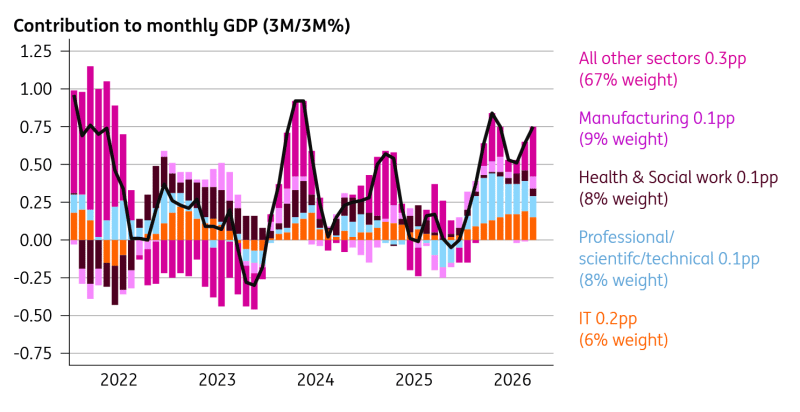
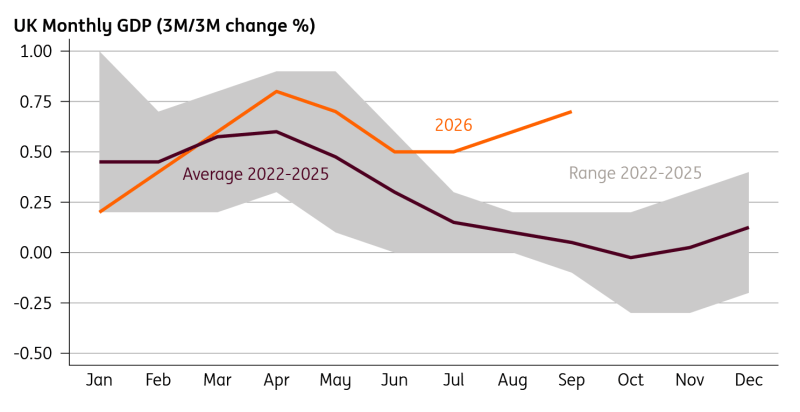
Still, in year-on-year terms, these two sectors are contributing half of growth in UK activity, despite only making up 14% of output. We think this helps explain why the UK has defied the strong seasonal pattern witnessed from 2022-2025, where the economy had been much stronger in the first half of the year than the second.
But this sectoral resilience isn’t the only thing going on. Consumer spending has undoubtedly held up better than expected. It grew by 0.6% in 3Q overall. Yet we saw in the 2022 energy crisis that the pressure on spending didn’t properly show through until early 2023. The strong spike in natural gas prices is relatively recent. And with utility bills now almost certain to rise by circa 25% in January, it’s hard to see how household spending doesn’t come under greater pressure into the new year.
The UK economy defied seasonal weakness seen through H2 from 2022-25
For the Bank of England, the strength in GDP this year is evidently beginning to play a bigger role in its decision-making. It’s one of the reasons we expect another rate hike in February. But despite this economic resilience, there are still clear signs that monetary policy is having a restrictive effect. Construction work on new projects is down more than 7% since mid-2025. Private housebuilding is down 30% from its 2022 high and is continuing to fall. This is a sector that is highly sensitive to interest rates.
UK interest rates were already restrictive before the recent rate hike – and will only become more so. That’s why, if we’re right that inflation starts to look less problematic by next summer, we think the Bank is likely to return to rate cuts before the end of 2027 – or early 2028 at the latest.
Author

James Smith
ING Economic and Financial Analysis
James is a Developed Market economist, with primary responsibility for coverage of the UK economy and the Bank of England. As part of the wider team in London, he also spends time looking at the US economy, the Fed, Brexit and Trump's policies.