Trump walks back NATO tariffs, signals de-escalation

What began as a sharp escalation risk quickly turned into a de-escalation signal.
Earlier this week, markets briefly priced in escalation risk after Donald J. Trump proposed a 10% tariff hike on eight NATO nations amid the Greenland dispute.
By Wednesday, the tariff threat was withdrawn and military action ruled out, easing geopolitical risk and stabilising sentiment.
A geopolitical-relief signal
Or in financial terms, a risk-on signal (appetite for financial risk is back on):
- Tariff reversals ease pressure on global trade expectations.
- De-escalation language reduces geopolitical tail risk.
- Legal clarity lowers policy uncertainty premiums.
Together, this dampens immediate risk-off demand and stabilises broader market sentiment.
Market impact so far
This kind of headline removes downside shocks rather than creating upside momentum.
- USD: Steady rather than spiking, supported more by yields than fear (seeking safe haven).
- Equities: Relief bid, especially in globally exposed sectors.
- FX: Reduced volatility across risk-sensitive pairs.
Keep in mind these are impacts that have likely to already have been priced in, rather than a forward looking projection. For that, let’s look at the technicals below.
How today likely trades
With the tariff threat removed and rhetoric cooling, today’s session is likely to be range-bound rather than impulsive.
- Expect lower headline-driven volatility.
- USD strength remains yield-driven, not fear-driven.
- Risk assets may grind higher, but momentum looks limited unless key technical levels break.
This is a fade-the-extremes, respect-the-levels environment rather than a chase-the-breakout day.
DXY one-day chart view
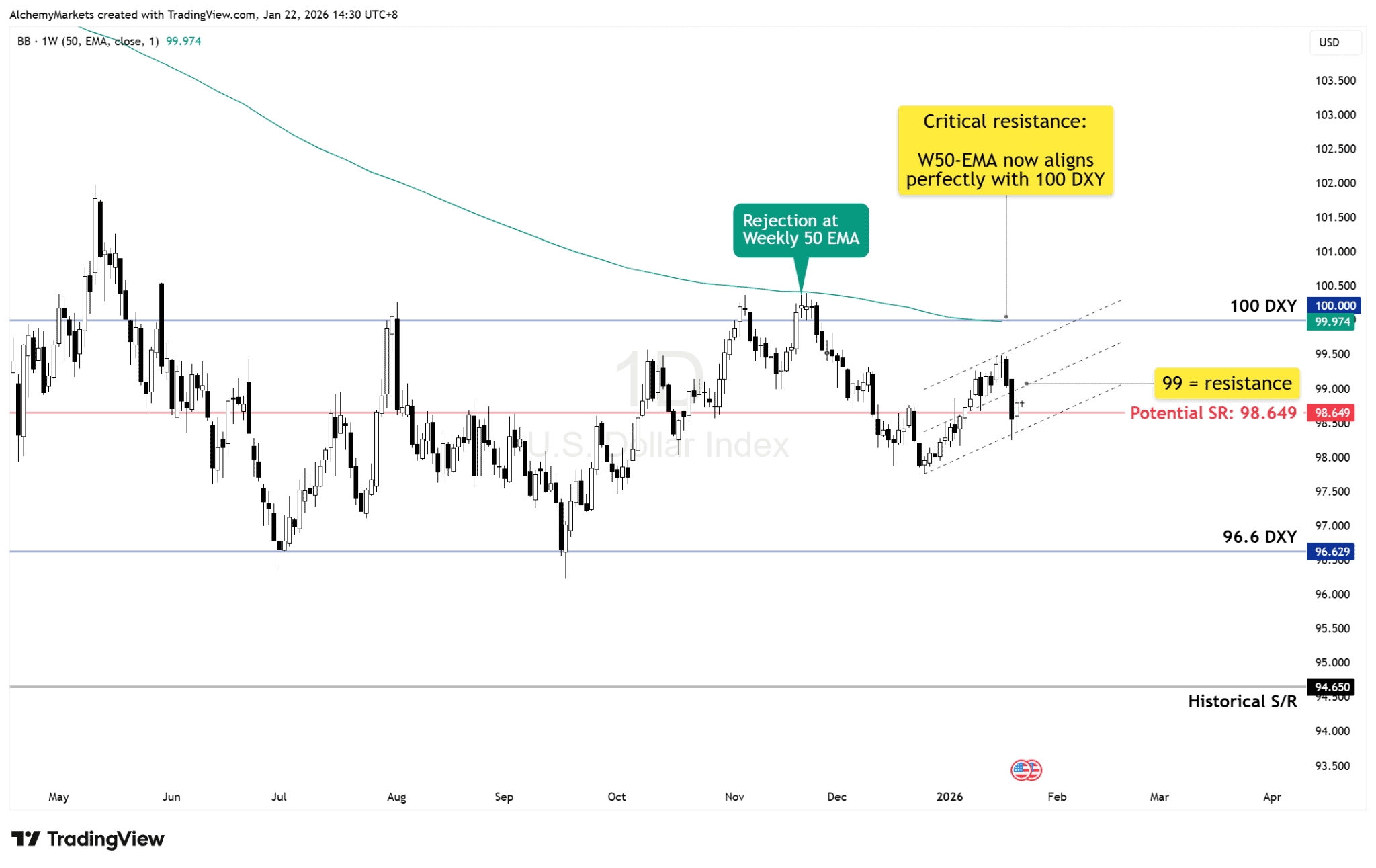
On the DXY – Notice that the weekly 50-EMA which has provided resistance in November 2025 now aligns perfectly with the 100 level. This hints at significant resistance at 100 DXY.
The asset is also grinding in a rising parallel channel, which is made more valid by successive touchpoints at the midline. That midline is now at ~99, which is potential resistance.
EUR/USD four-hour chart view
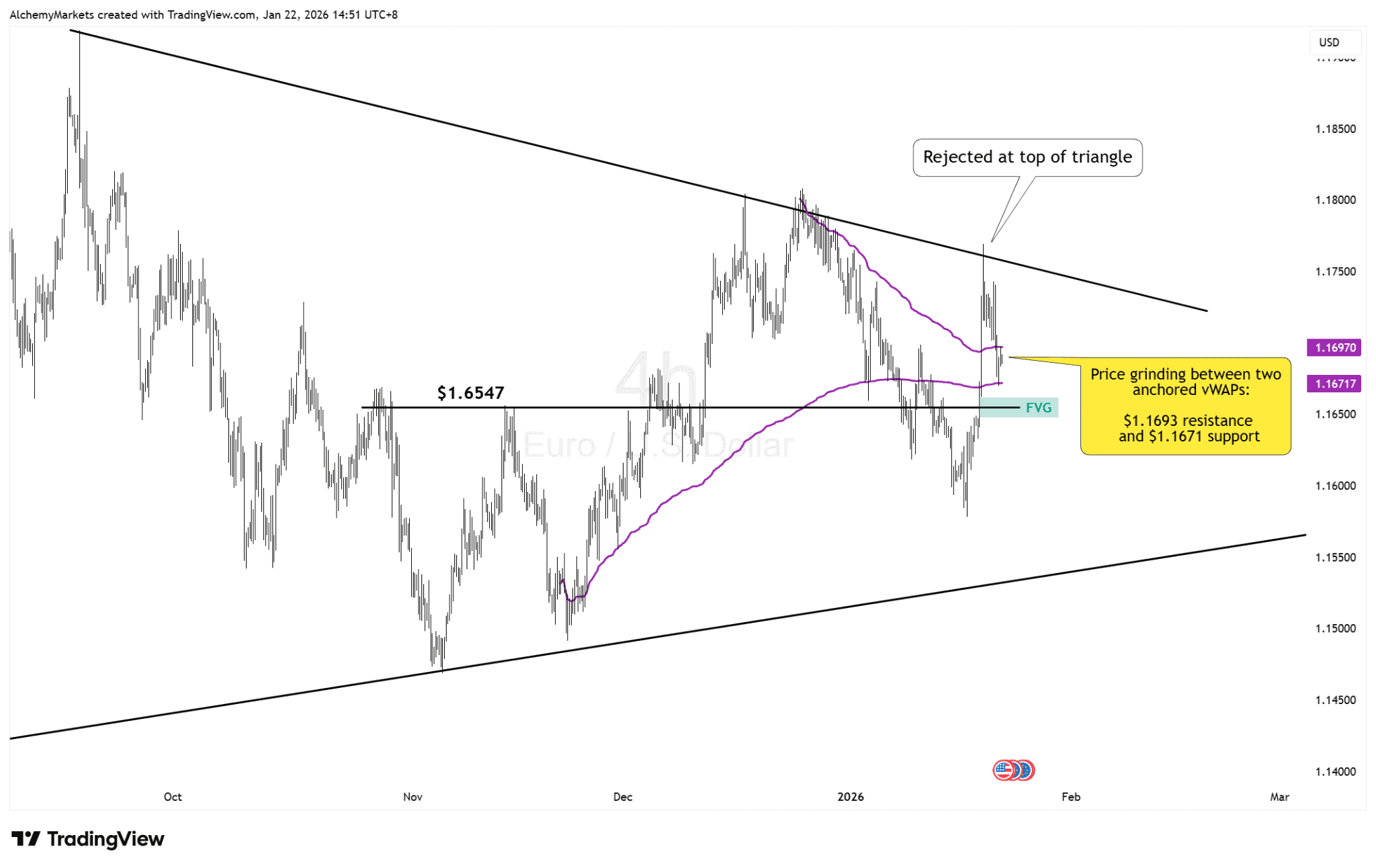
Given USD’s likelihood to hold steady in a slow grind up, EURUSD could grind a little lower and build at base before moving higher.
Price is potentially grinding between two anchored vWAPs between $1.693 and $1.671.
But, there is more supportive structure rather than resistance, as a 4H Fair Value Gap sits just below at around $1.6547, the neckline of a double bottom pattern.
SPX four-hour chart view
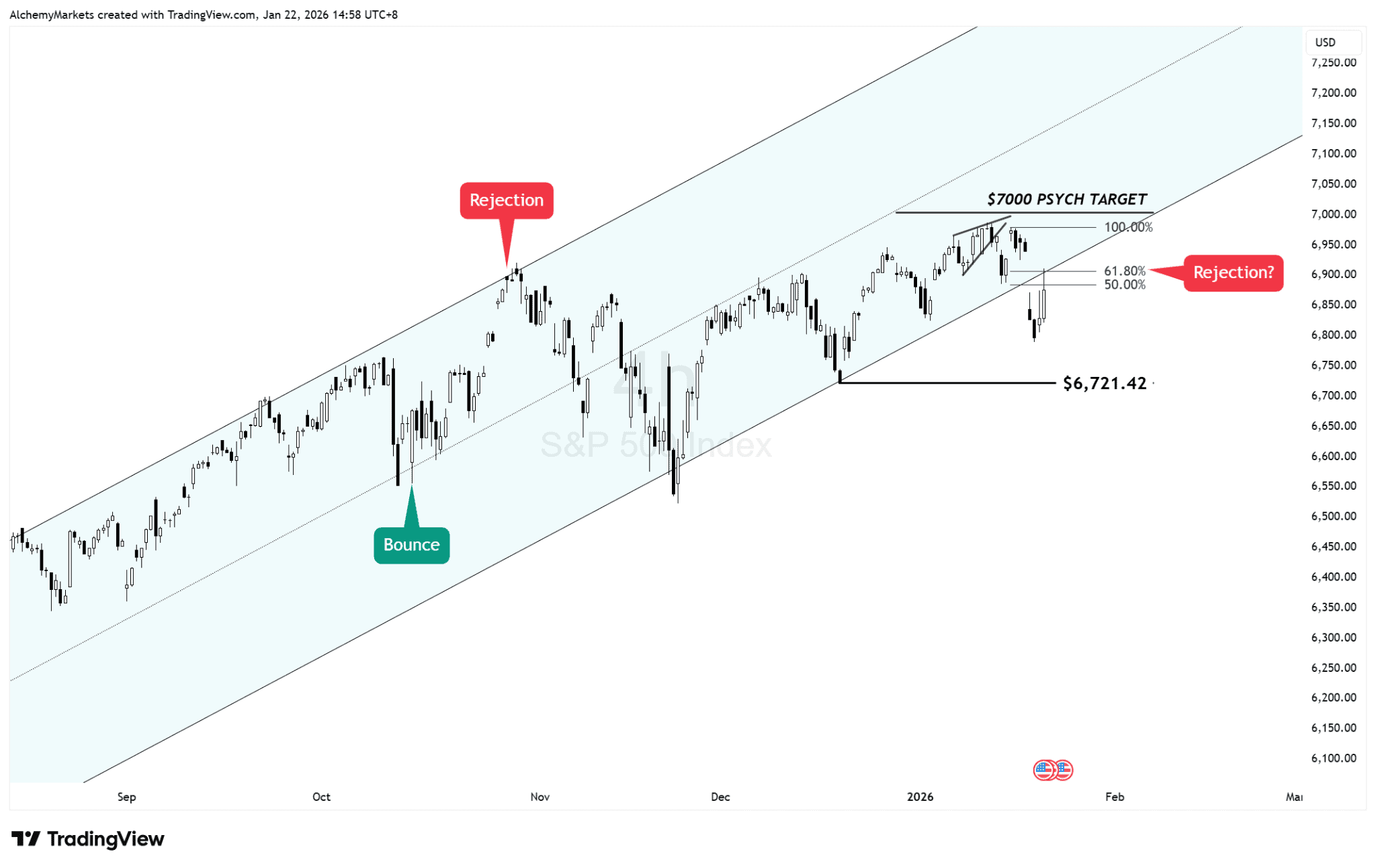
SPX is an interesting case. We currently have short term risk-on as seen by the last 4H candle rise into approximately $6,900.
But at the same token, a rejection tail was generated right at the rising channel of SPX since May 2025, and the 61.8% Fib retracement of the recent drop.
Not very positive signs for the index.
When you look at the technicals, it points to a possible sell the news event — stay cautious on this one.
Though further rise is possible, we need a close above $6,940 (market gap high), and for the SPX to hold the bottom of the rising channel to show that bulls are resilient.
What traders should watch
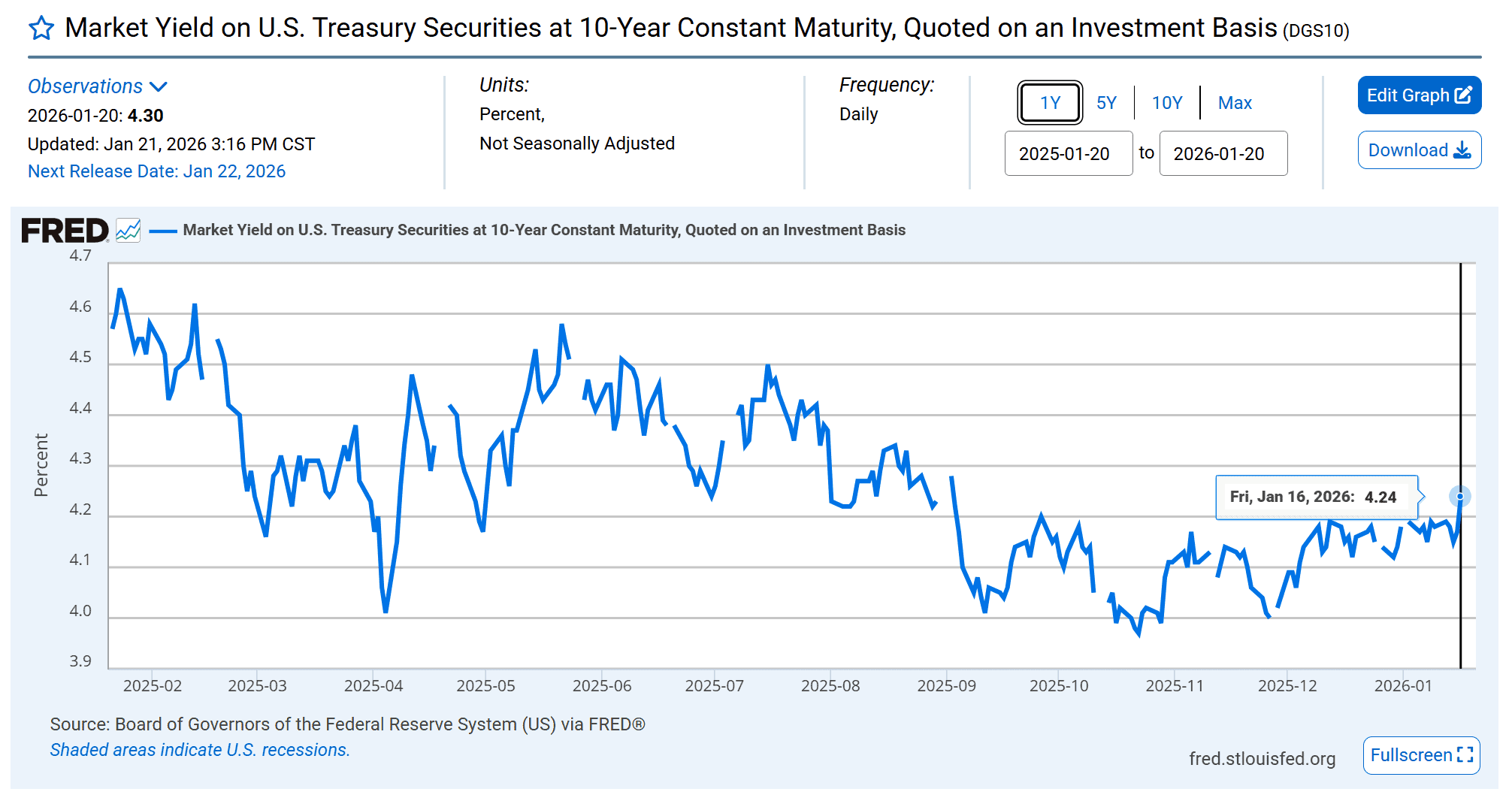
Over the past year, U.S. 10-year yields have remained elevated, oscillating mostly between the 4.0% and 4.6% range, and are currently holding near the upper end around 4.2–4.3%.
The key takeaway is not direction, but persistence. Yields have refused to break down despite easing geopolitical stress, signalling that USD support is coming from sticky rate expectations rather than fear-driven safe-haven flows.
For broader markets, this caps aggressive risk-on behaviour: equities can stabilise or grind higher, but rising discount rates limit upside momentum, particularly near resistance
For FX, this environment favours range-bound USD strength rather than a breakout. What traders should watch next is whether yields reclaim the 4.4–4.5% zone, which would pressure equities and risk currencies, or slip back toward 4.0%, opening the door for a more sustained risk-on rotation.
Bottom line
Markets are reading this as containment, not escalation. With tariffs off the table and rhetoric cooling, attention shifts back to fundamentals: data, yields, and technical levels, rather than headline risk.
Author

Zorrays Junaid
Alchemy Markets
Zorrays Junaid has extensive combined experience in the financial markets as a portfolio manager and trading coach. More recently, he is an Analyst with Alchemy Markets, and has contributed to DailyFX and Elliott Wave Forecast in the past.

















