Trump administration runs largest monthly budget deficit in five years

Without tariff revenue to paper over excessive spending, the U.S. ran the biggest monthly budget deficit in five years last month.
The Trump administration spent $432.31 billion more than it took in in July. It was the highest monthly budget shortfall since March 2021, amid the COVID stimulus era and the third-largest deficit on record.
With August beginning on a weekend, there were some calendar adjustments, as around $99 billion in August benefits were paid out in July, inflating the month's outlays. However, even adjusting for these calendar shifts, the July deficit was still $333 billion. That was up 18 percent from the prior year.
The July shortfall pushed the 2026 budget deficit to $1.8 trillion with two months remaining in the fiscal year. The deficit is now larger than the 2025 shortfall and is on track to eclipse $2 trillion.
Keep in mind that the federal government ran $1 trillion deficits for the first time during the Obama administration, during the Great Recession. Today, we’re seeing $2 trillion deficits, with the economy supposedly expanding.
A surge in tariff revenue moderated deficits last year and at least partially obscured the out-of-control spending problem. However, with the Supreme Court declaring the “Liberation Day” tariffs unconstitutional, Uncle Sam is now experiencing negative tariff receipts as the government refunds past tariff payments.
The government refunded $33.38 billion in tariffs in July. That sent tariff revenue negative by $8.55 billion last month.
Total government tax receipts came in at $334.01 billion. That was 1 percent lower than last year’s July revenue.
Through the first 10 months of fiscal 2026, the Treasury has collected $4.49 trillion, about 3 percent more than through the same period last year.
The real problem continues to be on the spending side of the ledger.
The Trump administration blew through $766.31 billion last month. That was a 22 percent increase from July 2025 spending. When factoring out the $99 billion for calendar adjustments, the federal government still spent $677.31 billion.
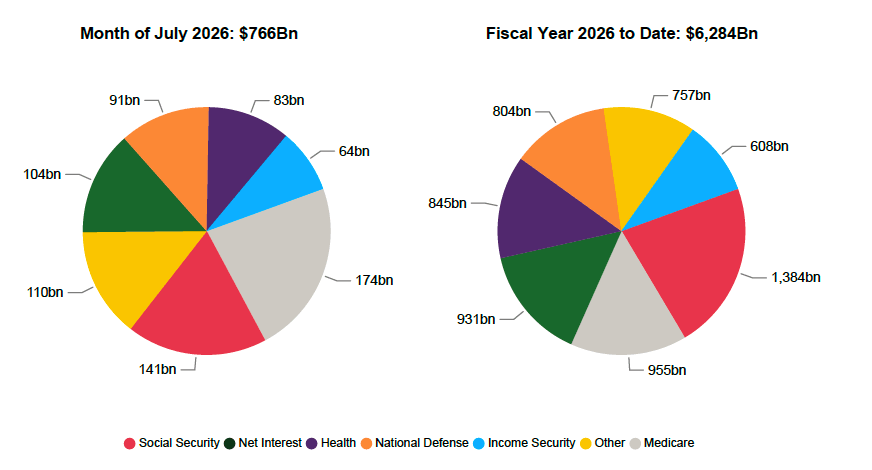
So far in fiscal 2026, Uncle Sam has spent $6.28 trillion. That’s a 3.3 percent increase compared to the same period last year.
A 3.3 percent increase in spending might not sound significant. But weren't we told there would be spending cuts?
In fact, there were some cuts in the Big Beautiful Bill (along with spending increases).
The increased spending comes despite cuts to the EPA and the Department of Education, along with staffing reductions that are now showing up in the data. Lower disaster spending also helped moderate spending levels through the first two months of fiscal ’26.
Looking at the big picture, the spending trajectory is up. Even with all the hype about DOGE and some lip service to cutting spending during the early days of the Trump administration, the U.S. government spent just over $7 trillion last year. That’s an average of $583.3 billion per month or $19.2 billion per day.
And now there's a war.
Despite some non-specific talk about “spending cuts,” there seems to be little to no commitment to tackle runaway spending. In fact, the powers-that-be constantly find new reasons to spend money, whether it is a crisis at home or a war overseas.
The cost of the debt
The cost of servicing the debt continues to climb in this higher-interest rate environment as the government keeps piling on new debt.
Interest expense has grown into the second-largest spending category in the federal budget behind only Social Security.
In July, the Treasury forked out $117.57 billion on interest payments alone. That was down slightly from a record $185 billion in June.
July interest payments pushed total interest expense to $1.17 trillion through the first 10 months of fiscal 2026. That was up 15.5 percent compared to the same period in fiscal ’25.
Interest on the national debt cost $1.2 trillion in fiscal 2025. That was up 7.3 percent over 2024.
Net interest (interest expense – interest receipts) was $104 billion in July.
Through the first 10 months of the fiscal year, the federal government spent more on interest on the debt than it did on national defense ($804 billion) or Medicare ($955 billion). The only higher spending category is Social Security ($1.4 trillion).
Much of the debt currently on the books was financed at very low rates before the Federal Reserve started its hiking cycle. Every month, some of that super-low-yielding paper matures and must be replaced by bonds yielding much higher rates.
When people say the spending is unsustainable, it feels like an understatement. In fact, it’s fair to call the federal government insolvent.
However, very few people in the political class seem the least bit interested in tackling the problem. The bad news is that at some point, the problem is going to tackle them.
To receive free commentary and analysis on the gold and silver markets, click here to be added to the Money Metals news service.
Author

Mike Maharrey
Money Metals Exchange
Mike Maharrey is a journalist and market analyst for MoneyMetals.com with over a decade of experience in precious metals. He holds a BS in accounting from the University of Kentucky and a BA in journalism from the University of South Florida.