Three reasons why the US Dollar is testing 2026 highs

The US dollar has staged a rebound in 2026, climbing toward its highest levels of the year against most major currencies. Since its January lows, the greenback has appreciated almost 4%, supported by a combination of geopolitical tensions, structural advantages in the global energy market, and shifting expectations for US monetary policy.
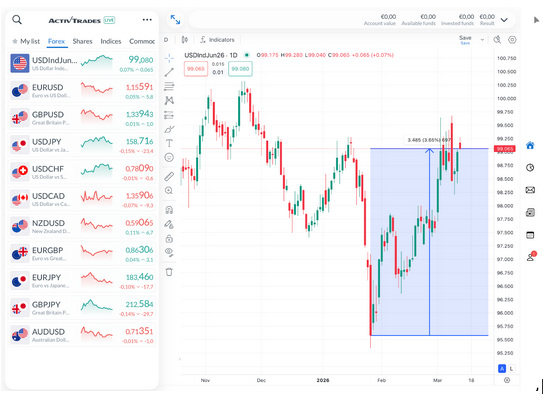
Daily Dollar Index Chart - Source: ActivTrader
While currency movements rarely depend on a single factor, the current rise of the dollar reflects a convergence of forces that are reinforcing each other. Periods of global uncertainty tend to trigger capital flows toward the United States, and the latest geopolitical developments have amplified those dynamics. At the same time, structural changes in the US energy sector in recent years and evolving expectations around Federal Reserve policy are strengthening the currency’s relative appeal.
Safe-haven demand returns as geopolitical risks rise
When geopolitical tensions intensify, global capital tends to move toward assets perceived as safe and liquid. The US dollar has historically been the primary beneficiary of these flows, and the current conflict involving Iran has once again triggered that familiar pattern.
Since the United States and Israel launched airstrikes on Iran on February 28, the dollar has gained more than 1.5% against a basket of major currencies. The move reflects a broad shift in investor positioning as markets attempt to manage rising geopolitical uncertainty.
The United States occupies a unique position within the global financial system. It issues the world’s primary reserve currency and hosts the deepest and most liquid capital markets. In times of stress, investors often reduce exposure to riskier assets and reallocate capital toward dollar-denominated securities, particularly US Treasury bonds. Because purchasing these assets requires dollars, the currency tends to appreciate almost automatically when demand for safety increases.
This safe-haven dynamic often acts as the initial catalyst for dollar rallies during global crises. However, in the current environment, other structural factors are reinforcing that momentum.
Energy independence gives The US a atructural advantage
One of the most significant economic shifts of the past decade has been the transformation of the United States into a net energy exporter. Driven by the shale revolution and the expansion of domestic oil and gas production, the US has been a net total energy exporter every year since 2019 according to the Energy Information Administration.
This structural change has important implications for currency markets, particularly during periods of energy price volatility such as right now.
Historically, oil shocks tended to weaken the US economy because the country was heavily dependent on imported energy. Today, the situation is markedly different. With domestic production near record levels and liquefied natural gas exports expanding rapidly, the US economy is far less vulnerable to energy supply disruptions than many of its major trading partners.
The contrast with Europe is particularly striking. The European Union imports roughly 58% of its energy needs, leaving it far more exposed to global price shocks. Even though most European countries do not rely heavily on Middle Eastern energy directly, they remain highly sensitive to global supply disruptions that push prices higher.
The current crisis illustrates this imbalance. Reduced supply from Gulf producers has triggered intense competition for alternative energy sources, driving European gas prices sharply higher. Oxford Economics estimates that the inflationary impact of rising energy costs in the eurozone could be up to three times larger than in the United States.
Several major economies are especially vulnerable. Italy remains heavily dependent on liquefied natural gas imports, including shipments from Qatar. Japan and South Korea are even more reliant on imported fossil fuels than Europe. As energy prices rise, these countries face deteriorating trade balances and greater inflationary pressure.
The euro has slipped toward its lowest level since November. The Japanese yen has weakened beyond 159 per dollar, approaching levels last seen in mid-2024. The British pound is trading near its weakest level of the year, while the South Korean won has fallen to a 17-year low. The Indian rupee has also dropped to a record low.
The pattern is consistent: currencies belonging to large net energy importers have weakened as markets price in the economic impact of higher energy costs. In contrast, the dollar is benefiting from the relative resilience of an economy that now produces more energy than it consumes.
This structural advantage amplifies the dollar’s safe-haven appeal, particularly during periods of geopolitical tension that threaten global energy supply.
Changing expectations for federal reserve policy
A third factor supporting the dollar is a shift in market expectations surrounding US monetary policy.
At the beginning of 2026, investors widely anticipated that the Federal Reserve would begin cutting interest rates during the first half of the year, with June often viewed as the most likely starting point. However, the recent surge in geopolitical tensions and energy prices has complicated that outlook.
According to data compiled by LSEG, traders now expect the Fed to keep interest rates unchanged until at least September. Some investors are even considering the possibility that rates remain steady for most of the year.
Interest rate expectations play a crucial role in currency valuation. Higher interest rates — or the expectation that rates will remain elevated — tend to attract global capital into dollar-denominated assets as investors seek higher yields. Even the simple delay of expected rate cuts can therefore provide meaningful support to the currency.
The economic mechanism behind this shift is relatively straightforward. Rising oil prices feed into consumer prices, which complicates the inflation outlook. For a central bank already struggling to bring inflation fully back to its 2% target, an energy-driven inflation shock reduces the urgency to loosen policy.
The US consumer price index rose 2.4% year-on-year in February, and that figure was recorded before the full impact of higher energy prices had filtered through the economy. If oil prices remain elevated, inflation could remain above target for longer than policymakers previously anticipated.
Nevertheless, there are credible reasons to question how durable this rate-driven support for the dollar may be.
Some economists from Bank of America argue that markets may be drawing the wrong lessons from the 2022 energy shock following Russia’s invasion of Ukraine. At that time, the Federal Reserve responded with aggressive rate hikes because inflation was already well above 5%, the unemployment rate was below 4%, and consumer demand remained extremely strong after pandemic stimulus programs.
The economic backdrop in 2026 looks different. Inflation has moderated, the labour market has softened, and fiscal stimulus has largely faded. In such an environment, a sustained energy shock might lead the Fed to adopt a more cautious stance, prioritizing economic stability rather than responding solely to inflation pressures.
Market pricing reflects this uncertainty. Traders still assign a 76% probability that at least one rate cut will occur before the end of the year, according to CME Group’s FedWatch tool. This suggests that the repricing of interest rate expectations remains incomplete.
As a result, while monetary policy expectations are currently supporting the dollar, this pillar of strength may prove more fragile than the others if economic data weaken in the months ahead.
A strong Dollar – For now
Taken together, these three forces help explain why the US dollar is currently trading near its highs for 2026. Geopolitical tensions have revived the currency’s safe-haven appeal, the United States’ position as a net energy exporter has strengthened its economic resilience relative to energy-importing regions, and shifting expectations around Federal Reserve policy have increased the attractiveness of dollar-denominated assets.
However, currency trends driven by crises are rarely permanent. If geopolitical tensions ease, energy prices stabilize, or the Federal Reserve signals a renewed willingness to cut rates, some of the factors supporting the dollar could fade. For now, though, the combination of the above factors is providing a powerful tailwind for the world’s reserve currency.
Stay up to date with what's moving and shaking on the world's markets and never miss another important headline again! Check ActivTrades daily news and analyses here.
Author

Carolane de Palmas
ActivTrades
Carolane graduated with a Masters in Corporate Finance & Financial Markets and got the AMF Certification (Financial Markets Regulator in France). Afterward, she became an independent trader, investing mostly in European and American stocks/indices.